Mizoram, a strikingly beautiful state of North-East India is known as much for its brave people as it is for its breathtaking landscape. As if defining this character, its name derives from two Mizo words, mi meaning people and ram meaning land, together meaning the land of the Mizo people. Situated in the eastern Himalayan region, Mizoram is bordered by Myanmar to the east and south, Bangladesh to the west, and the Indian states of Tripura, Assam and Manipur to the north, making it a strategic and cultural crossroad between South and Southeast Asia.
Much of Mizoram lies at elevations ranging from 2,000 to over 7,000 feet above sea level, giving the state a cool and welcoming climate for much of the year. Aizawl, the capital city, is situated along a ridge at an elevation of 3,714 feet, as if to keep watch upon the rest of the state, and is among the highest state capitals in India. The terrain is rugged and marked by narrow valleys and steep slopes and almost 85 per cent of the state is covered by emerald green forests making it one of the most forested states in the country. This geography has encouraged carefully planned systems of habitation and food production that respected the contours of the land. Rivers such as the Tlawng, Chhimtuipui also known as the Kaladan, and Tuivawl flow through the hills, supporting fishing, small-scale farming and are used effectively as transport routes to connect remote towns and regions.
The historical roots of Mizoram can be traced to the migratory movements of Tibeto-Burman people who travelled southward over centuries from, between approximately 1000 BCE and 500 CE. Oral traditions, clan genetics, and linguistic evidence suggest a gradual settlement process rather than a single migration. These early communities formed the foundations of what later came to be known collectively as the Mizo people. These clans shared similar languages, customs and agricultural practices while maintaining their own distinct identities. Settlements were built along hill ridges for protection and ease of defence while village life facilitated close and intimate social interaction. An enduring feature of this community was mutual support and a strong sense of collective identity that extended to sharing in the preparation and consumption of food making it an ideal community-based life.
These groups initially established settlements between the 4th and 7th centuries CE, across the Lushai Hills, and were governed by hereditary chiefs known as lal. Each village functioned as an independent political unit, with land allocated by the chief. This system governed patterns of agriculture, food sharing and rituals. Loyalty to the village and clan formed the backbone of social organisation and inter-village relations were defined by alliances, common celebrations and at times conflict, which were often settled by sharing food and reconciliation. Communal feasting also marked important occasions such as harvests, victories and funerals, reinforcing food as a social binding force long before formal state structures emerged.
The famed forests of Mizoram are rich with bamboo, wild greens, medicinal herbs and edible roots. Bamboo forests in particular dominate much of the landscape and influence many aspects of Mizo life, from housing and tools to food and ritual practices. The state’s high rainfall also nourishes this ecosystem, and determines its agricultural patterns and produce. This intimate connection between forests and hills shaped not only how people lived and moved, but also how they cooked, ate and preserved food, giving rise to a cuisine that is austere but nourishing and deeply connected to nature.
Agriculture in Mizoram historically relied on jhum or shifting cultivation, locally known as lo. Land in forests were cleared and cultivated for a few years at a time and then allowed to regenerate, ensuring fertility and sustainability. Traditional jhum cycles were carefully balanced with long fallow periods that allowed forests to recover fully and retain their natural nutrients. Rice, maize, millets, colocasia, legumes and chillies formed the backbone of crops, and were supplemented by forest foraging and hunting. The agricultural patterns were naturally determined by the seasons and the local festivals, songs and rituals revolved around them ensuring that cooking methods were adapted in harmony with seasonal availability.
Social life in traditional Mizo society was centered around the zawlbuk, a youth center that transmitted traditional community led practices in decision-making, cooperation and culture over generations. This served well in perpetuating their distinctive lifestyle, customs, morality and rituals. Food played a vital role in this process, reinforcing traditional communal bonds. Meat obtained from hunting, vegetables gathered from forests and grains harvested from jhum fields were shared and celebrated among the people and communities. This collective approach shaped a cuisine that valued simplicity, honesty of flavour and nourishment over complexity or excess.
The 19th century CE marked a period of profound political transformation. Following a series of expeditions, the British formally annexed the Lushai Hills in the 1890s, integrating the region into colonial administrative frameworks. The introduction of written records, census practices and new economic systems altered traditional structures, yet everyday life within villages remained largely rooted in customary practices, especially in food and traditions. Missionaries, however, introduced formal education and Christianity, bringing changes to social structure and belief systems. Over time, Christianity became the dominant faith (87.16% of the population as per the 2011 census) though traditional lifestyles endured and older values of community cooperation, respect for nature and disciplined living remained intact and continued to influence the lives of the people.
Christianity also reshaped festival calendars and dietary customs, even as traditional agricultural rhythms persisted. Sunday gatherings, church feasts and communal meals became new markers of social life. Meat consumption, especially pork, gained prominence during celebrations, even while everyday meals retained their characteristic simplicity. The Mizo ethos of moderation and humility found expression in the kitchen, where food remained functional, nutritional and rooted in local produce rather than indulgence.
The strategic position of Mizoram also connected it historically to trade routes linking present-day Myanmar and Bangladesh. Salt, dried fish, forest produce and textiles moved along these hill pathways, bringing subtle culinary influences without altering the core simplicity of Mizo cooking. Even today, the cuisine reflects a seamless blending of influences from neighbouring hill cultures and Southeast Asia, that filtered into local tastes.
In keeping with this adaptation but also the availability of local produce determined by its geography and weather, Mizo cuisine is deeply seasonal and unique to its people. It is defined by boiling, steaming and light smoking rather than frying. Oil is used sparingly, spices are minimal and flavours rely on freshness and natural taste. Food is prepared to sustain, mindful of nutrition rather than flavours that overwhelm the senses. This culinary philosophy aligns closely with the Mizo lifestyle that values restraint, discipline and harmony with nature.
Rice is the staple and forms the basis of most meals. It is normally eaten plain, accompanied by an assortment of vegetables, meat or fish. One of the most iconic components of Mizo food is bai, a light stew that is prepared in many variations across households and regions. Bai is usually made by boiling seasonal vegetables such as pumpkin leaves, jungle greens, beans or mustard leaves with herbs, bamboo shoots and sometimes fermented soybean paste. Pork fat or smoked meat is sometimes added for flavour, but the dish remains gentle and nourishing. Bai reflects the Mizo approach to cooking that allows ingredients to express themselves with minimal intervention.
Another important dish is sawhchiar, a rice porridge cooked with meat, usually pork or chicken, and seasoned lightly with ginger and local herbs. It is both a normal household meal but also a dish offered during community gatherings. Variants like sawhchiar chawhpawk, enriched with rice flour, are prepared during festivals or for those recovering from illness, underlining food’s role as curative and sustenance. Meat occupies a prominent place in Mizo cuisine, particularly pork, which is a preferred option. Traditional Mizo households often preserved meat by smoking it over kitchen fires. Smoked pork, known for its firm texture and deep aroma, is used in stews, bai preparations or eaten simply with rice and boiled greens. Smoking not only ensured preservation in humid climate but also added complexity without the need for spices.
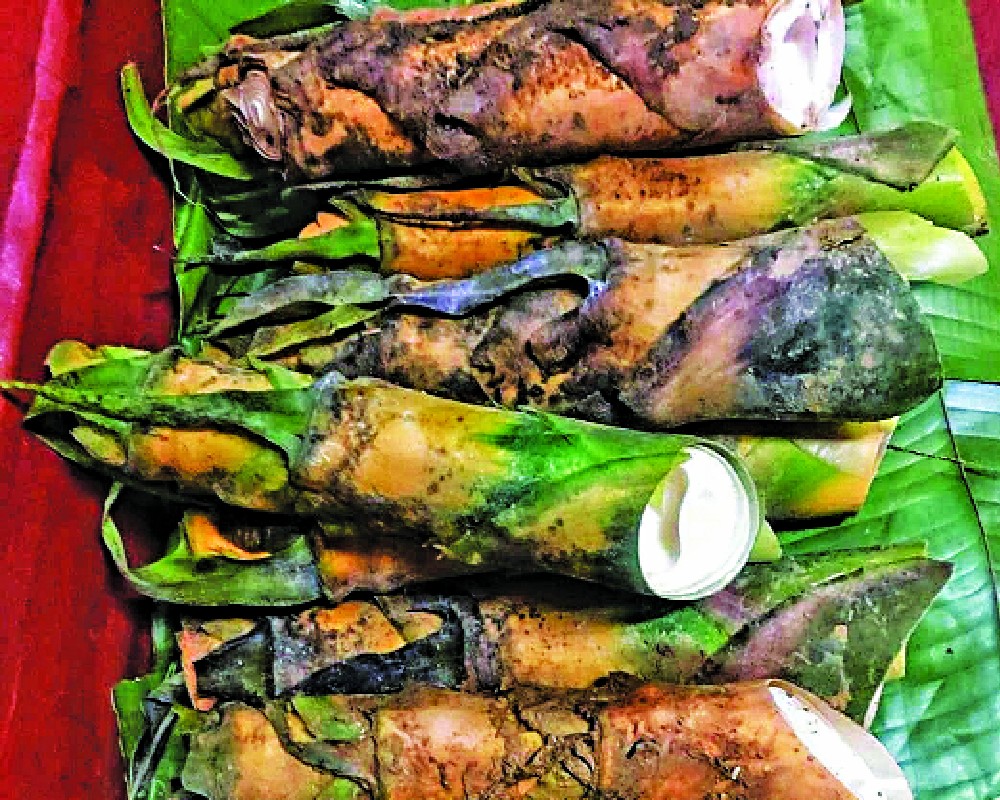
Forest produce plays an equally vital role. Bamboo shoots, known locally as mautak or rawtuai, are used fresh, fermented or dried. Fermented bamboo shoot preparations add depth and mild acidity to otherwise plain dishes. Bamboo shoot chutneys, stews and accompaniments are common during particular seasons, reinforcing the link between forest cycles and food.
Leafy greens gathered from hillsides and forests are also standard in Mizo meals. Leaves of mustard, colocasia, pumpkin and wild herbs are used by lightly boiling and sometimes mashing them into coarse pastes. These greens provide essential nutrients and are also valued for their medicinal properties. The emphasis on greens reflects an intuitive understanding of curative and nutritional diets long before formal nutritional science became popular knowledge. I believe these are lessons from our ancient traditions that we should make known with a view to preserving their memory and informing future generations of our wise ancestors.
Besides meat, fresh water fish is also an important culinary delicacy specially in areas closer to rivers such as the Chhimtuipui. Small river fish are boiled or smoked and added to vegetable stews while dried fish is also relished, lending intensity to mild dishes. Fish preparation remains simple, focusing on texture and natural taste rather than being overpowered by spices.
Chillies are often used in Mizo cooking but not excessively. They are added fresh or roasted and mashed into simple accompaniments rather than elaborate curries. One common side dish is a crushed chilli and herb mix, sometimes combined with fermented bamboo shoot or dried fish, served in small quantities to add heat to bland staples. In the southern districts inhabited by the Lai and Mara communities, culinary practices show subtle variations. Rice remains central, but greater use of fermented ingredients and local herbs is preferred. Pork and chicken stews are slightly richer, though still restrained. Bamboo shoot fermentation techniques here are more pronounced, producing sharper flavours that complement plain rice.
In eastern regions near the Myanmar border, rice noodle preparations appear, reflecting cross-border cultural exchanges. These noodles are served in light broths with greens, herbs and bits of meat or fish. The cooking methods remain aligned with Mizo sensibilities, emphasising boiling and steaming rather than heavy seasoning, suggesting influence without cultural dilution.
Fermentation occupies an important place in Mizo gastronomy, though in a quieter form than in some neighbouring cuisines. Fermented bamboo shoots and soybean paste are used sparingly, also unlike neighbouring states, to add depth and preserve nutrients. Traditional fermentation methods rely on ambient temperatures and natural microbes, demonstrating empirical knowledge passed down through generations. These techniques ensured food security during lean periods and allowed forest abundance to be extended across seasons.
Traditional beverages brewed from rice and using local fermentation techniques have existed for long in the region. However, some anthropological studies show that rice-beer and traditional alcoholic beverages lost their social and ritual status in Christian households who preferred tea or other non-alcoholic drinks. Food rituals have also shifted towards church-centred gatherings, but even these occasions bring communities together in faith, bonding and goodwill. In contemporary times, Mizoram’s cuisine is witnessing renewed interest and revival specially among the youth. Cafes and home kitchens are retaining traditional dishes with pride, adapting presentation without altering core practices. Smoked pork, bai, bamboo shoot preparations and sawhchiar are appearing in curated menus in contemporary cafes and restaurants seeking to highlight both heritage and health. Its low oil content, liberal use of greens and reliance on natural preservation has aligned well with mindful dietary habits. This is indeed a welcome development and must be encouraged.
It is my belief, therefore, that preserving Mizo cuisine in its simplicity and traditions is not about nostalgia but about recognising its relevance for future generations. They are a narrative of a people shaped by hills, rain and forests, who learned to live with what the land offered rather than in depleting it. Each bowl of bai, each serving of smoked pork or plain rice accompanied by forest greens reflects generations of practical wisdom, discipline and respect for balance.
To value this cuisine is to value the cultural intelligence of the Mizo people and their ability to adapt without excess. By safeguarding these food traditions, we honour a way of life that sees nourishment not only as sustenance for
the body but as an expression of harmony between people, land and belief. Let us all play a role in ensuring that Mizoram’s culinary heritage continues to nourish, instruct and inspire those who inherit its hills and forests and, indeed, even beyond.
(The writer is Secretary, Cuisine India Society); views are personal