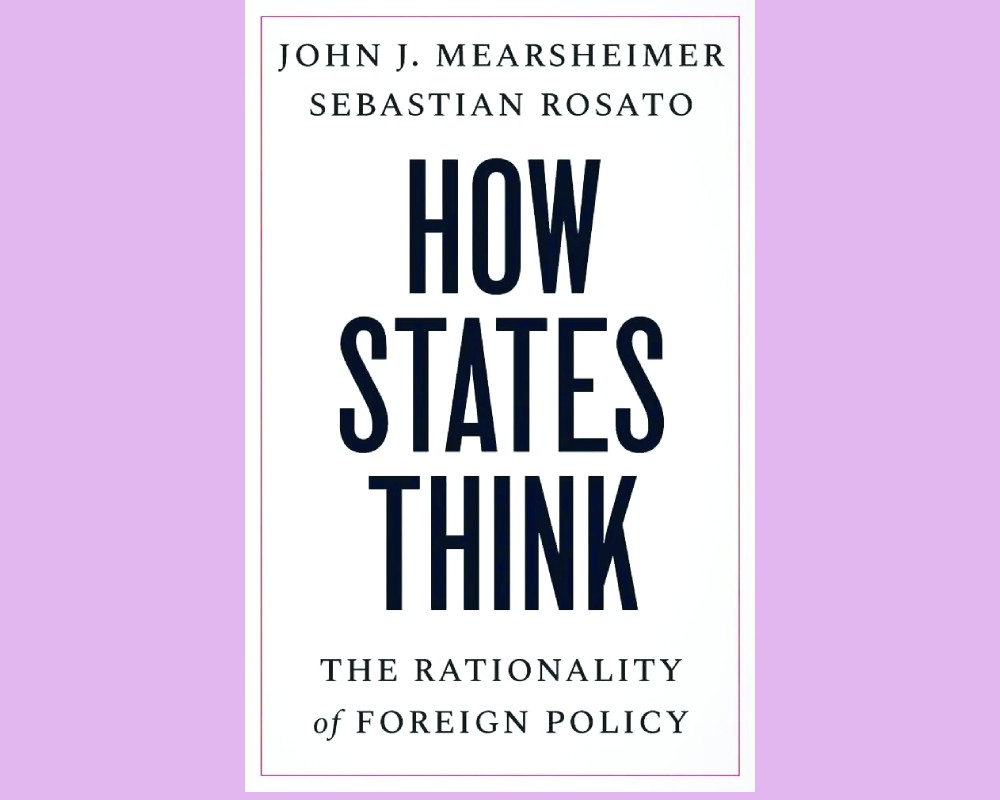
To comprehend global politics, it is essential to grasp the mind-set of states. A significant portion of international relations theory wants us to believe that states act rationally. However, numerous scholars contend that political leaders seldom behave rationally.
This question is vital for both the analysis and application of international politics, as only if states are rational can scholars and policymakers effectively understand and anticipate their actions. In contrast to individuals, states do not act impulsively; rather, policymakers evaluate threats in a strategic manner. Based on this reasoning, they argue that states typically place a higher value on survival and security than on any other considerations.
John J Mearsheimer and Sebastian Rosato assert that rational choices in international politics are based on credible theories regarding the functioning of the world and arise from thoughtful decision-making processes. By applying these standards, they conclude that the majority of states act rationally most of the time, even if they do not always achieve success.
Mearsheimer and Rosato support their argument by investigating whether historical and contemporary world leaders, such as George W. Bush and Vladimir Putin, have made rational decisions in the context of significant historical events, including both world wars, the Cold War, and the post-Cold War period. This book presents the concept of the decision-maker as homo theoreticus, an individual who is directed by coherent theories regarding the functioning of the world.
Mearsheimer is recognised for his ground-breaking contributions to the theory of offensive realism. With a notable career, he has written many influential works, including his magnum opus The Tragedy of Great Power Politics. Rosato, an emerging talent in the field, contributes his expertise in international relations to this collaboration. Together, they delve into the intricacies of state decision-making, challenging established beliefs and offering fresh insights into the rationale behind foreign policy. Through thorough investigation and persuasive arguments, the authors illuminate the complex processes that shape state behaviour in the international sphere.
In the initial chapter, the authors contend that states typically act rationally in their pursuit of foreign policy objectives, rather than being irrational entities motivated solely by emotions or ideologies. The book evaluates alternative theories such as liberalism and constructivism, claiming that the fundamental driving force behind state actions
is a rational reaction to security issues rather than ethical principles or cultural influences.
Although liberal theories — including democratic peace, interdependence, and constructivist concepts — possess some validity, they ultimately fall short when compared to fundamental security concerns. Realism’s emphasis on material factors serves as the most dependable framework for understanding state behaviour. States place a premium on survival over other aims, and failure to do so results in their classification as non-rational. Through a variety of examples, the authors illustrate that states adhere to the theory of expected utility maximisation, making calculated choices to enhance their security and interests.
In the subsequent chapter, the authors examine strategic rationality within the context of international relations, addressing the challenges faced by policymakers and states in a world filled with uncertainties. This is illustrated through historical instances such as American policy during the Second World War, strategies in East Asia, the post-Cold War era, Japanese decisions prior to the Pearl Harbor attack, and American actions during the Cuban Missile Crisis. They underscore the widespread uncertainty and lack of information that complicate decision-making processes. Whether in military strategy, diplomacy, or alliance formation, decision-makers encounter uncertainties that hinder risk assessment and rational choice. Mearsheimer and Rosato recognise the constraints of state rationality, investigating instances where external factors might affect decision-making. They contend that although states aim for rationality, internal dynamics and external pressures can occasionally result in irrational actions. The authors delve
into the complexities of state decision-making processes, scrutinising the influence of leaders, bureaucracies, and other elements in determining foreign policy choices.
They emphasise the necessity of comprehending these processes to accurately evaluate state behaviour. Furthermore, the authors underscore the significance of goal rationality in the context of rational decision-making.
They assert that the outcome of any decision is not solely dictated by rational thinking; while rational processes endeavour to optimise utility through careful analysis, external influences, uncertainties, and unforeseen events may affect results.
How States Think possesses several notable strengths. Firstly, its theoretical clarity is commendable. The authors accurately define their interpretation of rationality, distinguish it from misconceptions, and consistently apply this framework throughout the text.
The book is well-crafted and intuitive, presenting arguments in a structured and accessible manner. Complex concepts such as strategic rationality versus goal rationality are elucidated without excessive jargon, rendering the study beneficial for both experts and students.
The accuracy and depth of the book are remarkable. Mearsheimer, a seasoned figure in international relations theory, and Rosato, who meticulously constructed the argument, provide a systematic and precise examination of state decision-making. They do not merely claim that states act rationally; instead, they explain rationality and apply it across various domains. The theoretical framework is consistently anchored in realist literature, while the authors also engage meaningfully with alternative schools of thought, demonstrating a broad intellectual scope.
Moreover, their ability to integrate theory with historical context is a significant strength. Rather than remaining purely hypothetical, they employ historical examples to test and elucidate their theory. This enhances the credibility of their arguments. Ultimately, the book makes a significant contribution to the field of international relations by challenging several foundational assumptions. At a time when many scholars focus on institutional or normative influences, How States Think effectively re-centres classical realist thought. Even in instances of disagreement, it encourages a re-evaluation of established narratives.
This book is a compelling scholarly accomplishment. Its support for realist reasoning emerges at a moment when numerous international conflicts - such as the Russia-Ukraine war, the US-China rivalry, and instability in the Middle East - serve as reminders of traditional power politics. By reinterpreting events through this perspective, the book provides a context that is both realistic and relevant: global politics is increasingly focused on security needs rather than values in a world order that is becoming more aggressive.
The critique presented regarding liberalism and constructivism is thought-provoking, prompting readers to reconsider their beliefs about international cooperation, democracy, and norms. Nevertheless, the authors’ realist viewpoint may at times appear overly deterministic, overlooking the role of non-state actors and international institutions. Regardless, How States Think represents a significant addition to the discipline, providing fresh perspectives on the factors that influence state behaviour and global politics today. Overall, it is a stimulating read for scholars and enthusiasts of geopolitics alike.
(The writer is a columnist and an educator who trains aspirants for the Civil Services Examination); views are personal