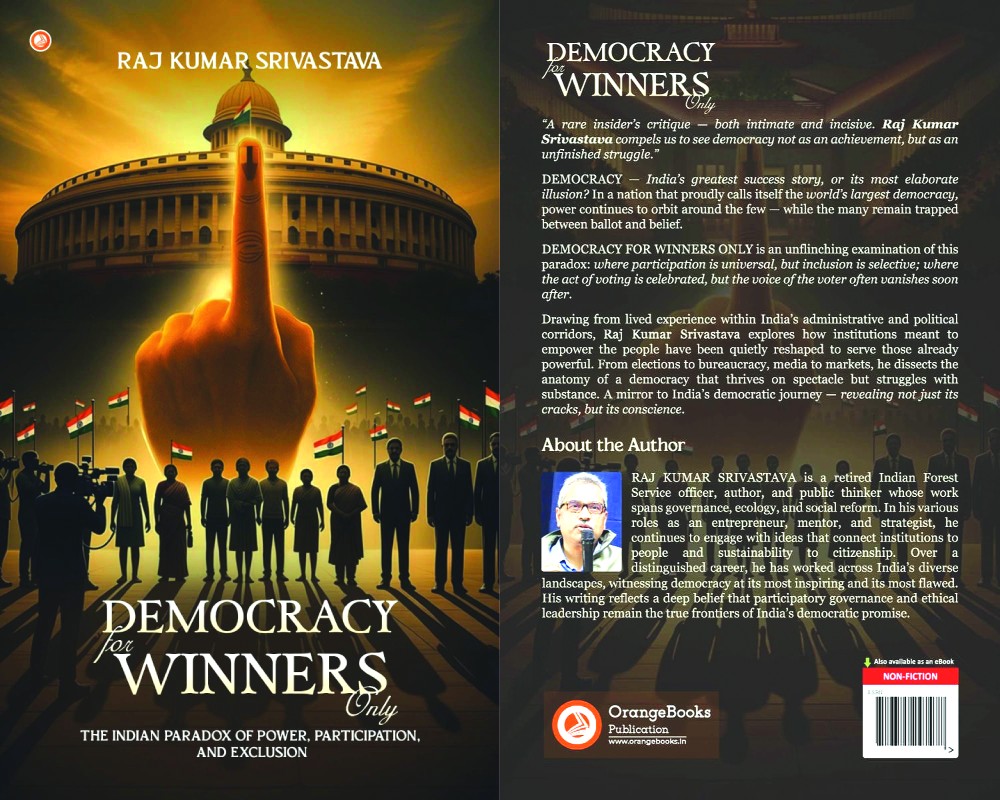
In Democracy for Winners Only, retired civil servant Raj Kumar Srivastava presents a deeply reflective and unsettling account of how India’s democratic journey has drifted away from its founding ideals. Drawing on over thirty years in public service across India’s forests, villages, and administrative corridors, Srivastava offers a powerful meditation on the widening gap between democratic participation and democratic power. The core argument is arresting: India’s democracy increasingly privileges the victorious rather than the virtuous. Electoral triumphs, he argues, have evolved into tools that legitimise centralisation, weaken institutions, and reduce citizens to spectators. Participation remains high, yet its influence on decision-making diminishes. This is the paradox at the heart of what Srivastava terms a “winner’s democracy”.
Democracy from the Ground Up
What distinguishes this book from typical political commentaries is its grounded storytelling. Srivastava draws from village panchayat meetings, forest rights disputes, drought relief interventions, and encounters with marginalised communities. These vignettes reveal the asymmetry between those who govern and those who bear the weight of governance. They illustrate how structural inequities-caste, class, bureaucracy, and political patronage — continue to shape democratic outcomes at the grassroots level.
His training as both a forester and administrator allows him to see democracy not as an abstract theory but as a lived ecosystem. Forest clearances, land conflicts, and community rights become windows through which the reader glimpses the contradictions of democratic practice.
The Digital Illusion of Participation
Srivastava’s exploration of the digital age is particularly compelling. He warns that India’s expanding online participation-tweets, hashtags, and viral campaigns-may be creating the illusion of empowerment without the substance of influence. When narratives overpower nuance and algorithms amplify majoritarian sentiment, the democratic conversation becomes shallow, polarised, and easily manipulated.
Institutions Under Strain
From legislatures to the media, from civil services to citizen forums, the book traces how key institutions struggle under the pressure of populism and speed-driven politics. Srivastava argues that institutional resilience-not electoral arithmetic-is the true measure of a functioning democracy. When institutions bend too easily, power becomes personalised and accountability erodes.
A Blueprint for Reclaiming Democracy
Despite its sharp critique, the book is not despairing. Srivastava lays out a reform agenda grounded in constitutional values: n revitalising local governance structures
- ensuring transparency in political finance
- strengthening the autonomy of regulatory and oversight bodies
- embedding community voice in development decisions
- rebuilding civic education and democratic culture
His message is clear: democracy must be continuously defended, renewed, and reclaimed.
A Timely and Courageous Work
Democracy for Winners Only stands out for its clarity of thought, graceful prose, and rare combination of practitioner insight and philosophical depth. It challenges readers without overwhelming them and urges introspection without cynicism. In a time of loud slogans and shrinking democratic space, Srivastava’s voice is steady, principled, and necessary.
This book is essential reading for policymakers, administrators, scholars, and any citizen who cares about the future of India’s democratic experiment. It raises a question that cannot be ignored: If democracy serves only those who win, what remains of its promise to the rest of us?