When a soul crosses the river, a granddaughter’s journey through the Vedic art of saying goodbye.To everyone who loves quietly and loses suddenly. In the quiet, early hours of 4 November, before the day could even break, my grandfather - as we fondly called him ‘Baba’ — exhaled for one final time. And in that silent moment, something arose within the walls of our Patna home: a language of grief older than our memories, older than the family he built and left behind. Something far older than desolation, cries, and silence awakened. It was the Vedic language of leave-taking: a departure in honour of the one who not only lived but completed the cycle of life given, and guidance to the one leaving the physical world.
A pilgrimage, a process. A process of returning, cleansing, remembering, releasing, and finally transcending. In our part of existence, passing away is not an ending. It is a journey, undertaken not by the living but accompanied by them — at every step, every ritual, every breath, until the soul proceeds on its journey to the next world. A set of traditions that do not rush sorrow, nor fear departure, and that do not let the soul take its leave unattended. A subtle way of being, a gentle whisper: ‘You were not alone here, neither shall you walk ahead alone, even there.’
The thirteen days that followed my Baba’s transcendence seemed like walking on a land unknown, following a map across an unseen terrain. It brought not just grief, loss, ‘ifs’ and ‘buts’ or a desperate ‘one last time’, but a philosophy of a sequence of customs, elaborate and unexpectedly tender. The loss is personal yet felt civilisational. An entire community of people gathered together in mourning and support, reciting a story of how it is not one man’s departure but a reminder that ‘you do not walk through this alone’. Not only us, but the soul. It is eerie, but comforting.
This is the story of that journey: of petals and pyres, of pepper and jaggery, of hidden lamps and clay pots hung under ancient trees; every step, every tear, every symbol and the world it carries forward. Of how humanity helps the living walk alongside the gone, one step at a time.
Life to Light
The morning our Baba left this world, time shifted its rhythm. What happened behind the mocha-brown iron gates of our residence was not panic or haste but quiet. A soft glance of affirmation among each other to place him in the earth he belonged to. He was lifted from the cot, along with his pillow and comforter, and placed gently on the floor to make sure he had a departure of utmost comfort. The Vedas call it not floor or ground but ‘prithvi’, the primordial mother, who absorbs the turbulence of the ‘prana’ as it leaves. Holding true to its essence and meaning came to mind with an unusual clarity Longfellow’s ‘A Psalm of Life’: “Dust thou art, to dust returnest.” Drawing a sharp connection to the Vedas and literature, science agrees - though unknowingly — that ground is the most stabilising conductor that helps discharge the final residual electrical impulses of a human system, ultimately bringing it into equilibrium.
Maybe this is what alignment actually is. Every aspect of what comprises the earth, science, faith and literature, in their own ways, align in perfect symmetry for one last time.
South, the Soul, and the Lord of Time
The Indian Vedic belief is to lay the departed to rest in a specific direction: south. The belief, as it elucidates, is that south has been considered the direction of Yama, the deity who receives the soul once it leaves the physical world. Contrary to the widely known, south is not negative; it is simply the correct spiritual orientation for a soul that has begun its divine journey.
It is also said that the soul subtly remains connected for some time, and that placing the head towards the south is a gentle symbolisation of closure, of peaceful surrender, an acceptance of the greatest transition. South ensures the soul follows the correct cosmic pathway, preventing the soul from wandering back.
Southward movement is for those who have completed their earthly cycle and are now moving to the realm of ancestors, called Pitrloka. Every gesture in Hindu funerary rites is designed not only spiritually but also psychologically to help the living release the departed. Facing south becomes a quiet act of letting go, a way of saying that we do not intend to pull you back energetically.
Science, yet again, remains in alignment with the cosmic order. The human body still holds some bioelectromagnetic charge for a few hours after it stops breathing. The earth’s magnetic field runs from north to south; if placed towards the north, the remaining currents may cause disturbances leading to rigidity, while facing south makes it stable and electrically grounded.
The Touch of Ganga, the Sanctity of Tulsi
Born from the locks of Lord Shiva, the Ganga is said to represent piousness, a transition, the eternal cycle of life and beyond. She is a goddess, the locus of Hindu mythology, whose waters are believed to sanctify everything they touch. It is a symbol of purification, spiritual merit, a pristine passage from the material world to the divine.
As Baba rested there, still, we were asked to put a few drops of this holy water — gangajal — in his mouth. Vedic literature calls it ‘amrita’ (the divine nectar of immortality). This symbolic final sip denotes that the soul has begun its next journey with utmost purity. When one turns to science regarding this, it can be noted that Ganga water contains self-purifying bacteriophages, surprisingly. Thus, both realities — mystical and scientific — co-exist without conflict.
With ‘amrita’ in his mouth and Tulsi beside him, he slept. His sleep was deep, peaceful but most significantly heavenly. Tulsi is a sacred plant in Vedic Hindu households dating back to its origin. It is believed to guide the departing consciousness onto the state of being. Contemporary studies have shown that the fragrant oil of this plant slows down the initial process of decay for a brief and blessed interval. The faith of our ancestors is now chemistry for us, but what remains constant is the tenderness and intention behind following the system. Translucent grey spirals of lit incense sticks rose around him all through the day and the night.
Sage Vyas’s Garuda Purana says that the light smoke from these fragrant sticks clears the subtle disturbances of ‘pretyoni’ (pretyoni can be understood as the portal state where the soul has neither fully left the physical world nor reached its divine destination). While logic states that the incense sticks, around the one who has journeyed over, keep insects away and the smoke clears the air of bacterial spread.Vedas and science, interlinked in the most subtle way, form a bridge. And on that bridge Baba rested, peacefully.
The Night of the Vigil
Baba loved flowers of all kinds. Yet his favourites were marigolds - saffron, yellow, or a mixture of both. And so he was adorned with them; all around him were either marigolds or marigold petals. He looked at home.
Flowers are ephemeral, symbolic of comfort in the most royal form possible. And thus one’s final rest is full of them, fragrant and soft. The Vedas say that they are a reminder to the soul that, in order to take the journey ahead, attachments must loosen.
Neuroscience agrees, suggesting that the soft aroma of flowers affects the limbic system of those grieving. The limbic system is the area of our brains that controls our emotions. Floral scent naturally reduces the stress response, slows breathing, and provides a sense of emotional steadiness. It almost seems unreal to accept how faith and belief are supported by science and rationality in their own ways, silently teaching us the balance we need - the patience and the co-existence.
Baba was home for one final night, and the rule was sacred. The light of the room he was in must not go off, even for a jiffy, not until the thirteenth day. With the spirals of incense and the white warm light, the night felt unusually long. Light, symbolic of swallowing the darkness that dawned on us, guides a soul through the subtle realms. Along with it all, at least one person must remain awake throughout the night as a gesture of bond, loyalty and family. Not for fear or force but sheer honour: for presence. An assurance, “You and your needs were never unattended here, nor shall they be unattended as you cross over.” The deep Vedic belief too is that consciousness lingers close for a little while, watching. As per psychologists, steady light and constant faint movements reduce hallucinations that might occur due to shock for those grieving.
That night felt darker than usual, colder, quieter. And that first long night, it was my father who sat through it all beside him, breathing with him even if he no longer did.
For the Path Beyond
As the night gradually went by, the time came to prepare Baba for his journey. It felt real and unreal at the same time. A tussle to hold on or let go. The rituals grew more intricate, older than the scripts, older than kingdoms.
The bamboo bier on which he would be tucked for the way ahead was kept ready. It is traditionally called the ‘artha’. The bamboo is organic, it is nature; it is pure and, unlike any metal, symbolically porous. Its significance lies in allowing the soul to pass freely without obstruction. It was adorned and made comfortable with flowers: marigolds, jasmine, roses.
Baba was given a final bath, gently. He was covered with ghee and turmeric, a mixture well used since the Atharva Veda. Ghee represents purity; turmeric, protection. As one dwells into it for reason, they shall find that this combination acts as a natural preservative that slows down degeneration here, until the rites are complete.
Modern ecology would smile at this environmental wisdom.His forehead was covered with sandalwood and over it a line of red roli (the ceremonial red pigment). Sandalwood is for peace and provides coolness, while the red upon it, in all its divinity, marks protection by a sacred feminine energy, ‘Shakti’.
An Eternal Loyalty
A gesture, a faith, a ritual. A loyalty beyond worlds pierced every heart. Culturally, when a woman is married, as a symbol of bond and union, a vermillion holder is given to her. It is called a ‘senhora’ (vermilion or sindoor is a red powder or pigment put in the parting of the bride’s hair by her groom to signify their marriage). She is to keep that sacred holder through her life. The senhora is more than an ornament. It is a covenant, a statement that I walk this path with you until the very threshold.
But if the husband journeys to the other world before his wife, she guards it like a final whisper of their union. Held close, never parted from her, until the day it is surrendered to the Ganga to drift with his ashes as a last act of love. Their union leaves with him, yet stays with her. And if the wife crosses over first, it is taken with her too, for it has no purpose without him. It belongs to the bond they built, to the vow they lived, to the love that breathed between them.
Its journey with the one who departs first is a testament to unwavering loyalty: that in this lifetime he was her only true companion, her chosen love, her sacred partner. Without him, she has no reason to keep what symbolised them. It tells the world quietly, powerfully, that he was hers - utterly, faithfully, eternally - and that some loves do not end even if the Almighty decides. Rather they simply continue in another realm.
As my grandmother’s was kept alongside Baba’s, every soul stirred in that moment - more with pride than grief. There might not be a greater anecdote of loyalty in lifetimes.
Her steps were slow, resilient, trembling, yet resolute in absolute devotion. She put a garland on him one last time, sending him forward with light, as just hers.
Shoulder of Honour
In our culture, to carry the one for their journey ahead is considered the final language of not just love but honour. It is done with utmost care, as the bier is carried on the shoulders, traditionally by those closest. Although no scriptures have ever stated this, the act is carried out by male members. As the bier is lifted, a son, a brother, or a loved one not only carries the departed but a lifetime of memories, debts of affection, the words said and unsaid - everything that no other thing can any longer hold. This is ritually called ‘kandha dena’ (providing shoulders). It feels heavy - not the bamboo, not the weight, but the mere holding on to them for one last time.
It conveys what words could never: “As long as you lived, we walked with you. Even now, as you leave, we will not let you go alone.” The shoulders that rise in devotion more than unison, the hands that with all might steady the frame, the rhythmic breath of grief - it is believed that the soul yearns for those who loved them the most and finds comfort in being escorted by them. ‘Kandha dena’ is both a duty and a blessing. A family’s final offering, accompanying their own to the edge of this world, being by their side as they proceed gently to the next.
In that silent procession, when the living walk slowly and the departed is carried with reverence, love becomes weight, and loyalty becomes shoulder.
Traditionally, the sons lead the procession. Today, in many families daughters walk alongside them. The Vedas do not forbid daughters - tradition merely forgot to include them.We remembered.
At the Edge of the Ganga
The way towards the Ganga feels like the longest one ever walks. It is not just a way or a direction; one knows its closure. It is ‘the destination’. The Ganga waits. She is eternal, forgiving, an ancient witness, from birth to departure, from virtues to sins, from beginnings to ends.
There, Baba was prepared for his heavenly leave. Tiny logs of sandalwood were placed on him; his posture was surreal. He looked fast asleep yet ready. To light the final flame, symbolic of separating the last bond between flesh and spirit, is called ‘mukh-agni’, lit by the eldest son. With this final flame, one dissolves into the ‘panchbhutas’ - air, water, earth, fire and ether. It is completeness, freeing the soul from the heavenly sheath.
The Ganga was then offered his ashes, their return to the infinite cycle. She carried not only him but all of us too, towards a world without him.
Where Pepper Burns and Jaggery Heals
The journey back is its own ritual, its own meaning. At the threshold of the house is kept an iron slab, warmed up a little along with a ballast, jagged and unpolished. The ballast is kept because they are known to be authentic.
Each returning mourner steps first on a warm iron slab and then on a large stone. Iron absorbs negative charges and the stone grounds the body.
The Vedas call it ‘shuddhi’, energetic purification after visiting the realm of those who have taken their leave. They are then asked to chew black pepper and spit it out. The bitterness of the pepper is symbolic of the negative energy that might have clung on. And as pepper burns the tongue, eventually spitting it out means discarding the negative - the grief that does not serve the soul.
Immediately after, they are given jaggery to eat, sweet and warm. It signifies taking in the good - the sweetness of life. They teach that sorrow and sweetness cohabit in every home, every family that mourns a loss.The house, cleaned once before the journey, was cleaned again.Not superstition, simply symbolism: renewal, transition, closure.
The Thirteen Days: Building a Bridge Between Two Worlds
The next thirteen days felt devoid of acceptance, of absence. These thirteen days are meant especially to honour, remember, and pray for a soulful journey for the one on their way forward. The house becomes a sanctified space. Traditions call it rules and rituals; when looked upon from a psychological point of view, we notice how indulgence in the same helps cope with grief and retain sanity.
It starts with hanging a clay pot on a peepul tree, a tree of high meaning in the Hindu custom. The clay pot is personified as the departed who is offered food and water every day. This is carried out by the eldest son, who is dressed in white. All through the thirteen days, white symbolises calm, a halt, something unfortunate. He is called the ‘karta’, the one who carries out rites, and is accompanied by his ‘paachak’, vaguely translating to an assistant or helper. This ensures nourishment of the soul in transit between realms.
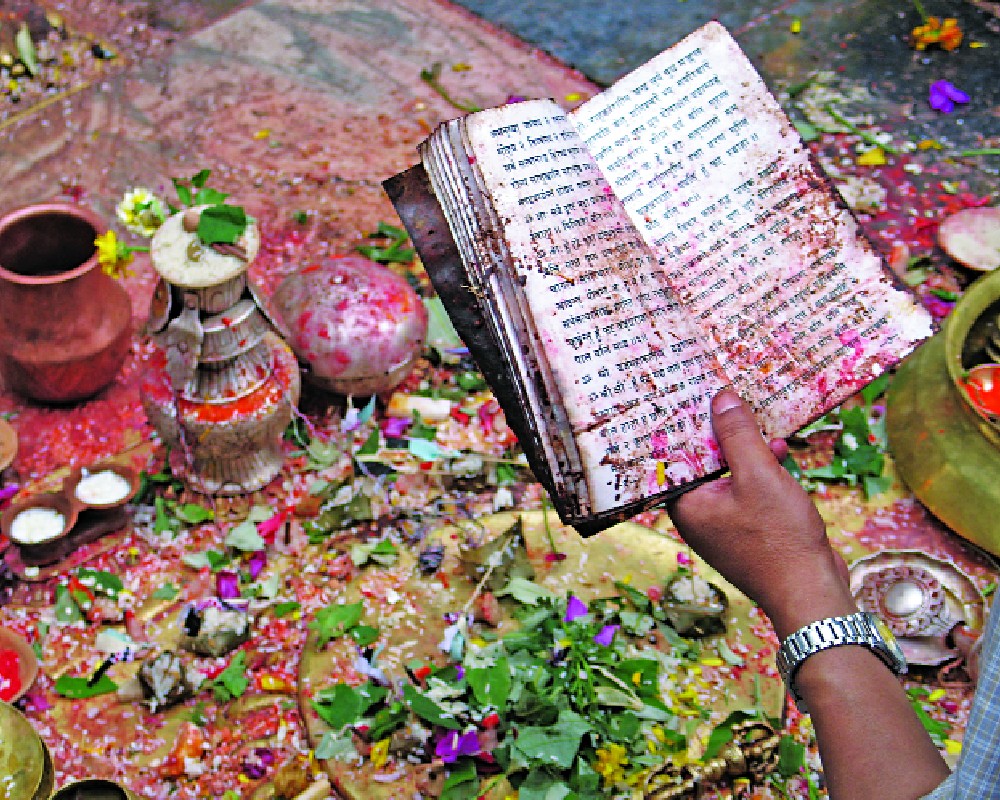
Every day for ten days, a priest read from the Garuda Purana, the text that maps the journey of a soul after death: its worlds, trials, and paths of light and darkness.
Beside the recitation, a diya (an earthen lamp) was kept burning on a bed of sand, concealed by bricks so no one could see the flame. On the tenth day, the bricks were lifted. The shape left behind reveals, symbolically, the realm the soul has reached.
For my Baba, a perfect sphere emerged - what the priest called the ‘Vishnu Chakra’, a sign believed to mean the soul had reached ‘Vaikuntha’, the abode of Vishnu.
Even for those who do not believe in metaphysics, the visual poetry of that spherical imprint is overwhelming. It is comforting; it brings peace.
Science? Light forms patterns in soot according to airflow and temperature. Light forms signs from the other world. Faith. Both coexist.
Inside the home, all family members ate food without salt or turmeric. Food rich in flavour and aroma is a celebration, stimulating appetite. Its omission was mourning, a discipline honouring grief.
Thirteenth, Turban and Legacy
The thirteenth day arrived as quietly as it could. A hawan was held (a sacred fire ceremony); the Vedas say that fire carries intentions and messages to the divine, unsullied. It felt like a bridge, a link, a connection at two ends through which our prayers reached Baba.
And then came ‘Saijiya Daan’ (a traditional Bihari Brahmin ritual). ‘Saijiya’ refers to a complete bed that is made in honour of the soul for their comfort. It means gifting an entire prepared bed, symbolising that the soul is being sent forward with comfort; that the family ensures they lack nothing in the next world, that the love and care given in life continues even beyond. A complete new bed made of pure wood, an extremely soft mattress, pillow, bed sheets, his clothes, his toiletries, his umbrella, even the small things he loved - a fragile assurance, simple, tender and moving: ‘May you never lack love, comfort and care in the next world.’
The ritual of passing authority, a turn to give back what he taught, a firm responsibility. It is symbolised by simplicity and solace: a white turban (pagdi), tied to the eldest son. It is not patriarchy, nor about gender; it is the sheer weight of continuity to the one who can carry it - an eldest daughter may take it too.
Finally, the mourning ended with a community meal open to anyone who wished to come. And for Baba, who never let anyone leave his home without sharing a wholesome meal, people came in hundreds, young and old, across every caste and creed. They sat together, ate together, and remembered him once more through the very thing that had always been his truest offering to the world: food that carried his love.A reminder that grief is not private in our culture. It is communal, shared, softened by company.
Love, After. Light, Forever.
Across these thirteen days, I discovered that Vedic death rituals are not about superstition. They are a sophisticated emotional architecture designed precisely to help the soul depart and help the living return to life. They merge psychology, ecology, spirituality, anthropology, and - astonishingly - science too, with a seamlessness that modernity is only beginning to rediscover. It holds not just faith, action, or tradition; it provides reasons and explains.
And as the world debates how to mourn in an age of hospitals, isolation, digital goodbyes and fragmented communities, the Vedic method offers something rare: a slow, deliberate, deeply human way to honour a life and its beyond.
My Baba left us that night. But through every ritual, he also taught us how to live - with tenderness, with continuity, and with a sense of belonging to something larger than a single lifespan.
When a soul crosses the river, a family crosses it too. And on the other shore, we discover that grief is not an ending. It is a return.
Maybe now, when I look up at the night sky, I will look with a different kind of meaning. I will search for the brightest star, because somewhere in that distant shimmer I will imagine him, glistening softly, just as that clear, amber glass of beer he once used to sip with such gentle joy. Maybe now, whenever I speak of life, I will speak of him, because how can I speak of beginnings, endings, or anything in between without remembering the man who moulded so much of our existence? From this moment on, every little thing I do will carry a trace of him, quiet, steady, woven into the smallest gestures. Grief has its ache, but love - love has its permanence. And the one like his does not leave. It simply changes form. It becomes light, memory, breath. It becomes the star I will look for, night after night, knowing that some bonds do not break, not even across the worlds.
Mythri Tewary writes to reach anyone who carries their grief silently - grandchildren, children, parents, and all those who heal alone. Through her work, she hopes to offer companionship, gentleness, and a reminder that loss is a shared human truth.