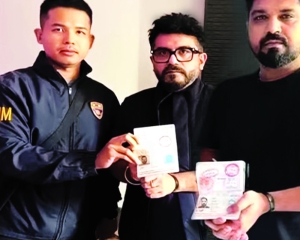
We are now feeling the pinch of terrorists being groomed in different parts of Odisha. Hitherto save and except the Maoist activities, the atmosphere was peaceful in the State though with an increasing incidence of crimes. Ongoing investigations reveal that we have mafia syndicates operating with wide connections. This was not the Odisha anyone of us dreamt of. But having debased the rural-agro and allied sectors, the hunger for easy money has caused serious compromises in the norms of behaviour.
Education is meant to be primarily a governmental responsibility, but the Government schools are in disarray. The teachers are asking for what they consider to be legitimate. The grassroots support-base employees in institutions like Anganwadi, etc., are also continuously litigating for very small grievances. The recent Panchayati Raj Day celebrations also put the focus on the inactions relating to the transfer of power and devolution of funds as per the Constitutional mandate. From the bottom to the top, when we have a distorted structure based on disoriented principles of governance, the end result will never be appropriately efficacious and meaningful.
If all the political parties forget their inevitable differences and agree on strengthening the Panchayati Raj institutions as mandated by the Constitution and ensure their efficient functioning, a process of regeneration could possibly start. But the atmosphere is charged more with propaganda with some voices of disgruntlement that require appropriate attention. A holistic strategy in rebuilding from below and cleansing at each level, from top to bottom, is the urgent need of the hour. Prosperity has not percolated in the right directions in our society. This has resulted in avoidable social unrest and intolerance. Criminalised support appears to be becoming a necessity for the political machinery to move. This virus is bound to eat into the vitals of the political structure, and we are likely to be driven to darker days. Indications are there that the forthcoming State Budget shall have a focus and emphasis on the agro-rural and allied sectors. This indicator should translate itself into reality. If two years of rigid exercise is undertaken in utilising funds in a purposeful and honest manner, the face of the State will undergo a radical change not requiring any cosmetics.
Fortunately enough, the Central Government is also putting equal emphasis on the agro-rural and allied sectors. On Biju Patnaik’s birth anniversary (Panchayat Day), there was hardly any mention of the great emphasis Biju Patnaik put on panchayat industries. His dream was to dovetail with the seasonal unemployment in the rural agro sector. This would also make micro-level units prosperous and successful. Our voice should be heard through the State Government in demanding a lion’s share in the restructuring of our socioeconomic base. Odisha still lives in its villages. Unless these units are made economically vibrant, the advancement towards growth will always be lopsided and face the problems that are presently disturbing us. For example, the Central Budget lays a lot of emphasis on drip and sprinkle irrigation and has otherwise proposed substantial funds for irrigation. We should have our project proposals ready and demand more than our share, which could be a substitute for a special class treatment. Our leaders should call for a moratorium on foundation-laying ceremonies and inaugural ceremonies. There should also be a moratorium on huge garlands purchased from other States. local floriculture has hardly received any appropriate attention. During this period, there should be a determined engagement with building the structure from the ground level, i.e., the villages. This process has to be given adequate leadership, political, bureaucratic and activist-oriented involving analysts and thinkers. If a call is given by our leadership for providing services, without any personal return for overtaking backlog of the restructuring work, the response is bound to be rewarding.
The representatives of people have to be made accountable for ensuring that the programmes sanctioned for their areas are completed within time and conform to quality standards. If there are obstacles, they should be resolved through inbuilt internal mechanism. This has become all the more important as people are bound to knock at the doors of the higher courts for small grievances, which do not require two judges to issue a two-line direction. A majority of writ petitions throw up grievances like non-application of mind, erroneous interpretation of the related provisions of law and preconceived opinionated bias. Valuable time of the court is spent on calling upon the executive to act. The executive awaits a direction from the court to proceed to take a decision. In the arena of “discretions”, unreasoned conclusions continue to dominate the scene. The origin of the vice lies in the mistaken theory of “unfettered” indiscretion. A power granted by a statute to a public authority is in the nature of a “trust”. It has to be discharged in keeping with the interest of the community at large. It is not a power that can run amuck. It’s regulated, calibrated and meant to subserve a public purpose which is inherent in the scheme of things. Good governance has been held to be a part of the “basic structure” of our Constitution. It is, therefore, permissible for the courts to intervene, when there are deviations from good to bad and from bad to worse. It is the decision-making process and not by decision itself that is ordinarily under evaluation.
But when an executive or quasi judicial authority decides a matter on erroneous premises of facts and law, coupled with vital procedural infirmities, it is the superior courts like the High Court and the Supreme Court that have to set things right. Necessity of justice compels the superior courts to issue directions regarding the factors that are to be taken into consideration so that the mischief of bias and erroneous exercise of power is minimised.
In this movement towards the alterations in the decision-making process, the youth have to play a dominant role as they are the largest number of citizens deciding the political future of the country. The elders have to provide adequate guidance. The time has come for catalytic and visible remedial steps. In this effort, all sections of the community have to join hands. And, surely this concerns us all!
The writer, a Senior Advocate, is a former All India Service officer, a former diplomat, a former editor, a former President of Orissa High Court Bar Association and a former Advocate General of Odisha. jayantdas@hotmail.com)