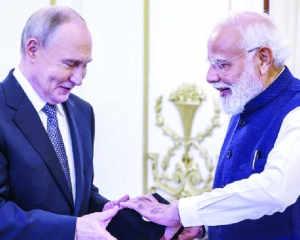
In his monthly radio address, ‘Mann ki Baat’, Prime Minister Narendra Modi on Sunday commended the efficient management of the Biparjoy cyclone in Gujarat, stating that India’s disaster management has become an example for others.
He touched on various topics, including the forthcoming International Yoga Day and the Emergency period in India’s history. The Prime Minister also discussed the eradication of tuberculosis, Chhatrapati Shivaji Maharaj’s contributions, and India’s recent sports achievements.
Modi expressed gratitude for the successful handling of the cyclone that struck the Gujarat coast last week. He highlighted the resilience and preparedness of the people of Kutch, emphasising that India’s disaster management capabilities have become exemplary. Modi emphasised that the collective power of Indian people can overcome any challenge, no matter how significant or difficult.
“The strength of disaster management that India has developed over the years is becoming an example today. Cyclone Biparjoy wrecked so much havoc in Kutch, but the people of Kutch faced it with full courage and preparedness,†he said.
“Be it the biggest goal, be it the toughest challenge, the collective force of the people of India, the collective power, solves every challenge,†the Prime Minister said.
On the upcoming International Yoga Day, which will be celebrated on June 21, Modi said he will be in the United States on that day, leading yoga enthusiasts in America. The theme for this year’s Yoga Day is ‘Yoga for Vasudhaiva Kutumbakam’ or ‘Yoga for the Welfare of All as One World-One Family.’
Reflecting on the history of India, Modi recalled the dark era of the Emergency, which took place on June 25, 1975. He condemned the atrocities committed against those who supported democracy during that period. He reaffirmed India’s commitment to democratic values and the supremacy of the Constitution, stating that the nation must never forget the significance of June 25.
Shifting the focus to healthcare, the Prime Minister announced India’s goal of eradicating tuberculosis by 2025. He acknowledged the efforts of the ‘Ni-kshay Mitra’ initiative, a movement against the disease, implemented by the Ministry of Health & Family Welfare.
Modi paid tribute to Chhatrapati Shivaji Maharaj, praising his bravery, governance, and management skills. He highlighted Maharaj’s contributions to water management and the navy, stating that they continue to inspire and enhance India’s historical pride.
The Prime Minister also celebrated the achievement of India’s women’s junior hockey team, which secured their maiden Women’s Junior Asia Cup in Japan’s Kakamigahara, Gifu Prefecture.
Modi acknowledged the significance of Lord Jagannath’s Rath Yatra, a grand procession celebrated with enthusiasm in various States across the country.
He fondly recalled attending the Yatra in Ahmedabad during his time in Gujarat, praising the diversity and unity it represents, emphasising the spirit of “Ek Bharat- Shreshtha Bharat†(One India, Great India).
During his address, the Prime Minister highlighted individual efforts for the public good, citing examples such as the revival of an extinct river in Uttar Pradesh’s Hapur district and the Miyawaki technique from Japan, which can be used to transform infertile areas into green spaces. He encouraged the nation to adopt such techniques, referencing the success of Teacher Raafi Ramnath from Kerala, who created a mini forest called ‘Vidyavanam’ with over 115 varieties using the Miyawaki method.
The Prime Minister concluded his address by seeking the blessings and support of the people as he prepares for his upcoming visit to the United States.