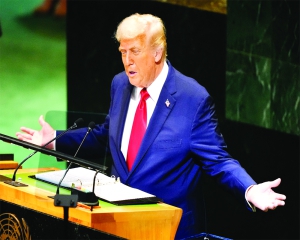
Donald Trump, the US president, has repeatedly claimed that the trade, tariff, and investment threats have yielded crucial results. Scared nations and regions such as Europe, Japan, and South Korea fell in line. Defiant ones like Russia, India, and China are likely to follow suit. Russia, burdened with growing sanctions, will wish to declare a ceasefire in the Ukraine war. A new-consensus has been reached between the American and Chinese negotiators. India, Trump claims, will give in soon. For example, he said that New Delhi will reduce its oil imports from Russia by this December, and buy more from the US and other non-Russian sources.
Despite claims that the India-US bilateral trade deal will be finalised by November or December this year, Indian ministers play the head-high, head-low game. Recently, even as a government official said that a final draft and text was in the works, Piyush Goyal, the commerce and industry minister, declared that India does not deal with a deadline, or a “gun to the head.” He added that the country does not do agreements in a hurry because they imply long-term perspectives, and national interests. The idea is to get the best deal, and keep the aspirations of young Indians in mind.
Thus, there is the stronger side, which believes in the efficacy of gunshot diplomacy, or using aggression to get its way. The other side is a growing economy, which believes in its future, and hopes to extract the best, despite pressures to the contrary. In the case of India and the US, however, it seems that both sides are partially right, and partially wrong. America has forced India’s hands over the past several months, and the latter has withstood the tide against it. The result will invariably be a give-and-take, although it will not be a balanced one. One side will extract more from the other.
Take the example of oil imports from Russia. The US imposed a 50 per cent tariff on Indian imports to stop oil shipments from Russia. Trump and his officials claimed that it was India and China, which purchased huge quantities, that helped Russia to continue the war in Ukraine. New Delhi resisted, even increased Russian imports for a while. But when Washington imposed sanctions on two major Russian oil producers, which threatened to derail the operations of India’s wealthiest business empire, did New Delhi seem to succumb. By then, the economic benefits of Russian oil, which was once lower by $10-15 a barrel, had vanished. The price differential came down to a dollar and, according to experts, was likely to vanish.
A similar thing, though with several differences, happened in the farm sector. For months, the Indian prime minister, ministers, and officials confidently claimed that they would not allow American farm imports, and they would never allow Indian farmers to suffer. There were statements to the effect that the Indian ruling regime would act like the Great Wall of India to stop foreign goods. Yet, over the past few months, the gates were opened, albeit selectively. Duty-free cotton imports were allowed. There was talk of corn and soybean supplies from the US. Many of the decisions were couched as favours to local industry, which would not affect the farmers.
When the Government announced GST 2.0 as a huge reform measure, which led to price cuts across segments, the Indian consumers jumped in delight. The policy-makers took the entire credit for slashing rates, and lowering the number of slabs. Not many people realised that the GST cuts may be another step to assuage the feelings of the peeved American politicians. With domestic taxes down to zero or five per cent for most goods, though services attracted higher GST, the import floodgates were open. Now, there was a case to allow cheaper American imports, with low duties that were in line with the local GST rates. Sources confirm that the India-US trade deal will have minimal duties on non-farm goods.
However, such moves beg a question. How will the Government convince the industry, and farmers about its decisions? In the case of energy imports, as we explained earlier, the price benefits are over. It will not matter if private and state-owned buyers shift sources because they will pay similar prices. Recently, Goyal admonished the industry for its criticism each time the country inks a free trade agreement, which allows bilateral trade at low duties. The minister felt that the Indians need to become stronger, and compete with cheap imports, and not rely on Government’s support. This argument will either blunt, or shut up industry-led criticisms.
Farmers, though, will be a different cup of tea. Already, unions, including those linked with the RSS, have voiced concerns over actual and possible imports from the US. One of the unions recently claimed that it forced the official think tank, NITI Aayog, to withdraw a report that favoured more American imports. However, the government is likely to follow a three-pronged approach. First, the imports will help large industries, which can buy from global sources, but protect the farmers’ supplies to the Government, mid-level firms, and official mandis and agencies. Hence, only a small percentage of the market will be impacted by imports.
Second, the Government will play the price card. Since supplies to the large firms are handled by major wholesalers, and influential middlemen, the latter’s clout will dwindle due to imports. The wholesalers may shift their attention to imports, rather than local procurements. As large buyers depend less on the middlemen for local supplies, the latter will procure less from the local farmers and, thus, exploit them less. In turn, farmers can sell openly and independently to the more friendly middlemen, or the Government agencies, or in the local mandis. In effect, the farm incomes are likely to rise due to lower exploitation, and better sales options.
Finally, the Government, as is evident, will open export opportunities for the farmers. Last year, it allowed imports of non-basmati rice. This year, it hopes to hold a grand rice fair to woo global buyers, who are currently not on India’s supply list. Some of the nations are large buyers, and can consume huge quantities. What is happening in rice will possibly happen in other products. Thus, farmers will be told that their incomes will increase because of the higher exports. The benefits on exports will help them further. In essence, if the imports do affect them, which they will not, the growers have the option to seek overseas markets in other products to grow their incomes.