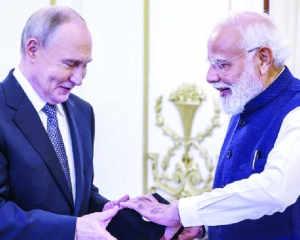
President Vladimir Putin’s 4-5 December visit to India has often been interpreted through conventional lenses such as energy supplies, defence transactions and routine diplomatic signalling. Putin described India as “a unique civilisation and a trusted partner,” a sentiment that framed the tone of his visit and underscored why technological cooperation now sits at the centre of the relationship. “India has shown remarkable stability and responsible leadership,” he observed in the interview.
India’s emergence as the world’s fifth-largest economy, with credible projections of becoming the third largest by 2027, forms the backdrop to this renewed engagement. A median age of twenty-eight strengthens India’s long-term capacity in digital innovation, advanced computing and scientific research. Bilateral trade with Russia has now crossed sixty-five billion dollars. A large part of this increase came from the shift in energy sourcing, with Russian crude rising from one per cent of India’s imports in 2021 to more than thirty-five per cent today. This shift generated savings estimated to be between five and six billion dollars in the last financial year.
Defence cooperation remains substantial. Russia continues to supply a significant share of India’s military equipment, and a large proportion of India’s defence platforms still depend on Russian technical ecosystems. The digital economy is projected to reach one trillion dollars by 2030. India has become the third-largest hub of global AI talent. Unlike earlier engagements that were centred on defence procurement and hydrocarbons, this visit placed technology at the forefront of bilateral priorities.
From Buyer and Seller to Joint Innovators
As he put it in the interview, Russia does not “simply sell weapons to India; we share technologies,” a remark that reveals how Moscow now views India as a long-term co-developer rather than a downstream recipient.
Putin’s interview reflects an important shift in Russia’s approach to India. He stated that Russia seeks to share technology with India rather than remain a supplier of equipment. The principle of joint development is now extending beyond defence into artificial intelligence, quantum technologies, space systems, nuclear research and advanced materials. These sectors jointly form a coherent Indo-Russian technology corridor. It represents a move from a transactional relationship to one grounded in shared knowledge creation and scientific confidence. For India, this aligns closely with the pursuit of technological sovereignty and long-term strategic autonomy.
Artificial Intelligence and the New East-Eurasian Axis
Artificial intelligence is one of the clearest areas where the benefits of collaboration are visible. India contributes nearly sixteen per cent of global AI talent and hosts more than nine hundred AI-based start-ups. Its digital public infrastructure, which includes Aadhaar, UPI and DigiLocker, provides a fertile environment for designing and deploying large-scale AI systems. Russia adds strengths derived from several decades of scientific investment. When combined, these capacities give the partnership the ability to build independent AI architectures without relying on Western technological ecosystems.
Quantum Technologies as a Transformative Frontier
Quantum science is another domain in which cooperation could deliver long-term advantages. India’s National Quantum Mission, supported by significant public investment, aims to build national capacity in quantum communication, quantum computing and advanced materials. Russia already possesses strong foundations in quantum physics and superconducting materials. Joint projects could include Quantum Key Distribution satellites, secure post-quantum communication protocols, shared quantum laboratories and hardware accelerators for high-performance computing.
Space Cooperation for Renewed Strategic Depth
India and Russia have a long history of collaboration in space. The recent visit opens the possibility of a much more expansive programme. Potential areas of cooperation include joint lunar exploration building upon India’s Chandrayaan missions, propulsion systems for deep-space mobility and a coordinated navigation architecture through NavIC and GLONASS. This functions as a form of national infrastructure that influences communication, logistics, defence readiness and economic planning.
Small Modular Reactors as a Strategic Advantage
A particularly important point from Putin’s visit is his confirmation that Russia is currently the only country with operational Small Modular Reactors (SMRs) and that it is prepared to share this technology with India. As India moves towards its goal of net-zero emissions by 2070, reliable and clean baseload energy will be essential. Collaboration on SMRs therefore represents more than a technological project. It is an investment in India’s energy security, industrial productivity and regional equity.
Strategic Autonomy and the Wider Technological Landscape
Putin also stated that “India cannot be treated today the way it was treated seventy years ago,” signalling Moscow’s recognition of India’s autonomous global position.
The global environment for high-technology cooperation has become increasingly restrictive. The United States limits exports under ITAR; the European Union remains cautious with dual-use technologies; and China is not a suitable partner for sensitive scientific collaboration. In this environment, Russia stands out as the only major power willing to engage in genuine co-development with India across civilian and defence technologies. The concentration of global technology and supply chains in a few regions, the need to diversify partnerships beyond China, and the search for stable long-term economic partners have all contributed to Moscow’s renewed engagement with New Delhi. India’s steady economic rise and its ability to maintain independent relationships with multiple global powers position it as a uniquely valuable partner in Russia’s broader Asian strategy.
A Partnership Recast for the Century Ahead
His observation that India’s rise is “not accidental but the result of strong leadership and national determination” reflects a rare acknowledgement of India’s long-term trajectory.
The earlier phase of the India-Russia partnership relied heavily on hydrocarbons and defence platforms. The emerging phase is driven by technologies that will shape the global order over the next twenty-five years. Artificial intelligence, quantum technologies, SMRs, deep-space exploration and advanced materials will shape the world India steps into by 2047. Putin’s remarks in New Delhi showed an appreciation of India’s steady and structural rise. The partnership now opens space for India to strengthen the technological foundations that support its aspirations for Viksit Bharat.
The writer is an Associate Professor at the Atal Bihari Vajpayee School of Management and Entrepreneurship, Jawaharlal Nehru University, New Delhi, India; views are personal