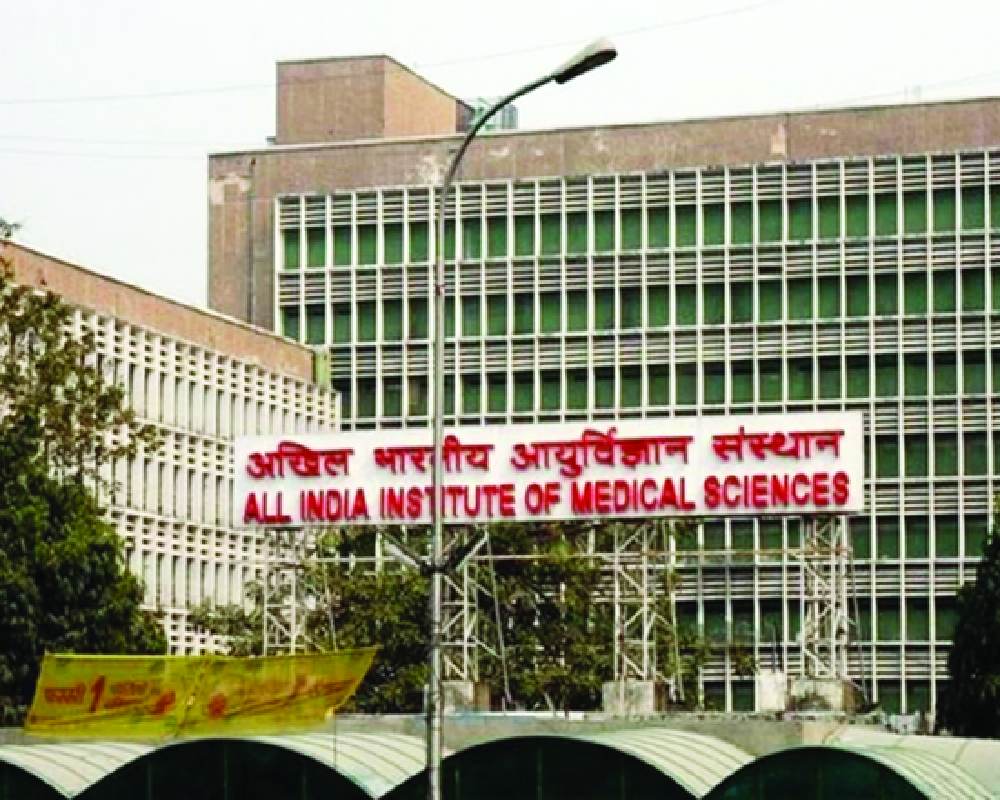
AIIMS Delhi has achieved a milestone in stroke care by conducting the country’s first dedicated clinical trial of a cutting-edge and advanced brain stent made for treating severe strokes.
The GRASSROOT trial, which evaluated the Supernova stent (Gravity Medical Technology), has found excellent safety and efficacy outcomes in the treatment of severe strokes, officials said.
The results were published in the ‘Journal of Neurointerventional Surgery’ (JNIS), part of the prestigious British Medical Journal group.
AIIMS Delhi was the national coordinating centre and the lead enrolling site for the GRASSROOT trial – India’s first clinical trial of a new and advanced stroke treatment device, the Supernova stent, the officials said.
“This trial is a turning point for stroke treatment in India,” Dr Shailesh B Gaikwad, professor and head, Department of Neuroimaging and Neuroradiology, AIIMS, and national principal investigator of the GRASSROOT trial, said. According to the JNIS, the GRASSROOT trial evaluating the Supernova stent has found excellent safety and efficacy outcomes in the treatment of severe strokes.
Earlier this year, data from the GRASSROOT trial were accepted by the Central Drugs Standard Control Organisation (CDSCO) and the Supernova stent-retriever was approved for routine use in India.
“This is the nation’s first stroke device cleared based on a domestic clinical trial. The approval follows the GRASSROOT India trial, which confirmed the device’s safety and efficacy in treating life-threatening strokes,” AIIMS said in a statement.
“Conducted across eight centres, the trial marks a milestone for the Make-in-India initiative and positions India as a global player in advanced stroke care,” it said.
Noting that it produced world-class clinical evidence entirely within the country, Dr Ashutosh Jadhav, Chief Scientific Officer, Gravity Medical Technology, said the effort built a “robust framework for future large-scale, high-quality trials”. Dr Deepti Vibha, professor of neurology, AIIMS Delhi, emphasised the role of patients and families whose participation will “bring faster, more affordable treatments to millions”.
Dr Shashvat M Desai, Chief Technology Officer at Gravity Medical Technology, described the approval as “more than just a regulatory milestone.” “This achievement demonstrates that India can design and deliver clinical trials of global significance, accelerating access to advanced therapies while upholding equity,” he said.
Desai noted that the trial and subsequent device approval stand as a testament to the expertise of Indian leaders such as Dr Gaikwad and his team, who bring over three decades of experience in advancing stroke treatment.
Developed by Gravity Medical Technology, Supernova is designed for India’s diverse patient population, where strokes often strike patients at a younger age than in the West.
“The device has already treated more than 300 patients in Southeast Asia. It will now be manufactured and made available in India at affordable prices, offering new hope to the 1.7 million Indians who suffer strokes each year,” Dr Dileep Yavagal, professor of neurology and neurosurgery, University of Miami, and the Global Principal Investigator of the GRASSROOT trial, said.
Bihar govt to confiscate properties of fodder scam accused, build schools on those spots: Samrat Patna, Dec 13 (PTI) Bihar Home Minister Samrat Choudhary on Saturday said that the state Government will confiscate the properties of those accused in fodder scams, and open schools on those spots.
Choudhary was responding to reporters’ queries on his previous remarks at a conclave on Friday that the Government was planning to open schools on properties of RJD supremo Lalu Prasad.
Without mentioning the former chief minister by name, Choudhary told reporters on Saturday, “The judiciary has already decided that the accused in the fodder scams will face strict action. The Government will open schools on their properties.”
Prasad has been convicted in several fodder scam cases, while proceedings in some other cases are pending or under appeal.
“Under Chief Minister Nitish Kumar’s rule, Bihar had in the past converted the seized properties of corrupt officials, including a former DGP, into schools,” Choudhary said.
The minister was ostensibly referring to a 2012 case wherein the Bihar Government, under the Special Courts Act, 2009, confiscated the property of former DGP Narayan Mishra to convert it into a school.
The Special Courts Act, 2009, was a culmination of Nitish Kumar’s reiterations that the Government will confiscate the properties of corrupt officials and convert those into facilities of public good.
The Act allowed for speedy trial of corruption cases and property confiscation in order to tackle public office corruption.