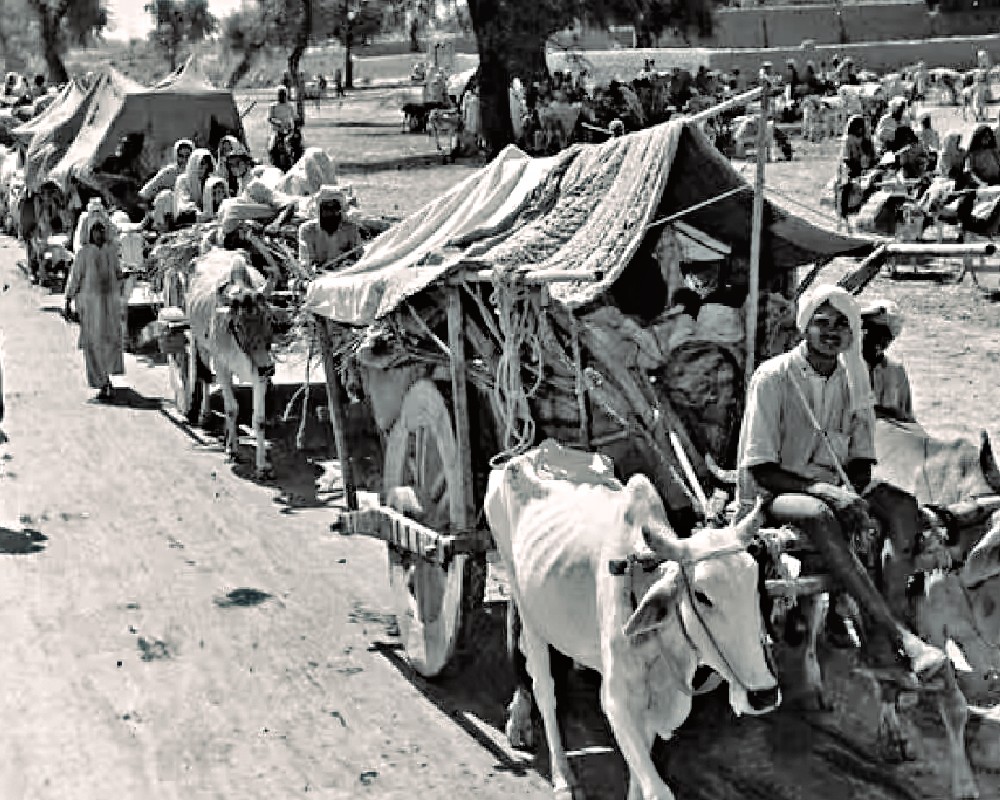
In August 1947, India was partitioned into India and Pakistan. What was intended to be a political solution to terminate colonial control resulted in one of history's largest, most violent, and most inhumane partitions, fuelled by religion. Millions were uprooted; communal riots, massacres, abductions, forced conversions, and sexual assault ensued as people fled over hastily formed borders. The human toll-lives lost, families fractured, and communities torn apart-became the defining tragedy of the subcontinent's fall from empire.
A History of Cultural Integration
Long before 1947, the Indian subcontinent was a layered, composite civilisation. Over many centuries it assimilated migrants and conquerors. India developed as a cross-cultural civilisation; Greeks, Kushans, Huns, and Persians all contributed to the development of India's culture; Amir Khusrau shaped early Hindavi-Urdu; Akbar's Din-i-Ilahi and Sulh-i-Kul promoted pluralism; Dara Shikoh connected Sufism and Vedanta; and Jayasi's Padmavat combined Islamic mythology with Indian ethos, creating a shared, composite civilisation that transcended strict boundaries.
The Tragic Anomaly
Sheikh Ahmad Sirhindi opposed syncretism; Altaf Hussain Hali emphasised a distinct Muslim identity; Sir Syed Ahmad Khan advocated for separate Muslim sociopolitical interests; Muhammad Iqbal envisioned autonomous Muslim destiny; Muhammad Ali Jinnah turned this into political separatism; extremist sects later inflamed hostility - but some humane stories of partition emerged amidst the chaos.
Their swords were gleaming, icy, and ruthless
I was only 12 years old when Pakistan was formed, but those moments still live inside me as if they happened yesterday. My mother, Gyanvati; father, Anant Ram; uncle, Santaram; older brothers, Ramnath and Prannath; and my six-month-old baby sister all resided in Bahdemalli at the time. Before everything turned red one day, life was straightforward and tranquil.
I can recall the thudding footsteps of men hurrying into our home and the sound of angry voices. Their swords were gleaming, cold, and ruthless. They attacked and killed my father, my uncle, and my older brother Ramnath before I could comprehend anything. I saw firsthand how repeatedly they struck them. I can still hear their cries of “hai, hai!” They cried out, but nobody responded. As a small child witnessing her world being torn apart, I was frozen.
My brother Prannath grabbed my hand, crying and shouting. We ran. My mother carried my infant sister in her arms and ran. She looked for a well to jump into to save their honour. To her shock, the well was already filled with women's dead bodies. Unfortunately, my little sister died due to suffocation. My mother survived, along with around thirty-five other women. Hours later, the military arrived and pulled the 35 survivors out of the well. From there, they were taken to the refugee camp, where my mother and I were reunited — thanks to the jawans of the Gorkha Rifles.
Even now, when I try to talk about it, the words break on my tongue. My heart starts to shake. I survived, but I lost my father, uncle, brother, and my youngest sibling at home, whom I never saw again. That youngster inside me is still looking for them.
Name: Darshana Rani Born: 1935 Baddomalli, Tehsil Shakargarh, Now lives in: Ghuman, Punjab
Terror consume even the toughest men
I was around thirteen or fourteen when Partition tore through our lives. We lived near Shakargarh, in a community where Hindus and Muslims had coexisted for years. My father, Ram Lal; my mother, Chaman Dai; and all of our relatives were present. We never anticipated that one day we would be running for our lives.
I visited Gota Sarajwali with my maternal grandparents a few days before the actual violence began. I had no idea that I would be separated from my entire family. When the killings began, people in my community started fleeing on foot-afraid, unarmed, and trying to save their children. My family crossed the Rawi Bridge and arrived in Sarajwali. There, Muslims urged us, “If you want to save your life, convert,” and we all converted to Islam. For nearly a month, this continued, and I witnessed terror consume even the toughest men. “Many who converted then used to go to the masjid for namaz, adopting a distinct identity.”
One day, Indian military vehicles entered the village. Their voices broke through the dread like a miracle. They saved the surviving Hindus and led us to safety. I was reunited with my mother and brothers in a refugee camp, and it felt as though I had been given my life back.
Years later, we rebuilt our lives in Ghuman. I married there, my family expanded, and life progressed. Her son Rajakumar has narrated this account.
Name: Kamala Rani Born: c. 1933-34 Kanjrur area, Tehsil Shakargarh Ghuman, Punjab
They gave the girls poison pills
My father, Sardar Gulab Singh, was an industrialist. He owned a cotton factory. We were four brothers and five sisters. The population of the Sillanwali mandi was about 10,000. More than half of them were Muslims. Inside the town there were Hindus, and around the outside were Muslim bastis. There were mostly bhatti (labourer) Muslims there. There was a municipality.
We had a very big haveli. The haveli's name was “Guru Arjun Building.” There were many servants.
Nawab Allahbakhsh, who was the uncle of CM Malik Khizar Hayat Tiwana and happened to be my father's friend, told us that we need not worry as long as he was with us. My father told all of us brothers and sisters that if ever there was an attack on our haveli by the Muslims, how would we face it? What should we do in that situation? Above all, he worried about his three daughters, who were aged about 12 to 17. He gave them, one by one, small sachets of poison (zehar ki pudiya) and told them that if such a situation arose and they fell into the hands of Muslims, then at that time they should take this poison.
Pakistan was formed, and conditions became worse and worse. Nawab Allahbakhsh said, “Sardar ji, now it is not right for you to remain here. Now you must leave this place.” Another friend from the bhatti also said, “Now you should leave and sell your kothi to me; I will give fifty thousand rupees for it.” But my father said that he would give him the haveli without him purchasing it and come back later on when all this ended-little did he know that we would not be able to return.
So one day we decided to leave the place and went to the station in the dark. Others soon followed, saying, “If you leave, we will leave as well.” Unfortunately, we could not leave because the train was full of dead bodies. By mid-August 1947, tensions in Punjab were rising, with allegations of looting and killings. Many Muslims' behaviour in Sillanwali had also changed, causing concerns.
We fled in a truck to Sargodha and from there to Amritsar, then spent a year in Rajasthan before settling in Ludhiana. There my father reopened our ration depot and rebuilt life from scratch. In 1963, I joined the Punjab Police, later serving in anti-terror operations and eventually becoming IGP. I also led the RAF and handled communal crises, retiring with Partition's memories still engraved in my soul.
Name: Charanjit Pal Singh Born: 2 December 1936, Sillanwali Mandi, District Sargodha. Now lives in: Sector-40, Noida
Diljit Rai Wadhawan
I was born in Gujranwala, in my nanaka, in 1936. My Nana ji, Nand Lal Chopra, was always ill, and I mostly remember him lying on his bed. Nani ji, Goma Devi, was active in Congress - always going to meetings. I spent my first four years with them before returning to Muraliwala, our village in Gujranwala district. As 1947 approached, the atmosphere worsened. Muslims in nearby villages began turning hostile. Even the local police were Muslim, so their “assurances” meant nothing.
One day, some friends came to warn my father: Muslims were planning a raat ka hamla, a midnight attack. My father refused to put Hindu guards outside; he did not want to provoke anyone. But the attack still came. Around midnight, hundreds surrounded our haveli. Cries of “maar do, kaat do!” echoed from all sides. Rain began pouring, making the chaos even darker. My father shouted, “Musalm?no? ne dhokha de diya!” as we scrambled inside.
Father locked my mother, siblings, and me inside a small room, saying, “Main apne saamne tumhe marta hua nahi dekh sakta.” He and my elder brother hid elsewhere.
I was looking through the tiny ventilation hole, at the faces who were very well known to us from our neighbouring houses, assassinating my relatives and family members in wrath. We heard blows, screams, and the pounding of doors through the night. Even today, that night feels like it never truly ended.
Name: Diljit Rai Wadhawan Born: 20 May 1936, Khu Wali Gali, Abadi Hakimrai, Gujranwala Now lives in: Sector-26, Noida
We extend our heartfelt thanks to the author, Krishnanand Sagar, who wrote the book titled Witnesses of Partition-era India, and who preserved these precious testimonies with such dedication and care. Because of your patient interviews, sensitive listening, and commitment to documenting lived memories, we were able to compile these stories with depth, authenticity, and respect. These voices — once scattered by violence and displacement — have found a place, a dignity, and a permanence through your work, ensuring that these experiences are not forgotten and giving future generations the chance to understand the courage, loss, and resilience of Partition survivors.