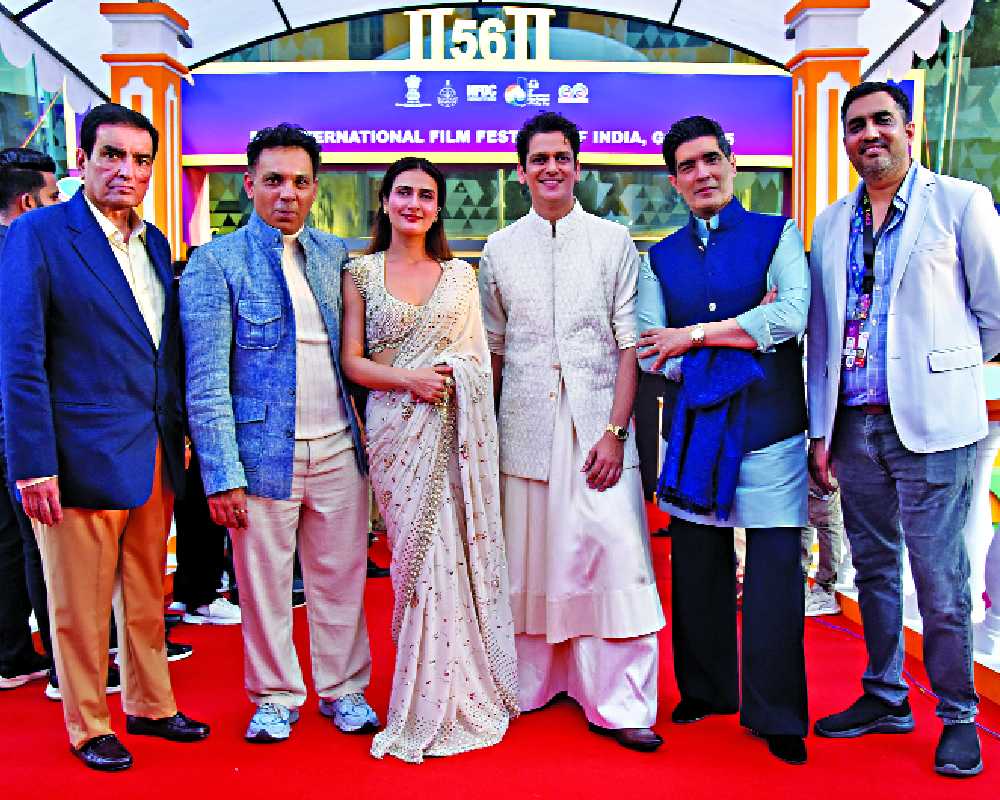
Flashbulbs popped as Goa’s evenings slipped into festival mode at the 56th International Film Festival of India, with the red carpet setting the pace each day. Cinema legends and emerging faces moved through the same space, turning it into the festival’s most visible meeting point. Across nine days, daily premieres reflected the breadth of Indian and global cinema. Rajinikanth, Ranveer Singh, Rishab Shetty and Aamir Khan appeared alongside teams from Gustaakh Ishq and Tere Ishq Mein.
Highlights included the world premiere of The Family Man (Season 3) with Manoj Bajpayee, Nimrat Kaur, Sharib Hashmi, Priyamani and Jaideep Ahlawat; a special showcase of 120 Bahadur featuring Farhan Akhtar, Raashi Khanna and Sparsh Walia; and the Marathi film Asambhav with Sachit Patil, Mukta Barve, Priya Bapat and Sandeep Kulkarni. Filmmaker Vidhu Vinod Chopra also attended the special screening of his restored classic 1942: A Love Story.
A defining feature of IFFI 2025 was its effort to place new cinema alongside traditions of craft, performance and exhibition. The Vintage Camera Exhibition offered a tactile glimpse into the tools that shaped early filmmaking, while the Handloom Sarees in Motion showcase linked cinematic presentation with India’s textile heritage. Adding to this was a Photo Exhibition inaugurated by Indian actress Amiee Baruah and Goa Chief Minister Dr Pramod Sawant at the Kala Academy, showcasing photographs from IFFI’s 22-year journey in Goa.
The exhibition also featured a collection of antique cameras, tracing the visual and technological evolution of the festival and cinema itself. The intellectual core of IFFI remained strong through masterclasses and in-conversation sessions at the Kala Academy. Filmmakers such as Vidhu Vinod Chopra, Anupam Kher and Shekhar Kapur spoke about filmmaking as an emotional, ethical and technical practice. The festival also paid tribute to legendary actor Dharmendra, acknowledging his remarkable range and contribution to Indian cinema.
A special celebration marked 50 years of Sholay, with director Ramesh Sippy’s landmark film revisited as a defining moment in popular cinema and collective memory. The penultimate evening belonged to Aamir Khan, who closed the festival’s final Fireside Chat with candour and wit. Speaking to a packed hall, Khan described his instinct-driven approach to cinema, saying he liked to surprise both his audience and himself.
Calling himself “a complete film personality, not an activist,” he stressed that entertainment remained his primary objective, adding that the day he consciously chose to direct, he would likely stop acting. IFFI 2025 also advanced international collaboration through industry engagement. A Memorandum of Understanding signed between IFFI, NFDC and the Indian Film Festival of Melbourne marked a step towards strengthening Indo-Australian screen relations. Tributes and restored classics provided continuity across generations, with films by Guru Dutt, Ritwik Ghatak and V Shantaram screened alongside contemporary works.
As the festival drew towards its conclusion, participation took on a personal dimension through India Post’s ‘My Stamp’ initiative. Visitors converted their photographs into official, postage-valid stamps using an IFFI-themed template, taking home a tangible memory of the event. Together, screenings, performances, learning sessions, industry initiatives and personal mementoes shaped an experience that extended beyond the screen. IFFI 2025 presented cinema as an art form shaped by history, refined by craft and sustained through collective experience, while remaining open to new voices and future possibilities.
(L-R) Actor Kamal Haasan, filmmaker Shekhar Kapur, actor Ranveer Singh, actor Vineet Singh, actor Kishore Kadam from the film ‘Gondhal,’ German actress Katherina Schüttler, actress Tran Quân, and director Ash Mayfair of the film ‘Skin of Youth on the red carpet at IFFI 2025. For nine days, Goa lived cinema as filmmakers, audiences and stories from across the world came together, sharing screens, streets, conversations and memories.
IFFI 2025 Official Awards (Key Winners) International Competition
- Golden Peacock - Best Feature Film: Skin of Youth (Vietnamese film by Ash Mayfair) — a bold romance featuring a transgender protagonist.
- Silver Peacock - Best Director: Santosh Davakahar for Gondhal (Indian Marathi thriller).
- Silver Peacock - Best Actor (Male): Ubeimar Rios for
A Poet.
- Silver Peacock - Best Actor (Female): Jara Sofija Ostan for Little Trouble Girls.
- Special Jury Award: Akinola Davies Jr for My Father’s Shadow.
- Best Web Series (OTT): Bandish Bandits 2 — commended for making arts and music accessible through OTT.
- ICFT-UNESCO Gandhi Medal: Safe House - recognised for promoting peace, nonviolence and intercultural dialogue.
- Best Debut Director (International/Indian): Kesari Chapter 2 (Hindi) - Karan Singh Tyagi.
Special Felicitations
- Lifetime Achievement / Special Recognition: Superstar Rajinikanth honored for 50 years in Indian cinema.
Select Top Films & Screenings at IFFI 2025 International Films (Competition & Gala)
- Skin of Youth (Vietnam/Singapore/Japan) - Golden Peacock winner.
- My Father’s Shadow - Special Jury recognition.
- Safe House - Gandhi Medal winner (Norwegian/International).
- A Poet - Performance-winning film.
- Little Trouble Girls - Best Actress performance film.
Indian Competition & Panorama Highlights IFFI’s Indian Panorama section featured a rich selection of contemporary Indian cinema across languages (films chosen from hundreds of submissions).
Notable Indian films included:
- Gondhal (Marathi) - Best Director award.
- Amaran (Tamil) - major Tamil film featured, also nominated for Golden Peacock.
- Sarkeet (Malayalam) - Malayalam title in the selection.
- Committee Kurrollu (Telugu) - in Best Debut Director nomination category.
- Shape of Momo (Nepali) - noted Indian Panorama nominee.
- ARM (Malayalam) - Best Debut Director nominee.
- Binodiini Ekti Natir Upakhyan (Bengali) - featured nominee.
Special & World Premieres
- Oslo: A Tail of Promise - documentary world premiere presented by John Abraham, screened in Indian Panorama.
- The Blue Trail - opened the festival (international selection).
Emerging Voices
- IFFI 2025 screened 240+ films from around 81 countries with world, Asian and international premieres across multiple sections.
- The Indian Panorama featured around 25 feature films and 20 non-feature films selected from a large national pool.
- Creative Minds of Tomorrow (CMOT), a youth-focused program, concluded during the festival with emerging talent at center stage.
Key Themes and Initiatives
- Focus on AI and Technology: CinemAI Hackathon spotlighted AI-driven filmmaking and storytelling
- Global Reach and Collaborations: The festival screened over 240 films from 81 countries, with Japan as Country of Focus and Spain and Australia featured as partner and spotlight countries.
- Inclusivity and Emerging Talent: Aligned with the theme ‘Nari Shakti’, over 50 films by women directors were showcased, alongside a strong focus on debut filmmakers and a dedicated Best Debut Indian Director award.
- WAVES Film Bazaar: The revamped film market boosted co-productions with a tech pavilion and cash grants.
- Accessibility: The festival incorporated various accessibility measures, including sign language interpreters and audio descriptions at venues, ensuring a more inclusive experience for all delegates.
- Cultural Engagement: The festival opened with a street carnival in Panaji, alongside the four-day cultural showcase IFFIesta.