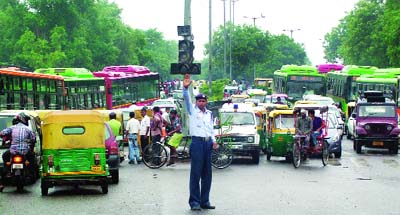
In order to improve traffic regulation in the national Capital, Delhi Traffic Police (DTP) have decided to optimise traffic signal timings as per traffic volume. Signal timings will be customised as per traffic flow on a particular stretch during peak hours and lean hours. On any given day, the signal cycles and phases will be automated into smaller slots. This move will reduce pile-ups at busy intersections where volume of traffic fluctuates even during rush hour.
As part of the move, more slots will be created in a signal cycle and the duration for which a traffic light turns green or red will be fed into the controller. “The move will optimise the use of traffic signals as per the flow of traffic. As traffic patterns change throughout the day, it is appropriate to modify the signal timing parameters to cater to the volume of traffic during that slot. Signal timings at a particular intersection will be modified based on the data gathered on existing traffic volumes and variations throughout the day,” said Additional Commissioner of Police (Traffic) Anil Shukla.
At present, the duration of a signal phase and a cycle is divided into peak hours and non-peak hours. At many busy intersections, including ITO and Ashram, the signal cycles are switched to manual mode to discharge the volume of traffic. However, depending on the volume pattern, the signal timings now will be automated for shorter durations. For instance, if the traffic volume at Chirag Dilli intersection is at its peak between 8 am and 9 am, the slot will have signal timings for longer duration than the next slot, may be from 9 am to
11 am, when traffic starts receding somewhat. “To curb rampant red light jumping, especially during night hours, the number of signals which work around the clock will be reduced and more signals will be switched to blinking mode during night,” he added.
In order to locate the dysfunctional signals easily, every signal in the city will have its unique code. Delhi at present has 807 traffic signals and 397 blinkers which will all have their unique codes by September 15. “The code will adhere to the Indian Road Congress culvert design and will have a yellow base and will be painted in red on each signal pole. The move will help not just road users to report about dysfunctional signals easily, but will also hasten work on signal repairs,” added the ACP. Commuters can report non-functional signals by calling the traffic police control room number at 25844444 or by posting on DTP’s Facebook page.