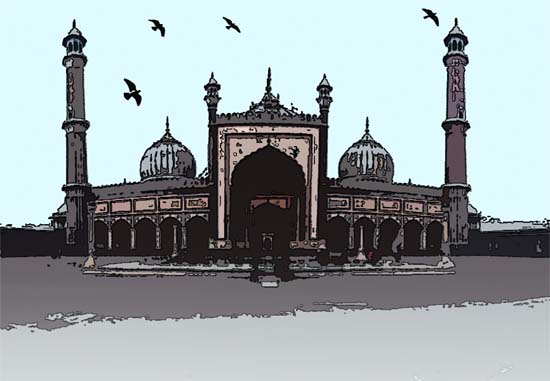
Despite being one of the oldest settlements in the world, Delhi remains a migrant city, with people having little, if any, loyalty towards it and the city having no particular identity. Utpal Kumar talks to a chronicler of the city, a prostitute and a rickshaw-puller to understand the idea of Delhi
Mayapuri. Primarily an industrial area in west Delhi. Not exactly the place where you would expect one of the best chroniclers of Delhi to live. “Yeah, it’s boring out here. It’s the last place one would like to reside after living in Old Delhi for a good part of one’s life,” says he in
a resigned tone. Old, thin and withered, he is wearing a rugged shirt, with one of its buttons missing. His trouser is dirty and has a hole in it. But the hardship hasn’t taken away the softness from his voice. He’s polite to a fault.
“Can we sit in a park nearbyIJ There is some work going on here,” he asks rather apologetically as I stand at the door of his nondescript flat. As we move through a narrow lane, a small brick falls from above. Construction work is going on in the neighbourhood. “This is the story of Delhi. Everywhere they are making or breaking something,” says he, placing his ‘protective’ hand on my shoulder. Warmth is the only thing he has today, except perhaps the stories — a lot of them — of the lost Delhi and its people.
Meet Ronald Vivian Smith. For someone who is regarded as an encyclopaedia of Delhi, he’s singularly ignored by the city and its people. He has been denied the importance and respect accorded to his renowned peers like Khushwant Singh and William Dalrymple. While Singh lives in a ravishing apartment in the posh Sujan Singh Park and Dalrymple owns an exquisite farmhouse in the upmarket Chattarpur, Smith is forced to live in an unremarkable locality in west Delhi. At the age of 75, he does not have a car to move around, or a computer to write his articles, relying as he still does on a typewriter. In some ways, he epitomises the old city he loves so passionately; he is as much marginalised, abandoned and ignored as the old segment of Delhi is.
When asked if he feels bad about being overlooked by the city to which he has given so much, particularly when some of his contemporary writers are showered so much importance, he smiles and looks away. Suddenly, he turns around — as if challenging the notion of being a victim — and says: “When I first came to Delhi in 1961, I used to take lunch at the Karim’s everyday. It would then cost me Rs 1, and since rotis were cheaper I would eat as much of them with a single plate of gravy. Decades later, I am yet to get over this habit of eating more rotis. How many of us are lucky to eat that much at the Karim’sIJ”
Recalling his stay in Old Delhi, Smith says: “I would often see elders sitting together talking about the past, and how 21 Mughal princes were killed during the 1857 uprising, how the British contemplated demolishing the Jama Masjid and the Red Fort, how the Fatehpuri mosque was sold to a Hindu merchant and the Zinatul Masjid converted into a bakery, and how buildings within a radius of 500 yards of the Red Fort were razed to the ground.” Old Delhi wouldn’t forgive anyone, wouldn’t forget anything! “I was close to a Muslim family during my stay in Daryaganj. One day an influential local Muslim came to me, suggesting I should keep some distance from that family. ‘They are traitors. It was their family that backstabbed the Mughals during the 1857 uprising and spied for the British,’ he said.”
Ask him about the mujras of Old Delhi, and Smith’s eyes lighten up. “Oh, it all started up on a ‘dry’ day when I along with a few friends like Saeed Naqvi and Vijay Shankar went at the place of Hali Vats, then editor of the See magazine, to chalk out a plan for a pictorial feature on the dancing girls of GB Road. We were also accompanied by Niaz Haider, a leading light of Hindustani theatre. Hali poured out generous pegs of whisky for us. Thereafter, we went to the kothas to see the mujra. As it was about to end, a few truck drivers entered the hall and tried to pick up a fight with us. Some of us thought of running away but suddenly things settled down. While coming back, I asked Haider how the truck drivers could be calmed down. ‘I just winked at a pimp and order was restored,’ he revealed.”
Smith is pained to see the world he once lived in hardly exists today. The mujra culture is all but gone. It’s all about sex now, he says. “Once these dancing girls were sophisticated, rich and cultured. Parents would send their sons to them to learn etiquette, Urdu poetry, the art of conversation and even the finer points of love-making,” says Smith, reminding us of what Dalrymple wrote in his book, The Age of Kali: “On the terraces of upper-storey chambers of the tawwa’if, the young men would come to recite their verses and ghazals... the tawwa’if would teach young men how to speak perfect Urdu.” It was the city where even a milkman would quote Mir and Dagh, and a prostitute would recite Hafiz. Today, hardly anyone remembers them, except perhaps Ghalib! So, what’s the big deal if Smith is being abandoned nowIJ
The missing light
The GB Road Smith talks about so fondly doesn’t exist anymore. The namesake stands there, but the light is all gone. Women are there, but their soul is missing. last time when I came here I met an old dancing girl, Reshma, who would sell gajras for sustenance. She was dejected at the decline of the mujra culture. “Cells have became more important than our dancing halls,” she complained. Now with the Internet bringing porn to the bedroom, even these small cubical cells are fighting a losing battle.
I am looking for Reshma again. She must be a year older now, and her life more abject. But she isn’t there where I saw her last.
It’s dark and I am getting uncomfortable at GB Road. Several eyes are staring at me, and I am looking for that old, lanky face. I ask a woman about Reshma. She looks at me mischievously and says, “Why bother about Reshma when you can get betterIJ Come up,” says she, trying to pull me upstairs. I remain unmoved. “ReshmaIJ Are you sure about that name. Here no one gives the real name,” she says.
“She was a 54-year-old, tall lady,” I ask again. Agitated, she tells me to go away, awakening to my presence only when I put a hundred rupee note in her hands. “At 50, women are all but dead here. To grow old is the biggest fear we have. It’s good for her if she is no more,” says she matter-of-factly.
I give up the search. Maybe Reshma is dead. Maybe she had given me the wrong name. Maybe she has left the place. “So, how did you come hereIJ” I ask the young, dusky woman. She’s reluctant to tell anything beyond her religion — she is a Muslim — but her accent reveals her Bengali origin. Is she from BangladeshIJ Her unwillingness to tell anything about her place of birth makes me suspicious.
After a bit of cajoling she opens up. “Being second of seven daughters, my father got me married at the young age of 13 to a 47-year-old widower. My husband would not allow me to go out, and always kept me in purdah.
Worse, two of his sons, elder to me in age, would give me dirty looks. I couldn’t take it for long and ran away with a young man from my village who worked as a labourer in Delhi. I came here looking for freedom, love. But after spending a month with me, he left me at one of these places. I couldn’t have gone back. So I stayed here,” she says rather nonchalantly. “I came to Delhi looking for freedom. I got it here but not the way I wanted it to be,” she adds. On whether she is sorry for coming to Delhi, she says: “I have no regrets. This place has given me freedom. Here I choose to sleep with men I want to. I earn money which I spend on whatever and whosoever I want to. I know till the time I am young and beautiful, I can have my say. Back in my village, I had none.”
So, what kind of customers she getsIJ “They are mostly labourers and rickshaw-pullers from Bihar and Uttar Pradesh. I hate their smell. They are often filthy and aggressive. Par kya karein, ganda hai par dhandha hai (what can we do, it’s dirty but it’s our job),” she says rather philosophically.
Unlike Reshma, she has no knowledge of the era when dancing girls had greater say and respect in Delhi. She doesn’t know about Ad Begum, who would appear naked at parties during the late Mughal era, but so cleverly painted that no one noticed. She looks at me in awe when I tell her about Nur Bai, whose popularity was such that every night the elephants of the great amirs completely blocked the narrow lane outside her house. “Even the greatest nobles could only gain admittance by sending in presents of larger sums of money,” informs Dalrymple in his book, The last Mughal.
As we are talking, the young woman gets a genuine ‘customer’, apparently belonging to a labour class. They seem to know each other well. As she takes him upstairs, I look at her. She looks back, and smiles. But I don’t ask her name. You won’t get the right name at GB Road, after all!
The second wave
People from the east have not just changed the face of GB Road. They have changed the face of Delhi itself. “We displaced the Muslims of Delhi after Partition. Now we are being marginalised by these bhaiyyas from Bihar and Uttar Pradesh who have been coming here in large numbers since the 1990s,” says Amrik Singh. “Do you think the Congress would have won the last three Delhi elections so easilyIJ What has helped the party is its solid vote base among Purvanchalis, while the BJP took time to come out of its Punjabi image. Delhi isn’t Punjabi anymore,” says Singh, who has a cloth business in east Delhi.
So, who are these bhaiyyasIJ Arjun Kumar, a rickshaw-puller, lives near Kohat Enclave in west Delhi. He is a Bhumihar, allegedly a landlord class in Bihar. “I came here because I couldn’t have worked as a labourer in my own village. My grandfather had a lot of landed property, but by the time my turn came there was hardly anything left for me. We are landlords without land, but our reputation in the village remains intact. Delhi provides me anonymity and when I go back home no one asks me what I do here,” says he.
Herein lies Delhi’s tragedy. Despite being one of the oldest settlements in the world, it remains a migrant city, inhabited by a population most of whose roots stretch back to mere 60 years. Dalrymple depicts the irony in City of Djinns when he writes: “Of the two peoples who had ruled Delhi during the previous thousand years, the British disappeared completely while the Indian Muslims were reduced to an impoverished minority.”
Now Punjabis, who are slowing accepting Delhi as their own, face the same prospect. But that’s what Delhi has been.
It has moved on after each setback to rise like a phoenix, to end up encountering a bigger crisis. That’s what makes it so enigmatic. That’s what makes it so less chauvinistic. That’s what makes it so inclusive. Maybe that’s why Smith doesn’t feel betrayed even when Delhi doesn’t recognise him. That’s why the prostitute of GB Road doesn’t want to go back home despite so much of pain and betrayal in the city.