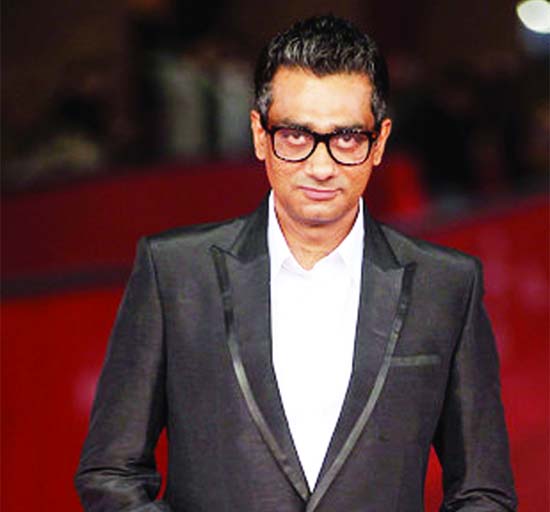
Qaushiq Mukherjee aka Q loves being non-conformist and is happy to be a non-Bollywood person making films for European markets. He chatted with Divya Kaushik on growing up with Tagore tales, his early influences and inspirations
He wears his attitude on his sleeves and his non-conformist choices were well reflected through the kissing graphic on his tee. Qaushiq Mukherjee introduced himself as Q. It is not just his name but it means a lot to him. “Q is the character, it is fiction, fantasy. The way I was born and raised, my morality, my sensibility was very different than what I wanted to be. So I have to create a character with no history, no lineage, no country, who can claim to be just anyone. The letter Q fits the bill. It is also important to me because of the film Visitor Q directed by Japanese director Takashi Miike. The film is about a visitor in a middle class Japanese house, who just by being there changes everything. Soon the family’s middle class sheen falls. It is a subversive, totally extreme film and I admire the director a lot. I wanted to be that guy, Q, who disrupts the system,” he explained.
The Bengali director we know for his film with a controversial title, Gandu, was in the Capital for a panel discussion that was part of Sweden India Nobel Memorial Week. Public platforms are rare for him as he said that “I only attend serious programmes. I don’t like the whole idea of celebrity culture ruled by appearances. Appearances and getting remunerated for appearances, I am working against that.” Sweden India Nobel Memorial Week is dedicated to Rabindranath Tagore this year and the topic of debate was ‘Tagore Now’. Q’s last film was an adaptation of Tagore’s play Tasher Desh. The filmmaker says that Tasher Desh was the play that he loved since his childhood, but saying that Tagore’s body of work has influenced him will be wrong. “I was brought up in Kolkata and Tagore has been part of my consciousness since I was growing up but it was never a part of my immediate system. I grew up with a fairly balanced outlook on Tagore, which became more analytical than reverential. There were several reasons for it. One of the key reasons was that for me and a lot of people of my generation, though they wouldn’t admit it now, his halo was like a burden. He was the guy whom you had to know through and through before expressing yourself creatively. Everything you did was governed by him. The language you spoke, your morality, your social sensibilities, your middle class values, your food and even the way your mother wore a sari, everything had Tagore in it. It is very difficult to live with that on a day-to-day basis if you do not follow the Bhakti Movement, which I was never a part of. He had touched upon every issue that governs our lives. You wouldn’t find a subject that Tagore had not touched upon except, I think, sexuality, which I am into. It is almost a given that the first thing you read is Tagore and the last thing you read is him. The only thing that excited me about Tagore was Tasher Desh. I have been a big fan of Tasher Desh since childhood probably because of its music. Originally it had 19 songs and I have used 17. The film is only my interpretation of the play. We followed the original theme, there was no screen script but everything else was improvised,” he shared and added that the reason why Tagore has been a favourite with the filmmakers is because “he is the most saleable commodity that Bengal has ever produced.” Q doesn’t dispute that he was a renaissance man but feels Bengal needs to build up on him and create new benchmarks. That indeed would be taking Tagore’s legacy forward.
Not much has been ever discussed about Q’s initial training as a filmmaker. He said, “There was no training. I don’t have a childhood to be shared. It began because I stumbled upon a particular kind of films. I am talking about the late 90s and the films I was watching at that time. They totally changed my perspective of filmmaking. It was during the post-90s’ digital explosion in European cinema followed closely by the Asian new cinema that I had me in thrall. But the breakdown of this plastic filmmaking approach, as it was known, started in 1995 in Denmark where filmmakers formed an association called DOGME 95. They abolished traditional rules of filmmaking be it of story, acting and theme, and abhorred the use of special effects or technology. They were political in nature, subversive and dealt with extreme content. In short, cinema was a fluid and extremely porous medium. But this kind of cinema is not known widely in India. Had I not travelled abroad I would not have been here.”
His treatment of subjects is dark and most of his subjects come from his fantasy. There is more drama in the shadows and underbellies. His purpose of making films is not to earn money and make bigger films, rather he would go against the tide and be known for doing things differently. He spoke about his inspiration: “I have been alarmingly inspired by people who are deviant in nature. When I was 14 or 15 I realised that I was always drawn to people who were working outside the system and at that time I had no clue on how to do that myself. I tried it in different, ambient ways through music (alternative music was becoming a phenomenon then). Then I wanted to be a rockstar which I couldn’t and ended up being a filmmaker which is far less cooler than being a musician.”
His films might not have gone well with Indian cinema sensibilities but he is happy surviving on his international following. “Films are for everybody, so I am cool with not categorising them. We at Overdose Joint are working on nine films. Three are mine. We are co-producing some and line-producing some. As of now I am finishing a film that I have been working on for four years. We will showcase it at the Berlin or Toronto film festivals. Early next year we will shoot a horror film and then a coming-of-age dirty comedy. International film fests keep us alive, they are our major space. Right now we have broken into the US market and we hope to have more tie-ups there. We also work with public broadcasters like BBC and over 20 public broadcasters in Europe,” he said.
Q never sees himself as part of Bollywood. “We have no value for art and cinema is not even considered an art. It is an occupational trait and is the same as harvesting potatoes. I have some agenda to push and I will keep doing that,” he ended.