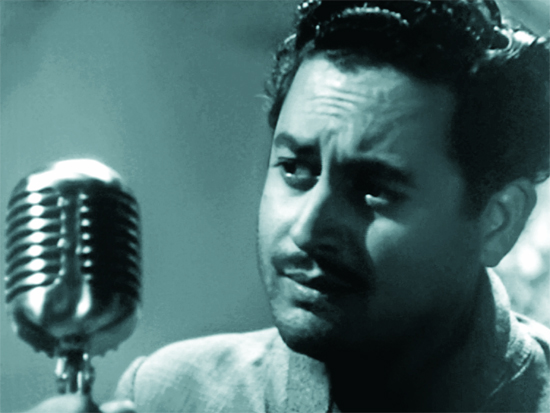
Although perpetually seen as a brooding and tragic icon, Guru Dutt cultivated humour and a child-like zeal for mischief. The innate multilayered persona of one of world cinema’s most serious figures, overlooked by most as being melancholic, was also charming and playful
He is the brooding poet in Pyaasa. Nothing is quite his to call his own. His poems are just pieces of paper only worthy of earning a few annas when weighed and sold as raddi; the girl he loves is the wife of a rich man. His home is not his own; and his own mother must subjugate her love for him to the will of his stepbrothers who tend to and feed her.
So deep is his despair that even the love of an adoring woman does not quite lift his spirit, and when he does finally acknowledge it, he sees it only as his escape from a loveless, mercenary world. In Kaagaz Ke Phool, his spiral of despair is built of more glittering material, but the depth of his misery is that much the deeper for it. The film, considered autobiographical in some aspects, portrayed as much the inner wilderness of the protagonist’s mind as it did the barrenness of the relationships in his life.
Even in the much lighter Chaudhvin ka Chand, Guru Dutt in the role of the hero broods and mulls over the strange destiny that has won him his loved one but at the cost of hurting his best friend. The crossroads of his dilemma occupy much of the latter part of the film, and cast its shadow over the viewer. Then of course there is that indelible fact of Guru Dutt’s suicide. With no real reason, a quiet, brooding descent into melancholy and an overdose that sent him into a world where despair could affront him no more.
How easily the world of film viewers decided then that among the greats, here was one tortured, dammed soul that sought release in creative expression, and when that afforded no satisfaction, in death! The world has painted Guru Dutt as a sombre, brooding personality in real life that, with every film, seemed to be orbiting nearer to his own end, and was hinting at it through his protagonists’ stories.
Perhaps it is the mystery of an untimely death that makes this a convenient belief. Most movie watchers love real-life drama, and an icon who committed suicide was a great peg to hang their own fabrications on. The media of course, speculative and intrusive, did its bit. And like it or not, a myth was born.
But the balanced critic of Guru Dutt’s films will see beyond the one-dimensional portrait that a skewed public memory has created. Films like Mr and Mrs 55, CID speak loud and clear of a mind that could take humour and lightness to a new level. In the former, the ‘ brooding’ actor himself takes on the hero’s mantle, and dons it lightly enough to possibly make him one of the earliest actors to combine comedy with the hero’s role.
But looking beyond his films, and to silence those who will argue that Mr and Mrs 55 predated his descent into unaccountable despair, let us glance into Guru Dutt the man as different from the director, actor, and producer. What was he like, this man who is today one of cinema’s greats; whose work has qualified to enter the list of the world’s best filmsIJ
Abrar Alvi, his writer and assistant for 10 years, and a friend and confidant through the entire period that covered Guru Dutt’s most productive phase and ended in his death, presented a very different view of the icon’s personality. He was, according to Alvi, moody, whimsical, exacting, quick-tempered, caring and mischievous; besides being creative, of course. Add to this the fact that like many other creative minds, Guru Dutt was also likely to have been diagnosed with manic depressive tendencies if he had ever consulted a psychiatrist to try and understand his mood swings; and the mental make-up of a complex and fascinating individual presents itself. Fans intent on preserving the brooding image might raise their voices hotly against Alvi’s reading of his friend and mentor, but the following facts might help quell their anger.
Among Guru Dutt’s closest friends, along with Alvi, was the man we know as Johnny Walker. The three would often take off on hunting or travelling expeditions, and it is difficult to imagine a quiet brooding persona riding a jeep or some other suitable vehicle, rifle in hand, in the company of two others, one of whom has a decided talent for humour. Off screen too, Johnny Walker could raise a laugh, as could Guru Dutt himself. In fact, of the three, anyone who studies them will come to the conclusion that Alvi was perhaps the most serious, being the most practical and logical minded. That Guru Dutt was not above practical jokes may come as a surprise to many, but he pulled a couple of fast ones on Alvi and other assistants, and was not beyond taking on Mehmood himself.
One work-related story narrated by Alvi tells of how one morning, when he entered the studio with his script, for the shoot of a scene for Pyaasa, he was told that he would have to shoot the scene himself, as Guru Dutt had gone off to attend court. Abrar had no option but to take on the director’s role, and do what he could to film the scene at hand. It was only when he was almost done that he realised that, standing high on the catwalk, wearing his trademark quizzical expression, his director was watching him at work. It was part experiment, part practical joke, of course. Someone with only a serious bent of mind would have just handed over the megaphone and told Alvi to carry on and not cooked up a story that needed the conspiring aid of other unit members, all of whom must have had to suppress their smiles while Alvi sweated over the assignment imposed on him without warning.
Or consider the time when Guru Dutt, Waheeda Rehman and others conspired to pull Abrar Alvi’s leg by telling him to meet a fan who was waiting in another room. A fan who sat swathed in purdah, insisted Alvi write a role for her in his next script, but would not let Alvi see her face, which to the writer who wished to write close to the truth and wanted to know if the role would portray a young woman or an old, and of what station, was unthinkable. After much exasperation, when Alvi finally threatened to lift the purdah off the face of the mystery woman himself, the joke had to be called off. The purdah was pulled back by the fan herself. It revealed the laughing face of Waheeda, and Abrar noticed an equally amused Guru Dutt watching from the doorway.
Guru Dutt’s mercurial magpie mind picked up facts and mulled over them with the wonder of a child exploring a secret garden. He could well decide to brew liquor with a group of villagers, or till a field to see if he could live a farmer’s life. Alvi talks of nights when he was woken up to be summoned to Guru Dutt’s side to watch with him as fluffy, yellow chickens hatched out of their eggs placed in an incubator by the curious director himself. His curiosity extended to words and languages. Through his tour of France, he forgot the reason for undertaking it, which was a special lens he had hoped to buy, and delved instead into the similarities in words in French and Hindi; the word savon for soap being one such example. Brooding, self-obsessed minds do not venture into wondering about such aspects; it needs a certain happy child-like bent of thought.
Yet most Guru Dutt fans choose to push his multi-layered, fascinating persona into the strait jacket of being a moody, melancholy loser. That is sad, indeed!