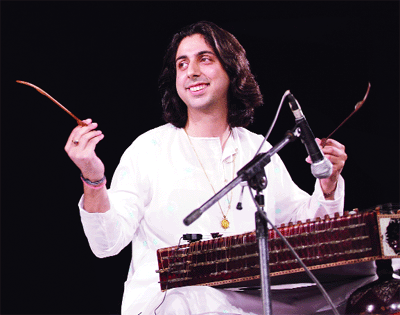
Santoor player Abhay Sopori will play old taraanas of the Sufi parampara created by his great grandfather today at the Umak festival. He spoke to T Mukherjee
After collaborating with acclaimed musician Zubin Mehta for his controversial Srinagar concert, santoor player Abhay Sopori will be performing today with sitar maestros Ustad Mushtaq Ali Khan and Pandit Debu Chadhuri as a part of Umak Festival. Along with his father Pt Bhajan Sopori, he will perform a khyal composition. Khyal, meaning imagination, is one of the popular genres of contemporary classical music, largely sung in North India. “It is a flexible form of music and offers a scope for improvisation,” says Abhay, who is the sixth generation santoor player from Jammu and Kashmir. His ancestors are known to have introduced music in the school curriculum of the state.
Hailing from the Valley which has been witnessing conflicts and riots over the years, Sopori feels that music enhances human sensitivities and is capable of bringing a vibrant and optimistic behavioural change. “Music is something that can create a balance in human beings,” he said.
Abhay Sopori derives his inspiration largely from the exceptional work of his father, who is a musicologist and composer par excellence. “I was extremely fascinated by my father’s work. I used to be left spell bound by the wide range of music that he could produce from a single instrument,” he says.
“Kashmir is more than just militants and riots,” he adds while talking about the Zubin Mehta concert which irked Kashmiri separatists. “For me, the concert was a medium to bring the music of the Valley on an international platform,” asserted Sopori.
The Umak festival, which concludes today, is celebrating the phenomenon of sitar maestros Ustad Mushtaq Ali Khan and Pandit Debu Chadhuri. “In a time when people forget acknowledging their gurus, it is great to be a part of an event that celebrates and remembers the indispensable contribution of our teachers. Also, it is associated with a beautiful cause. The proceeds generated from the event will be given to a cancer foundation,” he says.
In his part, he will also be performing compositions from the old taraana of the Sufi parampara. “The old taraana compositions were written by my grandfather and great grandfather whose music has blossomed into a fine musical industry in Kashmir,” he tells us. Taraana is a classical composition, essentially for Hindustani vocal music.
Sopori, whose music is renowned to contain elements of both classical and contemporary music, refrains from calling his compositions a fusion. He believes in making music that “pleases the ears”. For, instance, his composition Haftrang which was performed at Ehsaas-e-Kashmir, was a beautiful blend of Kashmiri folk music and German orchestra. “Haftrang was a tribute to Kashmir. Every single note of the composition depicted Kashmir. Even with the German orchestra, it was essentially an Indian piece of composition,” he says.
He is also trained in western classical music, but his forte continues to be the music of the Valley. “Being a composer, it is important to know how to extract music out of every instrument. I never say no to an instrument, but, by heart definitely lies with the santoor,” he says. The Umak festival will also witness an orchestral ensemble and dance performance by the students of UMAK Centre for Culture and sitar recitals by Chaudhuris.