Detective Byomkesh Bakshy! is Dibakar Banerjee’s way of mainstreaming intelligent cinema as entertainment. He tells Rinku Ghosh about his love for Bengali crime fiction — which he says was the only evolved literary genre in India — noir, and snooping into the private world of a conflicted man
In your earlier interview with us, you had expressed a keen interest in working on a period film. Why did you choose the fictional detective Byomkesh Bakshi as a fit subject for a period filmIJ
The idea of Byomkesh was in my mind since I was 14. I found his creator Sharadindu Bandyopadhyay’s writing very cinematic. At that point I did not know that in his later years he wanted to become a script writer in Bombay. Whenever I read his novels, I could very easily visualise his writing. Everything was very graphic, though it was not blown or exaggerated or over articulated. But at the same time it painted a clear and definite picture. And he wrote most Byomkesh stories in sadhu bhasha or purist Bengali. It was a different kind of Bengali than what we speak today but even then it was so direct.
Being a Bengali growing up in Delhi, how were you taken in by the idea of attempting reading something in sadhu bhashaIJ
My house was full of books. I read Bonoful’s (Balai Chand Mukhopadhyay) autobiographyPoschat Poth, which, too, is written in sadhu bhasha. I was reading Sharadindu and at the same time I was reading Feluda and other modern books that my parents were reading that time. It was all a mix, I was not even aware of anything being different from the other. Slowly I started understanding them.
When there was Feluda, Byomkesh and Kiriti Roy, what made you pick up Byomkesh and place him in a post-modern societyIJ
I think Byomkesh is the mother node, he is the beginning. A lot of Bengali detective fiction has a deeply pulp underlayer. The writers who have real originality write in that pulp domain but their sheer writing lifts it up, above the pulp. Sharadindu’s first Byomkesh stories were written for magazines and frankly there was not much crime and detection in them, it was only adventure. Those were the first few stories and the detection was not of a high order at all. In the first story, Byomkesh’s main clue to figuring out who the villain was by looking at his expressions. The later stories were all human studies of everyday characters. It is apparent from the first few stories that a young Sharadindu was writing a yarn, an adventure yarn to enjoy himself and to make his readers enjoy. And slowly as he grows, those layers grow. So my Byomkesh is that earlier Byomkesh where the love of the yarn is more important. That’s where I am drawing from because that is more cinematic and entertaining. I chose Byomkesh because he is the original template that more or less informs everything. He is the best selling detective in Bengali fiction. Feluda could be popular but he is for the teen audience, Byomkesh is for everybody and he has been there since 1934. Feluda came in the mid 60s. The charm of Byomkesh is that he is involved in human and social studies and at the same time he is the pivot of deep, rich crime stories.
Most commercial screen versions of Byomkesh focus on the cases he dealt with and yours is all about his personality... RiskyIJ
I think the only guy who brought real style to Byomkesh is Ray with Uttam Kumar (in Chiriakhana). Kumar personified his style, panache, incisiveness and attitude. I think Rajit Kapur as Byomkesh had a beautiful quality — innocence. Makers of his version did not try too much but just went with the stories. The stories came out but Rajit Kapur was such a great vehicle. His simplicity was his charm. For me, the clues are all in Sharadindu. He has written that Byomkesh on the outside seemed like a normal, pleasant and an ordinary young man. It was only when you provoked him and tried to challenge his beliefs that his razor-sharp intellect came out and he turned on you with full fury of his sarcasm and brilliance. And often Ajit (a Dr Watson like genial friend) would try to provoke him because he was the only one who understood Byomkesh and that side of him. I find that beautiful and I have used that in the film.
Who is your Byomkesh in a post-modern societyIJ
Conflicted. I attempted to answer what Sharadindu did not — why did Byomkesh become a detectiveIJ We never know. You can see in Conan Doyle’s Holmes that he is such a misfit that he can only be a detective. Whatever Byomkesh we wanted to construct, it came out of our intense research during the script writing. Urmi Juvekar (the scriptwriter) came up with the logic that we need to make this coming-of-age story — why Byomkesh became what he was, why would a man in 1943, where jobs weren’t too many, where there weren’t many opportunities in life, would jump into this unknown territory, wanting to become a detective. That is what I find most fascinating. If you have to perceive the character as a real one, then you have to go into his impulses. It’s not very ordinary for someone to just be a detective. All of us are what we are because of something that shook us up and all of us are what we are because the thought of not being that scared us even more. Something must have happened in Byomkesh’s life that must have led him to say, ‘I will search for the truth.’
An ordinary example to explain that would be that he was a fan of detective fiction but there is no mention of any detective fiction in the film. The film is about why Byomkesh became a detective and if he hates being called a detective, which Sharadindu had said, then why did he become something that he hates being calledIJ Sharadindu had written that though Byomkesh did a big song and dance of him being a truth seeker, he knew in his heart that he was nothing but a private detective. It means that Byomkesh is a detective but hates being called one — there is a deep conflict in him. And I think, Ajit, as a writer, has cut that out because he is so protective about him that he does not want to reveal Byomkesh’s conflicts and weak spots to the readers. That’s where I come in, another detective. I have snooped into Byomkesh’s private life.
What made you so sure about the film’s pan-India acceptability considering Byomkesh is a very private and protected reserve of the BengalisIJ
We had misplaced courage. When you have an impulse to make a film, it is not a very practical impulse. Also you never weigh the consequence of it, otherwise no film would ever be made. No ground-breaking film would be made if you sit and jot down the consequences.
We creative people are all insane and that insanity goes into our films. In my case that insanity is compounded by the obsession with Byomkesh and, I am always embarrassed to say this, a sense of national pride. But I am not nationalistic at all, I am not jingoistic. There is some kind of a pride that I think we can have in creations like Byomkesh Bakshy, that are home grown, tremendously entertaining, popular and yet are deep enough. No one can ever accuse Sharadindu and Byomkesh of being shallow. No one has ever compared Sharadindu to Jeffrey Archer. Today as we tot up the results of popular films and hits and misses, we continuously keep equating popular with kitsch, popular with shallow and anything which even hints at having depth. One is almost afraid to sound intelligent or perceptive. It has become a reverse snobbery when people say, ‘You are an intellectual.’ And I am patronised all the time in Mumbai for being a little elitist or a little arty. Some people would have thought that YRF was committing a career suicide by associating with someone like me. So in a situation like this, the impulse to bring Byomkesh out on the screen is to show that there is something tremendously entertaining, fun and rip-roaring about being intelligent. Byomkesh is an intelligent man and all his adventures are about him detecting a crime through his intelligence.
Byomkesh has a logical construct in his thinking. Is that why you picked him upIJ
That is a deterministic view that every detective will take. I am not so much of a deterministic believer. Detective fiction was a 19th century thing, just like deterministic, rationalist thinking. The story of this Byomkesh is detective fiction as well as a thriller.
Did you combine the stories to make the scriptIJ
I have combined different elements to make a story.
If this movie works for you, this could become a series.
If this works, there is definitely a beautiful journey that Byomkesh will take forward.
Why did you choose a 1943, war-hit Calcutta as the backdropIJ
Because it was exciting. Sharadindu Bandyopadhyay writes about the World War II, he writes about the riots, the Japanese bombings, the Independence. What I wanted to write was Calcutta under Japanese attack, Calcutta under divided loyalties, whether to side with the British or the Japanese, and Calcutta during the struggle for Independence and Calcutta going through a huge wave of crime and black market ring because of the war economy. Then there were American GIs on the roads, with swing and jazz music being played in night clubs, there were runways on Red Road. There were ships coming right to Khiderpore dock and loading huge stocks because Ganges was not silted up back then. All those things put Calcutta at the cusp of history. Calcutta has never been portrayed as a gritty, everyday interesting city in its period avatar. The only two guys who worked on Calcutta as a gritty city were Satyajit Ray and Mrinal Sen during the early 70s, and I have been tremendously impacted by them. Bengali writers have written about Calcutta in a very gritty manner always. And Sharadindu is quite gritty in his own way. I wanted to get that sense of grit and grime and danger across the corner. That’s where the city works as a metaphor. Even now if you go into certain areas of Kolkata, you will not get a word of Bengali — you will have Biharis, Chinese or Anglo-Indians. Calcutta was tremendously multi-lingual; I wanted to portray that truly cosmopolitan nature of the city. I read about that time in books and heard my father and other people talk about it. It influenced me.
There are also noir elements in the trailer of the film…
There is nothing more delicious than that noir feel in detective stories. You are talking about blackouts and air raids and rooms lit by one lantern. There are also a lot of Chinese characters. They are there in Sharadindu’s writing. The first story says that, ‘With China Town on one side and slums on the other side and a working class area on another side there was a delta. And in that delta there was a boarding house and after finishing my college I found myself spending some time there. To explain why would become a very long story. I met Byomkesh there.’ Therein lie the most evocative things, in every line — China Town, a very dangerous area.
He writes that it was an ordinary area during the daytime but the moment the sun set, it became another area. People disappeared from the streets. Everybody was furtive. All were kept in rooms and every second day a dead body would be found. That’s it, you have laid the foundation for an entire film. All you have to do is take the lines and go really deep. That’s what we have done.
Was it difficult to get YRF on board for such a storyIJ
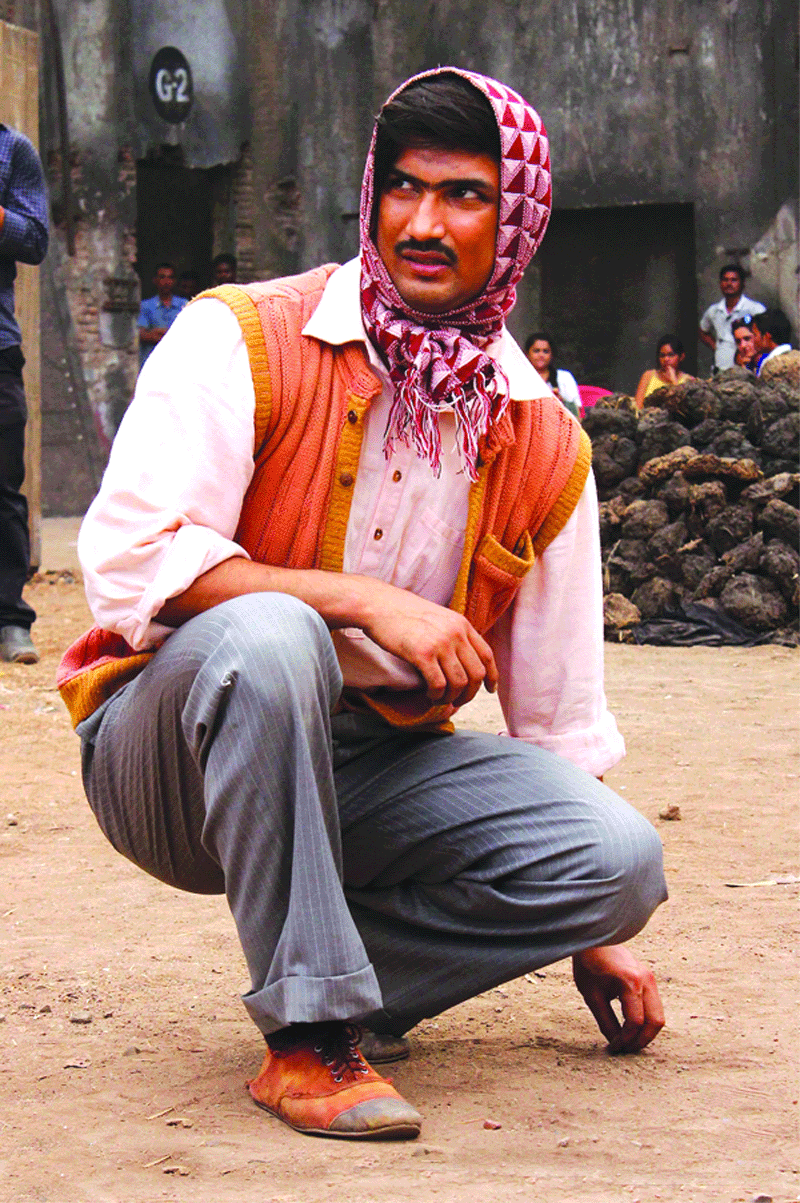
I have worked with big studios like UTV, Balaji and PVR. The whole point of YRF and DBP doing a co-production was to play out because Aditya Chopra was very clear that if he would make me do what they do, there is no point. The whole idea was driven by Adi’s passion. He said, ‘let’s do something where you take over three films, do whatever you want and we collaborate.’ We have a three-film deal. One of them is Anu Behl’s Titli, which will release immediately after this. Adi loved Byomkesh right from the beginning. He read the script, he saw the post-modern take and he just loved it. In fact, it is Adi’s passion and belief that has taken the movie to this level. I, on my own, would have been more cautious. If it weren’t for him, I would have never made that dance video for the film. I wanted something to depict the grunge and the post-modern conflict of the film and the concept of the video is contemporary, cool Byomkesh listening to that song and becoming Byomkesh. It was a transformation of Sushant to Byomkesh.
This film has a little bit of cabaret, little interludes; the heroine is a little sensuous, too. Was that a part of marketingIJ
No. It was actually part of the original impulse. Sharadindu’s stories are sensuous and he has hints in them, so when you come to the cinema you open those hints a little more.
Why did you choose Sushant, a North Indian actor, to play the protagonist while the rest of the characters are BengaliIJ
Along with Sushant there is Anand Tewari and Vidya Menon but I surrounded them with a lot of brilliant actors. I genuinely think that Bengal, because of its theatre and superior television which used to be much better 10 years back, has got a very interesting acting tradition even now. And even from the days of the 1940s. There is an interesting interview of Soumitra where he is talking about Shishir Bhaduri, his guru from the stage. He said, ‘Even when he was on stage, he would be the most natural actor on stage and he was not stagy at all.’ And it is his style that has influenced some of the more natural actors, including Soumitra. And they have got that style from Bhaduri into films. So imagine getting a realistic style into films from stage. Then there is Bohurupee and Utpal Dutta. I think Bengal always had this clear fascination for better actors than better lookers. And no matter how much we say, ‘Uttam Kumar was just a star,’ you just have to look at any of his three films to know that the guy has done everything. There’s nothing about acting that he did not know. He might have done them in a stylish way but if anyone would tell him to do it the other way, he would do that equally great. That is the mark of a brilliant actor. So, all these traditions are hugely ingrained in Bengali actors even today, so when you surround the main actors with all these actors, the flavour becomes wholesome and rich.
How did you train SushantIJ
There were definite things that we did. I told him that the young Byomkesh is restless and extremely impatient with other people’s slowness because his thoughts race. In the first few minutes of the film, Byomkesh has already solved the case without even entering it. I told Sushant that the character is restless so he worked out a body language where he was restless and it was a fight between him rushing with his own thoughts and on the other hand him learning to slow down for other people’s benefit. Otherwise he is being completely misunderstood and it is difficult for him to function. Byomkesh is not eccentric at all. He is restless coupled with intense periods of ennui.
Who is your most favourite sleuthIJ
I have many favourites. But I would say Byomkesh because nothing satisfies me more. I would not compare him to Feluda because Feluda, to me, is like my childhood friend. His are moral stories. They actively taught the young about the world, through Feluda. Feluda was his alter ego. Just like Byomkesh was Sharadindu’s.
What are your forthcoming projectsIJ
I want to give Titli the best release of an independent film in India, and that is a challenge. The movie will be unique because it will be a combination of Khosla Ka Ghosla and love, Sex Aur Dhokha.