Three decades after the Bofors controversy severely hit India’s long-range firepower capabilities, the Army is finally set to get state-of-the-art artillery guns. The Defence Acquisition Council (DAC) headed by Defence Minister Manohar Parrikar on Saturday cleared the induction of 24 indigenously-designed and manufactured Dhanush 155 mm guns, and acquisition of 145 M-777 Howitzer guns from the US.
The apex body for giving the go-ahead to acquisition plans for the armed forces, the DAC also reviewed and cleared deals worth over Rs28,000 crore — including six missile boats, five diving support vessels, flight simulators for Jaguar fighter jets and indigenous electronic warfare systems for the IAF.
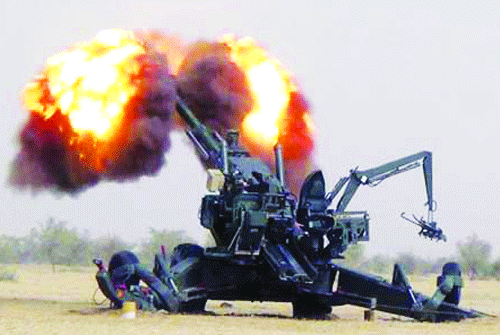
However, the most significant approval by the DAC is the induction of Dhanush, often labelled as “desi Bofors”. Manufactured by Ordnance Factory, Jabalpur, the Army will get the first three guns by the end of this month for user trials followed by another three guns by September-end. Another lot of 18 guns will come to the Army in the next one year.
The Bofors controversy in the mid-1980s hampered the induction of state-of-the-art long-range artillery guns thereby impacting the Army’s operational capabilities in the subsequent years. At present, more than 3,000 long-range artillery guns capable of hitting a target at more than 40 kms in all kinds of terrain are needed as the present set of Bofors guns are in the last stage of their operational life.
Giving details of the artillery gun acquisition plan approved by the DAC during the two-hour-long meeting here, officials said the bulk production of Dhanush guns will enable better exploitation and setting up of indigenous manufacturing facility later on.
The drawing, design and manufacturing technology was acquired from Bofors when the deal was inked with the Swedish firm in 1980s and Ordnance Factory, Jabalpur started developing the indigenous gun here five years ago. Dhanush has a range of more than 38 km as compared to Bofors’ 27 km. The “desi Bofors” also has an electronic sighting system for aming the gun accurately at the target. The Army has placed an order for 114 guns and will expand the order to 415 guns if the present lot of 24 guns passes the test, officials said. The total cost of the project is more than Rs1,300 crore.
The other artillery gun to get the nod by the DAC is M-777 Howitzers for fighting wars in the mountains. This light weight gun can be airlifted by helicopters or carried on horseback to the forward-most posts for deployment.
The Army will get 145 Howitzers from the US through the Foreign Military Sale (FMS) route wherein the US Government will stand guarantee for delivery schedule and maintenance.
Giving the breakup of the time lag, officials said once the 750-million-dollar deal is inked in the coming months, the first 25 guns will be bought off the shelf and delivered in India. This will save cost of transportation. The remaining guns will be brought to India in knock down condition and assembled here, they said.
The DAC also approved parleys for fixing the pre centage of offsets for this contract, officials said. At present, the vendor has to plough back at least 30 per cent of the total contract price back into the Indian industry if the deal is over Rs 300 crore.
The other deals cleared by the apex body included six missile boats for the Navy. The Rs 13,000-crore deal will see the Navy opting for Indian manufactured boats to replace six ageing vessels acquired from Russia in the 1980s. In all, the Navy has 12 boats as of now. The Navy also got the go-ahead for a Rs 386-crore plan for modernisations of its dockyards besides Rs 150 crore sanction for procuring five diving support vessels.
The IAF was sanctioned Rs 500 crore for procuring flight simulators for Jaguar fighter aircraft and a Rs 1,300-crore approval for indigenous electronic warfare system from Bharat Electronics limited (BEl). The DAC also approved design and development of counter measures system for T-90 tanks, officials said.