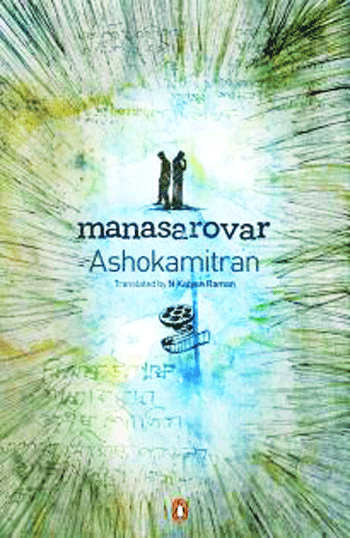
Publisher : Penguin, Rs 299
One cannot but appreciate the flair with which the prolific Tamil writer, Ashokamitran, deals with the seemingly mundane human life. In these three books, he brings out the intricacies and nuances of the ordinary men and women and manages to highlight something worth pondering whenever one opens up his written work, writes ASTHA JOSHI
With a strong grasp of human emotions and clarity of thoughts, Ashokamitran pens down thought provoking tales of ordinary men and women, particularly in three of his works brought out by Penguin Classics -Still Bleeding from the Wound, Fourteen Years with Boss and The Ghosts of Meenambakkam. His observational and analytical skills in terms of the immediate surroundings make for interesting readings. One cannot but appreciate the flair with which the prolific Tamil writer deals with the seemingly mundane human life. He brings out the intricacies and nuances of the mortal mind and manages to highlight something worth pondering whenever one opens up his written work.
Though Ashokamitran uses his native Tamil language for his writings, almost all his works have been translated into English and have managed to capture readers’ attention. His stories are packed with well thought out characters caught up in daily life circumstances. Some do find respite towards the end, while others remain caught up in the cycle with no relief in view. The reader can find an easy connection with the array of inner conflicts contained in the stories leading to a range of emotions.
The characters are far from ideal, but the way the he makes them deal with circumstances is what accords him appreciation and worth. Each character in these works is set up in a particular situation and their handling of it in turn lends a different perspective to the readers regarding life at large.
Still Bleeding from the Wound is a collection of short stories predominantly set in the geographical area the author belongs to, which shake up the reader to think. Writing from within his own traditional space Ashokamitran enjoys a good hold on his characters as well as on the situations they find themselves in. Set in the most ordinary of situations, each of the numerous short stories seem to discuss one or the other human emotions through a wide range of life-like characters. The story In The Reception Room highlights the relationship between those in power and those who come to them begging for small favours. Though the reception man feels sympathetic towards the plight of Mrs Abraham, there is little he can do for her. Himself not in a position to be of much help to her, all he is capable of doing is of fixing a meeting between his ever busy boss and the old lady. Unable to do that too and as a means of apologising for the trouble the old lady had to go to the receptionist, he gives her a rupee note. In an official environment ruled by the twins of power and money, the receptionist might be seen as a misfit.
Another story, Revelation, aims to de-bunk the popular belief that settling abroad could redeem one from all the tribulations back home. In the story titled Evolution we get a glimpse of the teacher-student relationship from a different fresher perspective. Here is a music teacher who invests a lot in his students and expects the best for them but unfortunately the latter, the married females are at times short of understanding the intricacies of this relation. In the story Free At last, we come across at another sort of a relationship, where an unexpected exciting opportunity for one seems to bring on the end of all hopes for the other. The collection is replete with such stories that deal with the predicaments of usual men and women narrated in an interesting but sympathetic tone. The end of a previous story gently pushes the reader to the next one waiting with its plethora of emotions.
Fourteen Years with Boss is an account of the author’s personal experience at a production house of the Madras’ film industry. He begins at the time Boss was practically not even his boss, that is, much before the author actually landed up with a job with the latter. After the death of his father in a manner quite incomprehensible for the author at that young age, he lands up with a decent job at the Gemini Studios. The camaraderie shared between his late father and head of the production house lands him an appointment in the then well-known Madras movie company. The non-fictional work is a faithful and engrossing narrative of Ashokamitran’s long journey of 14 years he spent at the studio with the Boss. The readers find interesting, and at times controversial tidbits of the movie world from the unbiased writings of the author.
The Ghosts of Meenambakkam revolves around a chance meeting between the nameless narrator and an old acquaintance Dalpathado. The two bump into each other in a most uncanny manner leaving the narrator at a failure to make sense of what actually happened. Its only when the innocent narrator tries to piece together traces from the past that he fully fathoms the present. The repercussions of this chance crossing of paths for both is what forms the core of the narrative. The author gives the story realistic aura through an interesting first person narrative and engaging descriptions of characters and situations.
In hardly 150 pages, the narrative displays the author’s skill while handling plots and characters. The unfolding of the plot leading the narrator being trapped unaware in bombing of an airport to his chance bumping into Dalpathado’s romantic interest Sylvia reflects the writer’s mastery at creating a crisp narrative without running into numerous pages.
These three literary pieces add to Ashokamitran’s reputation in fictional and non-fictional genres as well as in the story and the novella format. Characterisation by far seems to be the strongest in these works. The complementary nature of the characters and the plot elevate the reading experience for the interested reader.
The reviewer is a Phd Research Scholar in Modern Indian languages and literary Studies, DU