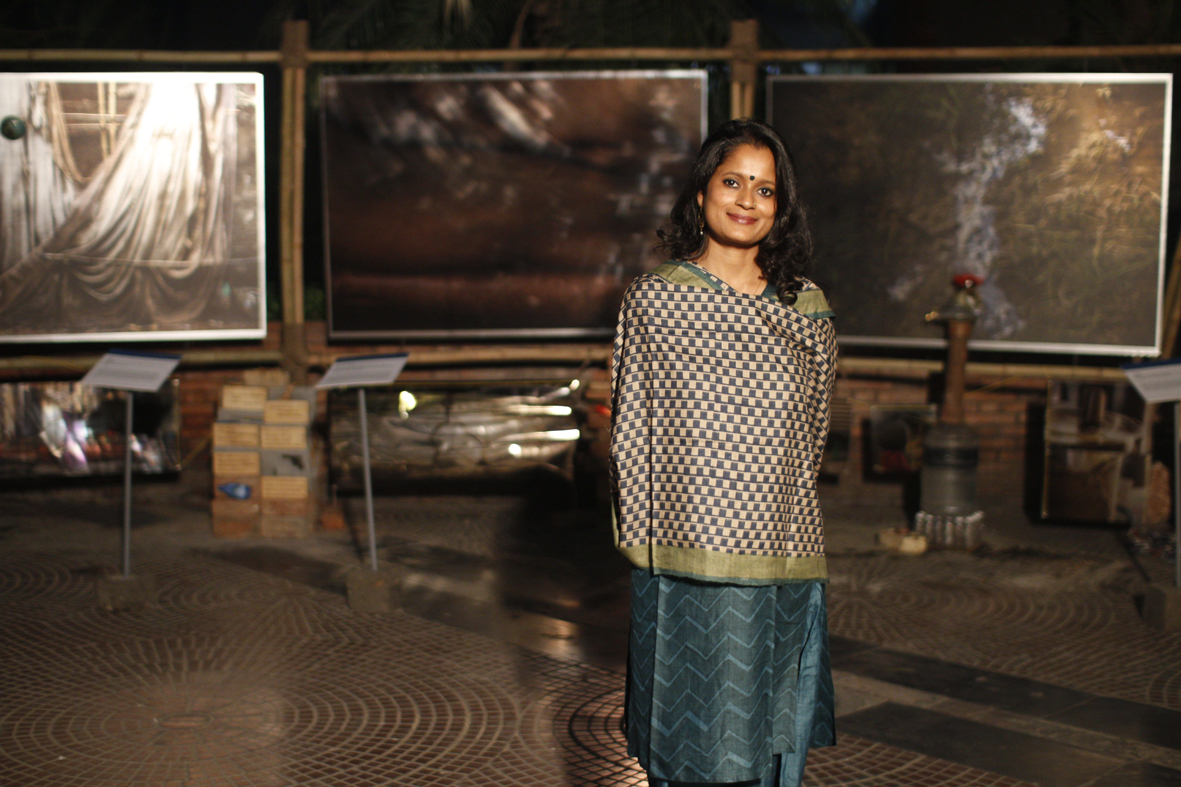
Shraddha Borawake’s installation-based photographic project Benevolence is born out of the belief that the five elements play many roles in our lives and even beyond. By Saritha Saraswathy Balan
Photo artist Shraddha Borawake has shot around 2,000 images for her walk-through installation titled Benevolence. The process, for her, involved many sleepless nights that defy words. Shuttling between Pune and Amsterdam and exploring the five elements in between was a life-transforming experience for Shraddha. She has chosen the all-encompassing earth as the topic for her works which are on display at the show Panchatattvas: The Road Ahead, part of the Photosphere photo festival in progress at the India Habitat Centre.
She is focussed on the earth and believes that the five elements are inseparable from each other and the balance and imbalance of the same results in various outcomes. Her installation Dharti (Earth) brings into question those very materials that we excavate from the earth to protect us from the elements. “The planet is contaminated with mass-produced objects ranging from natural to toxic. As the earth is exploited for her resources, she exhibits her own force, constantly reclaiming that which has been taken from her. Everything that is an artifact of man is a result of being processed through the five elements to create that, which is drawn from the earth,” she says.
In the image Agni (fire) what is explored is the various qualities of fire and how it plays a strong role in human lives ranging from the cosmic to the sentient. The aspect examined in this image looks at earth’s own history as a ball of fire that left the sun. She says that fire manifests in our lives internally – through the digestive fire — as well as externally, through the destructive forces that gives birth to the new. In the image, a morphing gravestone at the British Cemetery in Pune represents the flux found between man and nature. The chula, put under the work, illustrates our need for food as sustenance. Through representing the slow death of chula, Shradha provokes a thought of our own identity.
Vayu (air) draws a parallel between wind and time. like the earth’s planetary journey, over time the wind cooled the fiery ball to create a globe that could give birth to life forms in the ideal temperature. Time here is represented through a piece of cloth. looking at our own human history, the photographic installation illustrates how the action of the wind reclaims the scaffolding by covering it with dust and other moving earth particles.
The fourth image Jal explores water as an essential element; which covers 70 per cent of the earth’s surface and is fast depleting in its potable form. “The earth gives us oil and we create plastic from it. I try to draw attention to the fact that it costs much less to produce little plastic bottles, then discard or recycle them” she says.
In the image Akash, the sky holds the creative energy that flows within mankind itself. This energy reflects in the ability of mankind to create, transform as well as discard material as an urban consuming being. “We build and pollute this world, as the planet remains in flux between nature and artifact,” she says. Shraddha adds: “My project is a public art thing and hence it should be an experiment. There are so many people in the public space, so my attempt was to make a work that is universal. The entire experience which have been gone through for the work can’t be expressed through words,” she says.
For her everything is a process and human beings are just a minuscule part of it. Growing up in an agrarian, semi-rural environment, she instead of creating installations for a gallery decided to use visual signifiers.
“That is what I am exploring. A celebration - with a highly critical eye - considering the complexities of our times. I am formulating a way to set up an installation that will provide an all-encompassing experience of all these various layers of thought, subtleties and nuances,” she says. A section of the installation was designed in collaboration with ceramic artist Ruby Jhunjhunwalla who added supplementary clay forms that help tie together the concept of Benevolence.