Asarita Vardhamana Vidhi, that was presented as a lec-dem by the erudite dance-scholar Piyal Bhatacharya, was a wonderful enactment of chapter five of Natya shastra, writes Utpal K Banerjee
Natya Shastra, ascribed to Bharata, has been inarguably the world’s oldest and most comprehensive compendium on all the performing arts. As seen from many coherent references of later chapters from earlier text, the composition is likely that of a single person. Interestingly, near the end of the text we have the verse: “Since he alone is the leader of the performance, taking on many roles, he is called Bharata,” indicating that Bharata may be a generic name. It has been suggested that Bharata may be an acronym for bhava (sentiment), raga (melodic framework) andtaal (rhythm). In traditional usage, however, Bharata has been identified as an iconic sage, and the work is strongly associated with this personage. Written in Sanskrit, the text consists of 6,000karikas (verse-stanzas), incorporated in 36 chapters. The title can be loosely translated as: A manual of dramatic arts. Natya means dramatic arts and, in contemporary usage, this word does not include dance or music, but etymologically the root natya refers to ‘dance’. In Sanskrit, the term refers toDrishya Roopaka or Drishya Kavya, which embraces drama, dance and music.
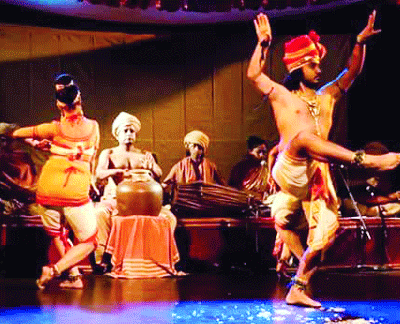
Asarita Vardhamana Vidhi, presented recently as a lecture-demonstration by the erudite dance-scholar Piyal Bhatacharya and his talented group under Chidakasha Kalalaya from Howrah, took up Chapter five of Natya Shastra, titled Chitra Poorvaranga (Procedure for the Preliminary Items). Coming sequentially after the first four chapters — Origin of Drama; Characteristics of the Playhouse; Adoration of the God of the Stage; and Characteristics of the Tandava Dance — was the chapter under reference: in the form of questions from the audience of sages seeking explanations — on Natya about the origin of drama; removal of obstacles; and adoration of deities — and answers from Bharata about Purvaranga (preparatory rites): in the form of kalas (artistic skills); padabhagas (step-demarcations); and parivartanas (walking around).
Under Sangeet Natak Akademi’s Natya Samagama, a festival of contemporary theatre practices, traditions and diverse cultural expressions of India, Piyal (and the musicologist Meena Banerjee) delineated how nritta is the causation behind the entire universe andnatya is the universe’s expansion. Using the ‘big bang’ theory behind the universe’s creation, Piyal’s group created their performative demonstration in several segments: using the foundation of pulsations and serpentine movements of the Shiva-Shakti duo. The concepts were abstruse and intricate, but their expressions were captivating in combining charis (movements) and karanas (head-torso patterns) into picturesque angaharas (graphic combination of karanas). Kalari payattu, the martial arts of Kerala, came for a short and fiery demonstration. The finale was a pleasant, pictorial display, by Chhandak Jana, of costume and jewellery — mentioned in chapter 23 of Natya Shastra — drawing analogy from ancient sculptures.
Interaction with Piyal Bhattacharya:
What was the sequence of the dance-performanceIJ
We began with Asarita-Vardhamana Vidhi, one of the typical songs to present Bharata’s nritta that was acknowledged as the first offering to the Ultimate Consciousness.Asarita is a Shiva-Stuti explicitly inter-twined with the practical manifestation of cosmic and philosophic truths and perceptions. Vardhamana is when the song follows an increasing taal-pattern on which the dancer performs.
Thetaal-base starts to slow down during layantar (change of tempo) and leads to madhya (medium) and jyeshthha (long) asarita. During the initial kanishthha (short) asarita and layantar asarita, the dancer offers the self to isha (the Supreme). During madhya-asarita, the dancer expresses the manifestation of Bhairava and during the final jyeshthha-asarita, describes all the cosmic forms of Shiva. There are various rules prescribed in the commentaries on the vidhi (instruction system). We chose kandika vardhamana vidhi for presentation.
We then continued with kapalgeetis, which are very special and form an integral part of the gandharva vidya. Kapalgeetis are regarded as mantras and their lyrics are full ofbeejas. While dancing with kapalgeetis, dancers offer prayers to Shiva and Shakti in magadhi, ardha-magadhi or prithula style.
Penultimately came gati mandala: especially designed sequence of charis and practiced for natya. They reveal the unleashing power of Shakti and manifest indrajaal supposed to mesmerise audiences. Our last sequence was Dhaivati Kapaalgeeti: invokes the attributes and all-encompassing presence of Shakti: in her mythical Rakta-Chamunda appearance.
How did you select karanas and charis leading to angaharas in your nrittaIJ
There is a mention of 36angaharas in Natya Shastra, where each of the Angahara comprises a proper sequence of a number of karanas. This sequence has only those karanas, which, if strung together in a proper philosophical way, reverberate with the meaning of that particular angahara: deeply embedded in its name. Again, this stringing must be in such a way that it won’t break the serpentine movements of the dance. Nritta of Natya Shastra is nothing but the manifestation of the gati of Shakti and we selected only those specific angaharas.
What is the source of your costume and ornamentsIJ
The potent source of costume and ornaments has been the sculptural remains of Bharhut. Panels of these sculptural remain are special as one can only find the relief of four dancing girls: surrounded by a series of musicians with Vipanchi veena (9-string harp), urdhak and mridanga. Such an arrangement is typically of Natya Shastra performance tradition. In no other Indian historical sculpture or relief-remains, one can find such a typical feature.