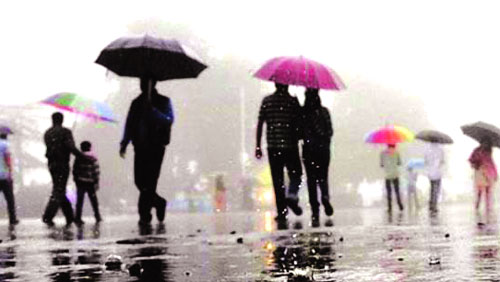
If vast swathes of the desert State of Rajasthan are inundated, it isn’t without reason. There is an aggravation in heat and breeze from south-west seas resulting in an increase in moisture in the desert areas, which, in turn, is increasing the average rainfall. In short, the dry desert areas of the State are becoming wet.
Western Rajasthan has witnessed 84 per cent more rain while the eastern parts have recorded over 23 per cent rain this year. The torrential rains triggered by the south-west monsoon have created a flood-like situation in several districts of Rajasthan.
According to Indian Hydrometeorology Department (IHD), increase in rain days has also been observed over most parts of Rajasthan during monsoon. Officials of IHD said that the extreme rain in Rajasthan was caused by a low pressure zone over the area, itself a result of extreme heat conditions.
low pressure area in deserts emanating from extreme heat is referred to as ‘thermal low’ in meteorological parlance. Western disturbances over east Afghanistan and adjoining Punjab move eastwards across the western Himalayas and cause extreme rainfall.
Interestingly, no study has been conducted on the changing pattern of southwest monsoon in India. Indian Meteorology Department’s senior scientist Charan Singh told The Pioneer that multiple factors may be responsible for change in weather pattern during monsoon. Singh sought to point out that even the global warming factor was based on 40-50 years of study on weather pattern across the world.
Some say Jojoba shrubs, the seeds of which contain an oil that is used as a moisturiser in bathing soaps and cosmetic products, which have been planted at large number in Bikaner, Udaipur and Jodhpur in Rajasthan are responsible for extreme rain as the plant has the capacity to attract rainfall but there is no scientific study to buttress it.
“With rising temperatures, the water-bearing capacity of atmosphere increases and more moisture is drawn from the oceans. Change in land use and land cover, deforestation, global warming, rise in normal temperature and pollution also impact the weather pattern,†IHD’s Deputy Director General (F) Surinder Kaur said.
As per IHD data, western Rajasthan has witnessed 84 per cent more rain while eastern parts recorded over 23 per cent rain till date in 2017. Western Rajasthan had recorded 473.2 mm rain against normal rainfall of 295.7 mm while eastern Rajasthan received 741.5 mm against normal rainfall of 684.7 mm in 2010.
In 2016, the western part recorded 347 mm rain while it was 860.6 mm in eastern part. Similarly, the rainfall in western part was 458.06 mm in 2015 while eastern parts recorded 650.6 mm. 2014 saw western Rajasthan having 302.4 and eastern part recording 683.9 mm.
Prior to 1992, the rainfall recorded in the desert regions in the State used to be 20 mm. It increased to 165 mm in 2000, Thereafter, the average rainfall has increased to 210 mm. Western Rajasthan is primarily a desert that gets 299.2 mm average annual rainfall while the eastern region receives a rainfall of 675 mm annually on the average. The average rainfall in the country is 386 mm while it has recorded 402 mm till date.
20 years ago, desert-dominated Barmer and Jaisalmer witnessed a mere 20mm rainfall but slowly, with the increase in rains, the scenario changed so much that floods have become a common phenomenon now.
A study carried out by researchers at IIT Bombay a few years ago, found that extreme rainfall events over India do not have significant association with land surface air temperature over India and sea surface temperature over central Indian Ocean. The results are contrary to the general notion that global warming or increased summer temperature is responsible for extreme summer monsoon rainfall events witnessed in some parts of the country in the last few years.
Another theory has it that good monsoon in Rajasthan comes after three or four years of drought. But excessive rainfall and flooding happens only once in 75-100 years.
In July 2003, United Nation’s World Meteorological Organisation had warned of an increase in frequency of extreme weather events because of climate change.