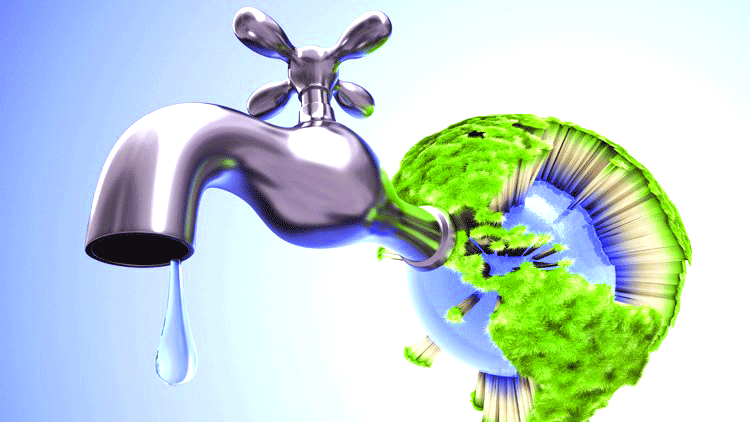
‘Water water everywhere, not a drop to drink.’ Coleridge’s words, which were used in a supernatural context, seem to be coming true in reality. Fresh water level has dropped strikingly in the past few decades across
the globe. The need for effective measures for conserving water is higher than ever. Else, a global crisis of water may occur, which is predicted to cause disruptions among the countries, writes Akshita Rawat
Countries across the globe celebrated World Water Day on March 22 to spread awareness about the issues related to water scarcity and pollution. Water scarcity isn’t a new threat to the world. Fast depletion of fresh water resources has gripped India as well. let us look at how India is facing this issue and what can be done for the prevention of it.
latur in Maharashtra faced the furious repercussions of the drought that was brought by this acute water scarcity. Some men in a village named Denganmal looked towards polygamy for answers during the drought. In fact, marrying women for fetching water became a norm for them. The stories of these ‘water wives’ are touching because we cannot but blame only water scarcity for their pitiable conditions. Delhi is not far behind in the list of water deprived cities. In fact, it has always been in a battle of water sharing with the neighbouring State, Haryana. The DDA flats in South Delhi were recently the victim of acute water crisis receiving water for only 10-15 minutes every day. According to a report, the minimum demand for water in Delhi is 800 MGD while the supply of water from all available sources is only 650 MGD. The problem is real and needs some effective redressal methods. Water conservation needs to take place on a micro as well as macro level. India has seen quite a few steps in the recent years taken towards conservation of fresh water bodies on various levels.
Community level
Rajasthan is known for its rich culture and heritage but is also the victim of acute water shortage. However, some people there have proven that efforts for a good cause can yield great results. An interesting water conservation method is found in a housing township of Jodhpur. Birkha Bawari, a 21st century stepwell has been developed by Umaid Heritage in an attempt at saving 17.5 million litres of rain water every year. It is unique because it contemporises of our traditional methods of saving water, going back to the roots of our civilisation. Birkha Bawari is the first Bawari made after 200 years in India, that too without wasting much of the non-renewable energy’s. The pioneer architect of this stepwell, Anu Mridul had bagged a national award for the same.
Crafted from the indigenous Jodhpur stone, the Bawari stands 60 feet deep, 625 feet long and 40 feet wide. The water stored through rainwater harvesting in this stepwell, is used for various purposes including the maintenance of the landscape around the township. The baoli is connected to all the houses in the township through underground channels, a system that helps streamline the water collected from various rooftops. The baoli is designed in a way that minimises any wastage of water and serves as an apt example of sustainable, green-promoting architecture. For a water scarce city like Jodhpur, Birkha Bawari has proved to be a marvel in providing the township the most precious asset of nature, water.
Society’s role
We are well acquainted with the heavy flooding problems in Chennai. last year Chennai saw one of the most difficult times when floods hit the city taking even the lives of many people. However, a fact less known is that it is frequently starved of water too. Mismanagement leads to an acute water shortage in the city during long summers. Sekar Raghavan and Indukanth Ragade, the Water Warriors of Chennai have been working for the betterment of water conditions of the city since early 90s. Raghavan undertook door to door campaign for creating social awareness about rain-water harvesting among every household in South Chennai. With time, he managed to inculcate small methods of water conservation in houses like recharge wells and percolation pits. Eventually he along with Indukanth set up the first ‘rain centre’ of the country through Akash Ganga trust in 2002. This one-stop informative and assistive centre helped Chennai a great measure in saving rain-water for good use with the help of rain-water harvesting structures which were made compulsory for every household to have by the end of 2003. The centre is working still with its projects expanded and causing a greater good to humanity. Bore wells, underground storage and treating grey water, they have done it all. They believe that micro level help to the cause can yield long lasting effects.
Commercial level
A survey report says that around 52 per cent of water in Delhi gets wasted due to leakages in pipes of Delhi Jal Board and the poor infrastructure of the public washrooms. If responsibility of the construction of water pipes and public washrooms gets shared by Commercial enterprises as well, a better hope for less water wastage can be seen. But, are they sharing this responsibilityIJ “So far in India, there is no commercial line of water products supplies for public washrooms, and that is why, India’s public restrooms are in a shabby position”, says Anup Kumar Tripathi, Country Head of Sloan India.
Sloan is a Chicago based Company dealing in bathroom products which has recently expanded its business to India. India is the 71st country to have welcomed Sloan for business. The motto of the company being “Water Connects Us”, it places emphasis on water conservation and sustainable development for the globe. The company has a proud legacy of maintaining public toilets which are working fine in many countries since as long back as 1927. lEED certificated Sloan, which testifies for their contribution towards environment, claims to play a path breaking role in helping save water up to 50 per cent. Compared to 12 litres per minute water usage by any other faucet, Sloan produces taps and faucets that are designed to let out only 475 ml of water per minute which is enough for a hand wash. Technology like this leads to the rise of the most fundamental question for any project in our country, ie cost management. Is it too expensiveIJ
While the upfront cost of installing Sloan products might seem a little on the higher side, the lifecycle and the efficiency promises to make the cost seem worthwhile in the long run. It does not need maintenance charges every five years or so which is a common attribute in other public supplies. Sloan is slowly expanding its business in commercial as well as household sectors as well. Our only wish is that they maintain their end of the deal and ensure a better situation for the water problems in our country.
Government participation
The problem of water scarcity is very complex. It is not only that there is a shortage of fresh water resources, but also that the available water is polluted and not fit for use. Here is where the sewage treatment plants play a part. They pump the polluted water after treating them back to the fields for irrigation purpose. Kolkata is really lucky that the city has the most efficient and cheap sewage treatment system. Biddhanagar or the Salt lake City is called a planned satellite town. The fishermen who depended on these salt lakes for their occupation created an innovative system of saving the water body as well as their livelihood years ago. The city’s sewage would drain into these lakes so the fishermen could rear fish ensuring the cheapest sewage treatment. The wastewater too could be used for growing crops of paddy (dhan). They did not only ensure treatment of water for rearing fish without much cost but also gave the city people back rice crops at cheap rates. This is one of the reasons why Kolkata has the cheapest food in the country, a fact which everyone living there relishes in.
A college in Mangalore, Yenepoya Medical College, has also saved a ton of money by installing their personal rain water harvesting system and sewage treatment pumps. No longer are they dependent on tankers for getting water in a water scarce city, and they also have a lush green environment because of irrigation by the treated water. If the government ensures a good sewage treatment management system in every city and state of the country, the pollution of water could be reduced a great deal.
Individual’S Responsibility
There are a number of things which all of us can do for conserving the most needed element of life. Every big step taken by the Government or any small step taken by an individual makes a change. The important thing is that we as a society become aware of the problems and help at our level in doing something about it. Moral science education in school time had taught us to do our best to save water by closing unnecessarily running taps, not using showers much, making others aware, using water optimally for daily use etc. It is high time that we start taking such small steps seriously and be a part of the change we want to see in the world.