About 53 kg of plastic waste was extracted from a cow’s stomach during a surgery witnessed by Kunal Vohra and his team when shooting for his documentary The Plastic Cow. What should be our real priorities, he asks Aakriti Narang
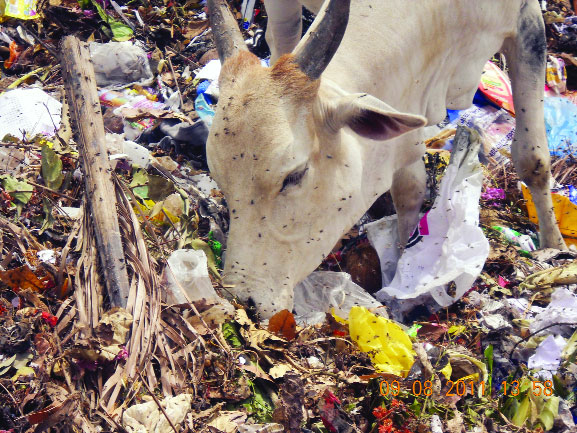
How many of us actually stop and consider whether or not animal rights are actually being implementedIJ The closest contact that we have to the plight of animals is when we see dogs panting for air on the streets during the high heat of summer. Our minds never bother to wander beyond that, and in particular, to the impact that our carelessness is having on their bodies. Among excessive fishing, factory farming, animal experimentation and poaching, one major threat that we impose on the lives of animals is the amount of plastic that we throw on the streets. It all ends up in the stomachs of animals, particularly cows. In fact, during a surgery done for the shooting of director Kunal Vohra’s film The Plastic Cow, a bovine was found to have been carrying 53 kilos of plastic waste in his stomachIJ
Director Kunal Vohra’s documentary called The Plastic Cow was first released in 2012. But it is being screened all over again to highlight the pressing nature of the problem. “Essentially,” says Vohra, “The Plastic Cow is an animal rights film, which looks at how our indiscriminate use of plastic bags has become a serious threat to the lives of cows across the country.”
The film, which is just over half-an-hour long, looks at the impact of our almost complete dependence on plastic bags, which we use and discard carelessly every day, often to dispose garbage and kitchen waste. Not only are these bags a huge environmental threat, they end up in the stomachs of the thousands of cows that we see wandering on the streets across India. These cows are discarded because either they’re not milking at the time or the dairy owner is unwilling to look after them. In such cases, these cows have to fend for themselves and forage for food, which, like all other scavengers, they find in the open garbage dumps. Owing to cows’ complex digestive systems, these plastic bags, which they wholly consume for the rotting scraps of food they contain, get trapped inside their stomachs forever and eventually, lead to a slow and painful death.
The film was shot in seven cities around the country, including Chennai, Pondicherry, Puttaparthi, Anantapur, Delhi, Mumbai and Varanasi. Regarding the difficulties he faced while shooting, Vohra informs us that, “while there was no real trouble in the south, in Delhi we faced a little hostility from dairy owners and especially from owners of what are known as ‘stray’ cows. This happened on Pankha Road, in Kotla, and in Vasant Kunj. Many times I called and wrote to different government officials in relevant ministries in the Central Government, the Government of Delhi, Animal Welfare Division, Central Pollution Control Board and the Municipal Corporation of Delhi but not one person was willing to talk about it on camera.” This film was part of an animal rights case that took place in May 2012 and which prompted the Supreme Court to liken plastic bags to atom bombs when it heard and admitted the plea.
Often when an Indian says that he or she is a vegetarian, people assume it has something to do with the individual’s religion. Vohra tells us that he has been a vegetarian for “almost 28 years now and my reasons have nothing to do with religion. I’m against the idea of all meat – for me cow’s meat isn’t any better or worse than the meat of any other animal. But, of course, I don’t impose my beliefs on anyone. Everyone has to decide for themselves. Everyone has to find their own reasons to stop or not. But, for anyone who’s ever watched a rumenotomy, you do wonder whether slaughter is the relatively easier way out for cows because the alternative, which is a life on the streets, is far too cruel. So, we decided to make a film about the cruelty cows face every day. We wanted to show the ugly reality of what our holy cows have now been reduced to.”
His film derives its name from the notion that we are what we eat. Vohra explains that, “Before the film was made, I guess the only plastic cows we knew about were those small, cow-shaped-plastic dispensers for milk they use in the West. But, like it says in the film, we are what we eat, rightIJ So, what else should we call cows who feed largely on plastic waste these daysIJ What else are they if not plastic cowsIJ”
There is a long story behind the decision to make this film. The inspiration for Vohra was initiated by Clementien Pauws-Koenegras, president of the Karuna Society for Animals & Nature (an NGO in south India), and Philip Wollen, who runs the Kindness Trust in Australia and supports projects around the world. “Clementien invited Rukmini Sekhar, an animal rights activist and writer and myself to Puttaparthi to watch a rumenotomy (surgery of the stomach of a cow) at the animal shelter that Karuna Society runs. We watched in shocked silence as 42 kilos of plastic waste was slowly pulled out of one poor cow’s stomach and, trust me, this is not something that you can forget,” he tells us.
In order to break our unguarded dependence on plastic bags, Vohra suggests that we should use “good old cloth bags or corn starch bags.” The problem of plastic bag consumption is not just a problem for animals living on land; it exists for marine animals as well. Elephants, deer, monkeys, turtles, fishes, dolphins and whales are all equally in danger. landfills have as much plastic waste as the oceans around the world.
The Plastic Cow was part of a public interest litigation (PIl) filed in 2012 by Karuna Society for Animals & Nature, Vishakha Society for Prevention of Cruelty to Animals, Clementien Pauws-Koenegras, Pradeep Nath and Rukmini Sekhar. The PIl demanded the following: ban on sale, use and disposal of plastic bags; phasing out and ultimately prohibiting the open garbage disposal system; implementation of door-to-door garbage collection; segregation of plastic waste and animal shelters and veterinary services for cows and other suffering animals.
Vohra says that, “The court accepted the grievances of the petitioners as legitimate but the government hasn’t taken any steps to get cows off the roads and to eliminate plastic bags from the system. On the contrary, existing laws that prohibit use of plastic bags below mandated thickness are not being enforced. Is the government investing time, effort and money in exploring and developing viable alternatives for plastic bagsIJ Have the municipal corporations around the country been instructed to improve existing systems of waste managementIJ Will the government shut down illegal dairiesIJ Will it organise camps, or seek help from animal rights groups, to conduct rumenotomiesIJ”
On the cow protectionism that’s trending now, he elaborates: “It’s a strange sort of reverence, isn’t it, that causes them to kill at the hint of a rumour but remains unmoved by the cruelties that cows have to face every day on the streets, where they have to scavenge for survival. So common is the sight of cows feeding at open garbage dumps that it doesn’t bother anyone – neither the devout, who see cows as holy and mother-like figures, nor these cow vigilantes, whose notions of themselves as defenders of religion are enshrined in the benign albeit bloated-with-plastic cows. I wonder what happened to the dossier the government wanted each state to compile about these thugs. Vohra has been working on a couple of self-funded documentaries and hopes to turn them into talking points.