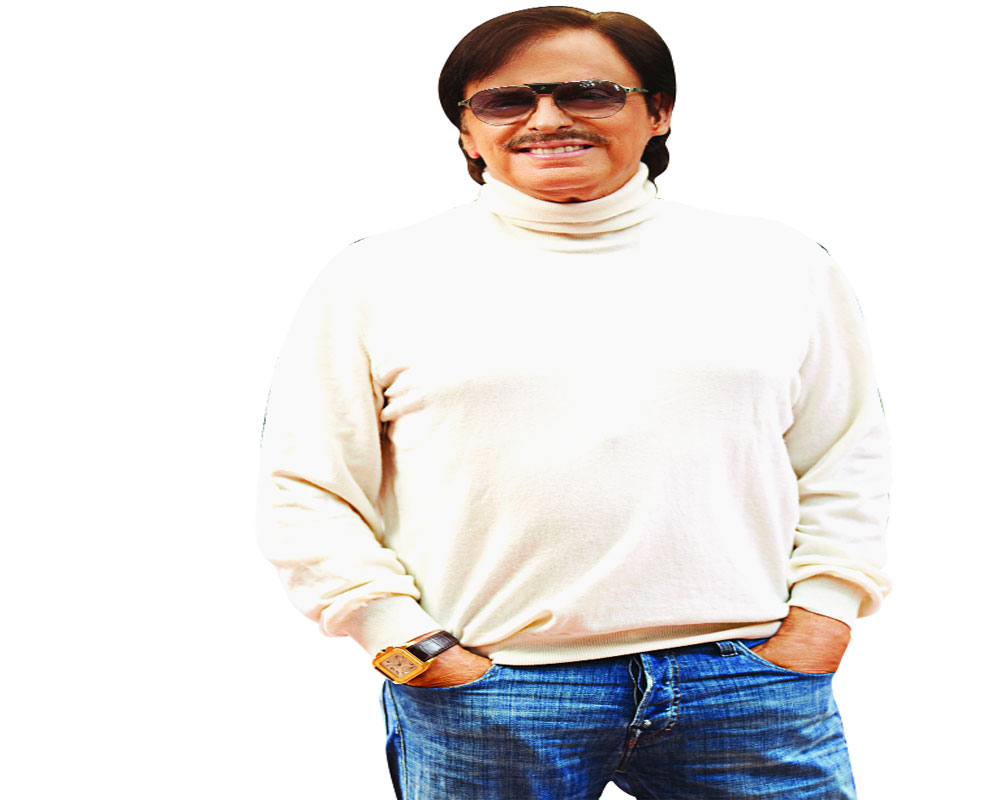
Actor, director, producer and writer Sanjay KHAN tells Saimi Sattar that his book Assalamualaikum Watan is his ode to the country where the duty of the citizens is to create an invisible yet strong bond with each other
For anyone who grew up watching Doordarshan and the mandatory Chitrahaar, Sanjay Khan bounding about wearing an impish grin while teasing Mumtaz with the song, Gori ke haath me jaise ye challa is hard to forget. It was aided, of course, in ample measure by the fact that he was easy on the eye in Mela (no resemblance to the horror starring Aamir Khan which masqueraded by the same name). Having made his debut in Chetan Anand’s 1964 war film, Haqeeqat in a small role as a soldier, he went on to play a pivotal supporting role in the blockbuster Dosti. He starred in hits like Dus Lakh (1966), Ek Phool Do Mali (1969), Intaqam (1969), Shart (1969), Mela (1971), Upaasna (1971), Dhund (1973) and Nagin (1976). In 1977, he made his directorial debut with Chandi Sona starring himself, Parveen Babi and Raj Kapoor. In 1980, he directed and starred in Abdullah alongside Raj Kapoor and Zeenat Aman. He made his last film appearance in the 1986 film Kala Dhanda Goray Log, which was his third and last film as a director.
He burst upon the small screen with the big-budget historical series The Sword of Tipu Sultan, which was nothing short of Khan’s labour of love. Not even a fire that broke out on the sets that killed more than 40 crew members and inflicted 65 per cent burns on Khan could deter him from its completion. After several surgeries, he swung back into action. He directed the series jointly with his brother, Akbar Khan and also played the lead. The series first aired on DD National from 1990 to 1991 and lasted 60 episodes. He produced and directed other popular television series like The Great Maratha, Jai Hanuman and 1857 Kranti.
Khan has turned his hand to writing and his second book, Assalamualaikum Watan, talks about his journey and more.
What is the reason behind naming the book Assalamualaikum Watan?
An author in principal will always look for a pertinent title which advocates the content with a flair.
What prompted you to write this book? In days when Islamophobia is rife, when Muslim bashing on social media and news has become the norm, what is the reason why we have come to this? And what can be done to thwart it?
This is most unfortunate. The WhatsApp University is filled to the brim with mischief mongering sections of misguided people. This should not be taken for granted. The good and wise people of India do not appreciate this as it tars the image of our Democratic Republic of India in the eyes of the entire world and also will devastate the economic parameters and prosperity of this country. Only a peaceful country can be successful. This is the responsibility of all good thinking Indian citizens to challenge this attempt at sabotage. We must take a lesson from Finland where, I’m told, every citizen respects the other creating a bond which is invisible but the strength, mutual love and respect is the underlying factor for peace and tranquility of the country. This small country is the richest in the world. I would like the reader to think about this.
You speak about the role of Muslims in fighting for Independence in the book but now the narrative has changed completely...
It’s not difficult to see how people of diverse faiths and regions have come together and stitched the fabric of India. It’s always best to read history backed by facts, based on documented evidence written and accepted by world-renowned historians and researchers and not WhatsApp forwards, where people often share false information to suit their own bias. It will only be fair to warn the future generations of the effect the absence of a factual and fascinating history of this great land will have if it is hidden and reconstructed to benefit an ideology. It will deprive them of this wealth of knowledge. Real history has an uncanny knack of emerging from the labyrinths of the earth.
You talk about setting up the Indian Muslim Socio Economic Trust. What exactly is its role? How many people are involved with it?
The IMSET will be a non-profit organisation in the form of a digital application. A trained team of youngsters with complete knowledge and functioning of the digital app will guide it. This team will be monitored by an expert and eminent committee from the community who will offer their services. It will engage pre-eminently successful Muslims in today’s India from each state, which will include captains of industry and tycoons in their respective fields of expertise. The IMSET app will be defined by a collaborative spirit and genuine empathy, as all the members will be invited to serve based on their seminal achievements and inclination for volunteerism and social responsibility via video webinar, online meetings, training, and support. These positions will be highly prestigious, not due to the traditional business perks of compensation, rather due to the substantially impactful work. They will leave their indelible imprints on the sands of time and their heroic deeds will inspire generations to come. The organisations’ operating budget will invite like-minded people to participate in this venture. There are many anxiously waiting to participate. It will be inappropriate to mention any names at this time. We cannot proceed with our plans currently due to the unfortunate COVID-19 in which India and the entire world is embroiled in.
You’ve also dwelt upon another popularly propagated myth that Mughals looted India...
The Mughals came to India as conquerors but lived in the subcontinent as Indians and not as colonisers. They merged their identity as well as that of their group with India and the two became inseparable, giving rise to an enduring culture and history. Mughals being seen as foreigners was never a point of discussion till quite recently, so well had they integrated and assimilated into the country that they made their own. There was no reason for it either, since Akbar onwards, all Mughals were born in India with many having Rajput mothers and their ‘Indian-ness’ was complete. As I have explained, Muslims have selflessly contributed an immense amount to India, from the standpoint of art, architecture, science, technology and governance, making India the richest country in the world. These timeless, priceless and permanent contributions make India just as much ours as anyone else’s.
You’ve dwelt at length on the prescriptive qualities of Islam. Are Indian Muslims particularly adhering to it?
Islam is a casteless and egalitarian religion. The essence of it is equality and humanity. The reading and understanding of Islam worldwide as per the tenants of holy Quran are equally adhered to everywhere. Its message to the people is to be loyal to their motherland.The heart of an Indian Muslim is truly patriotic as their history is replete with numerous sacrifices for the country which they will continue with. Indian Muslims represent 200 million of the country’s population who profoundly contribute to the cultural vitality and demographic vibrancy of India on a daily basis. This number represents the second largest critical mass of Muslims in any nation in the world. First and foremost, as Indian Muslims, we should feel tremendous pride, a sense of empowerment and responsibility because we serve as the trajectory to the compass of achievement for Muslims worldwide. The age old saying of safety in numbers is only partially true as there is also an inspiration in numbers. The social responsibility should serve as the spark for the guiding light that is ingrained in the mentality of all Indian Muslims. If given proper opportunity of education, they can contribute heavily to the GDP of our country.
You’ve had your share of ups and downs. The fire during the shooting of The Sword of Tipu Sultan being one. How do you bounce back?
I have answered this question many a times, I would like to quote the great genius Albert Einstein in which you will find my answer and the readers would be refreshed by this beautiful message under the present Covid 19 circumstances. “Love multiplied by the speed of light squared, we arrive at the conclusion that love is the most powerful force there is, because it has no limits. Love is light, that enlightens those who give and receive it. Love is gravity, because it makes some people feel attracted to others. Love is power, because it multiplies the best we have and allows humanity not to be extinguished in their blind selfishness. Love unfolds and reveals. For love we live and die. Love is God and God is Love.â€
While the films of your time talked about the beauty of diversity, the ones currently border on jingoism. What do you attribute the change to?
This is a temporary phenomenon. Let us look at it as a passing shower. The industry is highly sensitive, intelligent and knows it’s way. The power of good stories and the sweet melody of the songs will soon return.
The film industry has become much more politicised than it was before. What is your take?
I don’t believe it. The film industry is untouched. But there is always a joker in a pack.
You look upon Tipu Sultan as a hero. But he has become a contentious figure in today’s time. What do you have to say to this?
My tryst with history is one of the strong pillars of my personality. I have always been a flag-bearer of peace and harmony. I’ve delved deep in the research from Bhagwan Gidwani’s best seller, The Sword Of Tipu Sultan to bring few important aspects which have been swept under the carpet from public view and I strongly feel it is a threat to our nation’s fabric to do so. As many historians would like to agree with me that ‘bad history’ affects our youth and development. Several Kannada folk songs (lavanis) lamenting his death were in circulation in the 19th century, the earliest dating back to 1800, the year after he died in the battlefield. This is a very special fact since folk songs do not exist for any of the kings of Karnataka. They exist for only tragic heroes like Tipu Sultan and other local chieftains who were martyred at the hands of the British. As an Indian, I felt it was my duty to place these facts of history for the greater understanding of our people as this would cure the minds of faulty judgements.
How long did you take to write the book?
It took seven years of deep and accurate research and two years to complete it.
Any more in pipeline? Future plans?
Presently, I am finishing a script based on a true story of an Indian war hero, after which I intend to produce and direct the film.