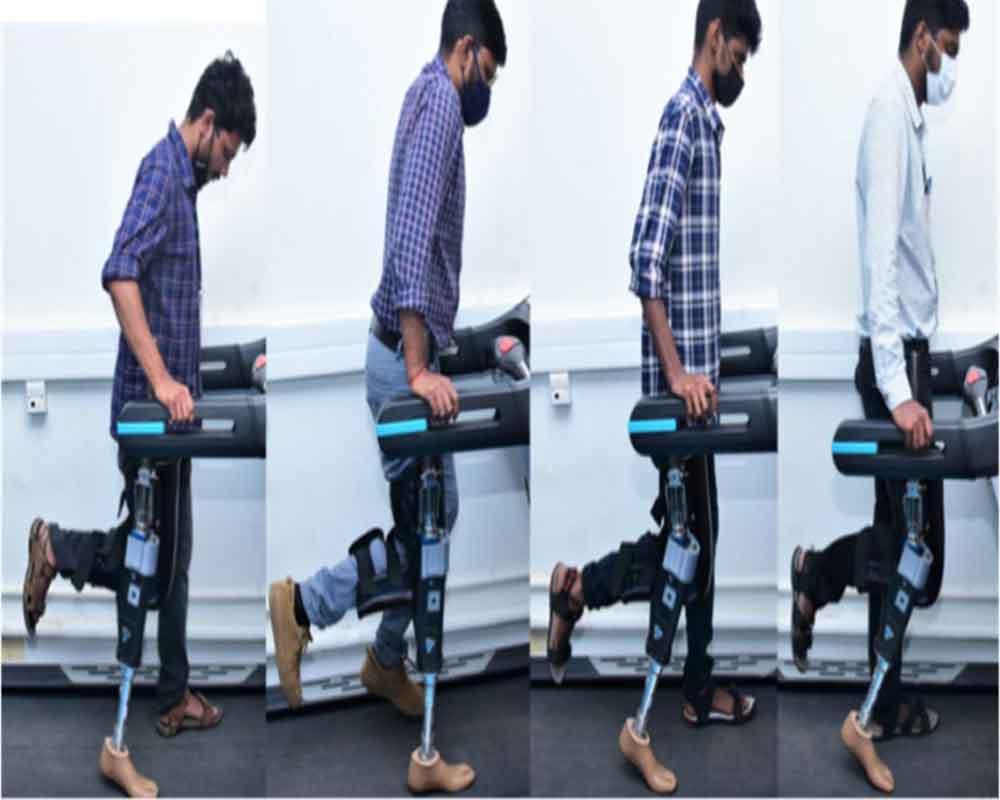
As a spin-off of space technology, Indian Space Research Organisation said on Friday that it has developed an intelligent artificial limb.
It is likely to be commercialised soon and expected to be cheaper by up to 10 times, benefitting above-knee amputees to walk with a comfortable gait, ISRO said.
These microprocessor-controlled knees (MPKs) offer extended capabilities for the amputee than those offered by the passive limbs that do not use the microprocessors, ISRO said in a statement.
"Thus far, a 1.6 kg MPK has enabled an amputee to walk about 100 metres in the corridor with minimum support. Efforts to improvise the performance are underway," it said.
These smart MPKs are being developed by ISRO's Vikram Sarabhai Space Centre (VSSC), under an MoU with National Institute for Locomotor Disabilities (NILD), Pt. Deendayal Upadhyaya National Institute for Persons with Physical Disabilities (Divyangjan) (PDUNIPPD (D)), and Artificial Limb Manufacturing Corporation of India (ALIMCO).
A MPK consists of a microprocessor, hydraulic damper, load & knee angle sensors, composite knee-case, Li-ion battery, electrical harness, and interface elements.
The microprocessor detects the state of gait based on the sensor data. The control software estimates the real-time damping needed to attain the desired gait by changing the stiffness of the system that is achieved by a hydraulic damper operated by a DC motor.
Walking parameters specific to amputees can be set using PC-based software to improve one's comfort. The interface plots the parameters in real time during walking.
The development of MPK was a multi-disciplinary, multi-stage activity, the national space agency headquartered in Bengaluru said.
After arriving at a configuration based on the literature, validating it through kinematics analysis for estimating the sub-system requirements, multiple models of the system were developed.
The feasibility of the design was verified using an engineering model. The system consisted of an aluminium knee case, a solenoid valve-based damper, and a six-axis load cell.
While the next engineering model included a stepper motor-based damper and composite knee case, the subsequent model utilised DC motor-based damper with a spool position sensor, pylon integrated load cell, miniaturised control electronics, and a Graphical user interface for parameter tuning.
The sub-systems of the limb -- hydraulic damper, control electronics, and load cell -- were tested and characterised in stand-alone mode, using customised setups.
An ingenious method was conceived for conducting the walking trials with non-amputee involving a custom-designed exo-socket realised for the purpose.
Multiple walking trials conducted with non-amputee enabled the updating of the control software and fine-tuning of the parameters.
With the clearance of the Joint Project Monitoring Committee (JPMC), the device was tested with an amputee, identified by NILD for conducting walking trials. The trials were conducted at NILD lab jointly by NILD and VSSC. The socket and fitment of MPK to amputee were realised by NILD. VSSC tuned amputee-specific parameters.
Initial walking trials were conducted with the support of parallel bars. Subsequently, the amputee could walk about 100 metres in the corridor with minimum support, the statement said.
"All the sub-systems of the knee performed satisfactorily," ISRO said.
MPKs currently available commercially in India are imported and range from Rs 10 lakh to Rs 60 lakh, depending on the complexity and functionality, according to the statement.
"MPKs being developed, once commercialised, are expected to cost around Rs 4 lakh to Rs five lakh. Optimisation of MPKs in terms of mass and envelope size is underway", it said.
"More intelligence is being incorporated into the system to help the amputee walk through uneven terrains with advanced features for more comfort," ISRO said.