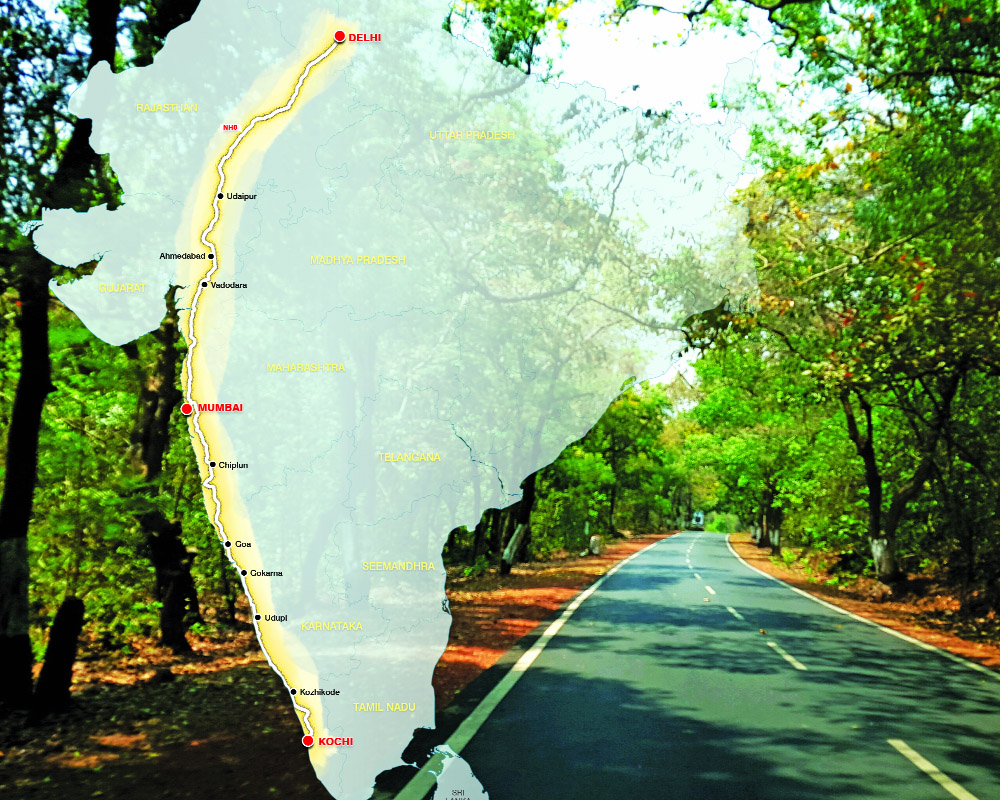
Continuing their road Odyssey, Chandan Mitra and Shobori Ganguli resume their trip from Kochi, traversing the sylvan stretches of the Konkan coast through Kerala, Karnataka, Goa and Maharashtra, visiting some splendid getaways off the coastline too, on their return journey to Delhi, covering nearly 10,000 km circumambulating Mother India.
During Parliament’s Budget Session, while I was chatting with friends in the Central Hall one late morning, my cellphone rang. I noticed it was Suju Krishnan from Malabar Gateway in Kochi. My immediate thought was that my car, parked in his hotel premises, had got damaged. But Suju had called not to report damage but to request me to send the car keys by courier at the earliest. The reason was somewhat amusing but not to be trifled with. Apparently a family of mongooses had taken fancy to the car’s undercarriage and could be spotted playing there all the time. Suju said he feared that their innocent frolicking could result in wires being chewed up and the vehicle’s sophisticated computer system becoming dysfunctional. I had experienced something similar some years ago when a few puppies chewed up wires and the car became immobile.
.jpg)
I told Suju it was the driver’s mistake that he brought the keys back to Delhi and I would immediately have them couriered. He said he wanted the car to be moved to a location outside the target of the playful mongooses, who seemed to have been greatly enamoured to find a stationary object that did not threaten them, unlike their usual enemy — the slithering snake. Suju later reported that the operation had been successfully conducted, the car had a new location and mongooses were back chasing their traditional combatants.
We reached Kochi on the evening of April 6, 2016, two weeks after Part I of the Budget Session ended and my duties as Chairman of the Standing Committee of Commerce also concluded when we cleared the Demand for Grants with some modifications. The Land Rover Discovery 4 had, meanwhile, had its battery recharged and minor repairs done in readiness for the next leg of my parikrama. On this leg we were keen to take it even easier, observing coastal destinations in a more leisurely way.
KOZHIKODE: FISHING FOR HISTORY
So our first halt was Kozhikode (Calicut of yore), where it is said Vasco da Gama first landed. It is not as bustling a port as it must have been in the Portuguese explorer’s time but the seafront was busy enough with hundreds of fishing boats lining up along the shore, disgorging their catch or in preparation for a perilous journey into the deep.
.jpg)
Significantly, the Taj Group seems to have consciously taken over plots or properties along the beach everywhere. In all our internet searches for good hotels on or near sea beaches, Taj Gateway invariably cropped up, be it Kochi, Kozhikode or Mangalore. We booked at Taj outlets with the assurance of their fine service, without spending time looking for other options.
I had initially thought of stopping at Mahe, yet another erstwhile French outpost but the small town passed by us even before we could exclaim “Vive le Republique!†Having travelled past several former French outposts, such as Yennam, Karaikal and the Dutch colony of Tranquebar, I felt saddened at the state of decay of the once-magnificent historic buildings and churches. Many of them may have been classified as heritage sites but the maintenance is negligible. Also little effort has been made to develop them as tourist attractions although many Europeans come visiting them annually. It is not uncommon to see elderly Europeans wandering through the streets to locate the town cemetery in search of the tombs of their ancestors. All these towns contain a great deal
of history in their bosom which needs to be brought into the public domain lest succeeding generations forget this chapter of our colonial past and the battles European powers fought among themselves for control of coastal India in the 16th and 17th centuries.
Frankly, the drive along the Malabar (or Konkan) coast was not spectacular, contrary to expectations. Most of the coastal road was at an elevation and one could not feel the sea at close quarters. Also the road diverged into many towns big and small, veering away from the coast. After a night halt at Mangalore a bustling port city, the hub of iron ore exports earlier, we resumed a languid journey northwards. Kozhikode onwards, the scenery was resplendent with palm trees swaying in the breeze and dense foliage as the undergrowth. I recall a journey I made to Manipal some years ago, remarking at the sheer greenery along the drive.
But no visit to the Konkan coast can be complete without dropping into the Udupi, the mother of all Udupi eateries in India and the world. I was particularly insistent on having an Udupi meal in Udupi, having tasted their surrogate stuff for decades from a restaurant on Bahadur Shah Zafar Marg where our office in Delhi is located. We were not disappointed by the typical vegetarian fare served for lunch and it was an added pleasure to be recognised as a TV commentator so far from home. The owner of the eatery insisted on posing for a series of selfies, an urge I readily obliged.
GOKARNA: PRISTINE SANDS
Friends had often extolled the natural charm of Gokarna, many calling it India’s Riviera. It took some effort to locate the scattered set of beaches that together comprise the entity called Gokarna, so named because from top of the Western Ghats the formation resembles the (karna) ear of a (gau or go) cow as the sea meanders in and out of a formation of low rocky cliffs. However, the Government has a firm policy to disallow construction close to the isolated clusters of beaches and one can admire the pristine beauty of unspoilt sands glistening in the sun from a distance. I decided that the climb down to the beach would be physically taxing, especially the ascent on the way back. So after taking some photos of the spectacular rock formations, frothing seas and placid sands, I just let myself and the water be.
.jpg)
Considering its awesome beauty and splendid isolation, I was disappointed that no worthwhile hotels have come up here. We had booked into the Santushti Resort on the Om Beach Road, which was passable but left many things to be desired. Most importantly, most rooms, including the rather pricey deluxe suite, had no view of the sea. The resort consisted of a set of cottages built around a swimming pool; we could well have been staying inside a crowded city hotel. But maybe I did not scout around enough or seek suggestions from those who had been to Gokarna before. I am sure there are nice places to stay considering the number of Europeans we noticed heading for the beaches. I must make another trip to Gokarna, this time from Karwar, India’s submarine base. In fact, on our way up to Goa, we passed Karwar, which boasts a spectacular bay and a neat naval township hidden under an array of palm trees swaying in the Arabian Sea breeze.
GOA: STILL HAS SECRETS
Political boundaries have no real meaning along the Konkan coast. Just as Kozhikode seamlessly merged into Mangalore, the state of Karnataka drifted into the erstwhile Portuguese colony of Goa. The only distinctive things noticeable were bands of motor-cycles zipping down Goa’s narrow tree-lined roads, signs in English and, of course, the ubiquitous church in the town square. Apart from that of course are liquor shops merrily selling a variety of feni, wines, beer and IMFL. Unlike the puritanical taboos in the rest of India, Goans have no qualms drinking openly in public. As we were travelling through South Goa around noon, we found people seated in clusters under palm trees, sipping beer or feni. The men were mostly bare-bodied and wore shorts, while most of the women could be spotted in frocks or kaftans, saris and salwar suits being a rarity.
.jpg)
I had been to Goa about a dozen times although my first attempt when I was a student was aborted as the train I was supposed to board steamed out of Churchgate Station before my eyes. My desperate run to get a foothold met with no success. Over the years I have made up for that failed effort and visited this idyllic enclave many a time and stayed in hotels across the state, especially in South Goa. With Dilip Ray’s Mayfair having opened a property here a couple of years ago, that was my obvious choice this time.
Mayfair Hideaway Resort justifies its name fully. In fact, it is not east to locate unless you are following GPS directions. Tucked away near a village in South Goa, it’s far from the madding beaches for which Goa is rather too well-known. It is one of Mayfair’s smaller properties but is exquisitely built amid lush foliage and a huge swimming pool which opens into the sea. The beach is at a distance at the mouth of a river where it merges into the sea. The hotel has its own boats and residents are ferried to the sandy beach some 2 km in the distance. For those seeking a quiet holiday in the sun and the sea, no Russian tourists or desi hangers-on to bother them, Mayfair Hideaway is the perfect rejuvenation destination, complete with the chain’s fabled hospitality and culinary excellence.
After two days spent in complete relaxation, we set off for the last stop on our visitor’s itinerary. For, after the next halt at inland Chiplun, the remaining stopovers were only those necessary to spend the night while driving back to Delhi.
CHIPLUN: TWIN RIVERS
Readers may be surprised by my choice of Chiplun, not a well-known place outside Maharashtra. It entailed a detour on the route from Goa to Mumbai and cost us an extra day. But for years I had yearned to visit a hotel there, mesmerised by its apparent charm seen in Taj Hotel brochures of yore. Those brochures (of the 70s and 80s) advertised a Taj property called Chiplun Riverside Lodge and showed a man sitting in the verandah of his hotel room reading a book while two rivers flowed below, meeting up at some distance. I thought this was the closest one could come to paradise and made a mental note determined to visit it someday. Juggling with road maps while working out my route from Kochi to Delhi via Mumbai, I located Chiplun in Sindhudurg district. The internet confirmed that such a place still existed except it was no longer run by the Taj Group. We contacted the Lodge telephonically, somewhat unsure if it was a proper hotel or had turned into a marriage garden and baraat-ghar. Unfortunately, heavy traffic en route and narrow roads took us a long time to reach Chiplun, a temple town in the Western Ghats, nestled close to the picturesque Sahyadri ranges.
.jpg)
It was past 11 at night when we finally located the Lodge, a typically 70s construction. We were pleasantly surprised by the hospitality, for the staff served a tasty meal without demur even at that hour. We learnt that a relative of the Tatas had purchased the structure from the Taj group when the hotel chain decided to exit the property. Apart from weddings, the Lodge catered to weekend holidaymakers from Mumbai and its fortunes had turned around. The Lodge is now quite a paying proposition.
We had to wait till daybreak to spot the confluence of the two local rivers and found the two river valleys draped in light mist, with birds chirping all over the Lodge’s resplendent gardens. The picture I had seen in brochures more than 30 years ago were indeed true to reality. I felt vindicated that Chiplun turned out to be quite what the pictures had said. Unfortunately there was not much time to savour the sylvan surroundings, so we hit the road to Mumbai after a quick breakfast served on the verandah of our room.
Although the road from Chiplun to Mumbai was wide and hassle-free, goods traffic kept on increasing as we inched closer to Navi Mumbai. Soon we found ourselves encircled by industrial areas with the typical din and bustle of factories spewing smoke and workers. We stopped for lunch at a dhaba where the main subject of discussion was the mounting water shortage in interior Maharashtra. Indeed, we found washroom taps dry in the dhaba and people using water stored in buckets. After battling madding traffic all the way we entered India’s commercial capital. I had often stayed at Taj Land’s End in Bandra, so had no real difficulty locating it. For the next couple of hours we observed the magnificent view of the sun setting on the Arabian Sea.
VADODARA: MORE SURPRISES THAN THALIS
Next morning we left after an early breakfast on the penultimate leg of our journey to Vadodara (nee Baroda). Gujarat roads are among the most exquisite in India, wide and, (to borrow Laloo Prasad Yadav’s expression) smooth as Hema Malini's cheeks! There are many food plazas on the way. I recall driving down the Mumbai-Ahmedabad corridor in 2005 and there were hardly proper stops on the way barring the much lamented A-1 outlets located in Reliance Petroleum complexes. But now there are many plazas with well-appointed rest rooms, children’s playing areas, nicely built walkways to exercise tired leg muscles and other amenities to help weary travellers. We found large family groups stopping over and boisterously consuming Gujarati meals all along the way.
.jpg)
Finally, we made it to Vadodara just after nightfall and checked into the Gateway (Taj) hotel there. Contrary to the general impression that Gujarat is a strictly vegetarian place, there are eateries that serve excellent non-vegetarian dishes. The Rogan Josh at the Gateway Vadodara, for example, was delectable and so was the rest of the dinner we ordered in our room. Unfortunately, there was not much time left next day to explore the city but a wrong turn we took shortly after exiting the hotel, sent us on a wild goose chase and a detour of nearly 50 km before we could get back to the main highway, NH 8, heading for Udaipur and Jaipur. In the process, we saw quite a bit of Vadodara, although unintentionally.
In the process though we missed the entrance to the Vadodara-Ahmedabad Expressway, India’s first access-controlled highway, with double barriers on both sides to prevent infiltration of cattle and canines. We still made very good time and had successfully bypassed Ahmedabad city before 2 pm. Gradually, the landscape became treeless, then shrubless and finally turned an arid brown as we entered Rajasthan by late afternoon. We had decided to stop over at the Lalit Fateh Sagar Palace in the lake city of Udaipur, a gigantic palace overlooking the other lake, namely Fateh Sagar, as opposed to the Pichola Lake on which stands the more famous Lake Palace. A few months back, I had spent a night at the majectic Circuit House in Udaipur, one of the grandest Government guest houses in the country. The Lalit is next door and even more impressive in structure than the Circuit House. As we got down from the car, an array of flowers and petals heaped down upon us from some point above. I was taken aback as we could not spot any human presence. But we soon realised this was the hotel’s patented way of welcoming guests — bombarding them with flowers thrown from hidden openings on the first floor. The Lalit has retained every bit of the regal charm that must have existed at the time of the Ranas and it is really creditable that the huge, high-ceilinged rooms are not only air-conditioned but have every conceivable contemporary creature comfort.
.jpg)
After a restful night and sumptuous breakfast, we began our journey back home to Delhi after an Oddyssey spanning more than 30 days. Udaipur to Delhi (675 km) was in fact the longest drive we had attempted in one day, so naturally it took us a little over 12 hours to reach the National Capital. On the way we stopped at the Maharaja Dhaba in marble city Kishangarh for some delicious Marwari food. Driving into our house on Feroze Shah Road in Central Delhi on April 30 night, I felt both a sense of achievement and submission. Achievement that I had finally circumambulated this vast land of ours and submission because it entailed a humble re-dedication of commitment to the Motherland, best expressed in Rabindranath Tagore’s words: