In response to repeated requests from the Delhi government, which had sought the Centre's assistance for artificial rainfall as a potential short-term solution to improve the city's hazardous air quality, the Government informed Parliament on Thursday that rainfall brought by Western Disturbances in northwest India during the winter months already serves to mitigate the region's air pollution, thus eliminating the need for cloud seeding.
It also highlighted experts' concern over potential adverse effects of chemicals used in this process.
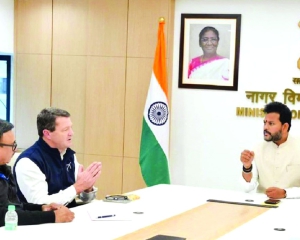
Replying to a question in the Rajya Sabha, Union Minister of State for Environment Kirti Vardhan Singh said his ministry received four letters from the Delhi government between August 30 and November 19, asking it to consider cloud seeding as an emergency measure to improve air quality in Delhi during winters.
The minister said expert opinions were sought from the India Meteorological Department (IMD), the Commission for Air Quality Management (CAQM) and the Central Pollution Control Board (CPCB) regarding the feasibility of cloud seeding for artificial rainfall in the national capital.
Citing the experts, Singh said, "Winter clouds in the region are primarily formed due to Western Disturbances (WD), which are short-lived and travel from west to east. When low clouds form due to WDs, they typically result in natural rainfall over northwest India, eliminating the need for cloud seeding."
The experts told the ministry that high-altitude clouds, which are typically at elevations above 5-6 km, cannot be seeded due to aircraft limitations.
"Furthermore, effective cloud seeding requires specific cloud conditions which are generally absent during Delhi's cold and dry winter months. Even if suitable clouds were present, the dry atmospheric layer beneath them could cause any developed precipitation to evaporate before reaching the surface.
"Additionally, concerns about the uncertainties, efficacy, and potential adverse effects of cloud seeding chemicals remain," the minister quoted the experts as saying.
Last year too, the Delhi government considered using cloud seeding in collaboration with IIT-Kanpur to improve air quality during winter. The goal was to induce rain to wash away pollutants.
However, the project got delayed because it required permissions from several Central government agencies, including the aviation and environmental authorities.
Cloud seeding involves dispersing substances into the air to encourage condensation, resulting in precipitation. The most common substances used for cloud seeding include silver iodide, potassium iodide and dry ice (solid carbon dioxide). These agents provide the nuclei around which water vapour can condense, ultimately leading to the formation of rain or snow.