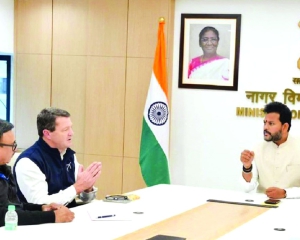
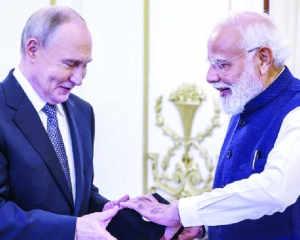
Most governments, both central and states, generally indulge in name changes. The name of the existing welfare projects are changed, roads and streets are renamed, and new schemes are named as per the wishes of the regimes, and not as per historical practices. The reasons can be many. Officials may want to highlight the names of the new political leaders, prime ministers, and chief ministers. They may wish to remove the names of the old ones who belonged to the opposing and competing political parties. Legacies need to be removed, new names added that may become the future ones. The naming and renaming exercises go on over decades in the new nations, and over the centuries in the older states. The efforts to determine which names will remain, and which vanish never ends. Hence, it is not surprising that the name of the popular scheme under Mahatma Gandhi National Rural Employment Guarantee Act (MNREGA) is now Pujya Bapu Gramin Rozgar Yojana (PBGRY).
In this specific case, there are several specific reasons to change the name. One of them is that this central regime does not believe in popularising the names of personalities, and political families. Indeed, one of the reasons for its three consecutive victories is because of the precise, crisp, and regular attacks on specific families within the Congress Party. Although several leaders across the political spectrum still follow the earlier generations’ profession, there is at least a public impression created to disassociate from the continuing practice. This is evident from the fact that most of the schemes in the past 11 years are named after a more general Pradhan Mantri (Prime Minister), rather than a specific personality, or personalities. In addition, the names used earlier were removed. The personality cult is enhanced through other means such as massive national advertising, which has large displayed images. In most cases, the photographs of the prime minister are visibly larger than those of the chief ministers, and central ministers.
Another major reason for the changes is to remove past, and historical legacies. For example, in the recent past, the names of some of the colonial laws were changed to give them distinct Indian identities. This provides a nationalist fervour to the entire exercises. Indeed, the ruling leaders confidently espouse that their attempts are to establish India, and Bharat as entities with their own culture, traditions, beliefs, civilisation, and ancient past. De-linking the nation with the Mughals, British, and other past rulers is crucial for the citizens to feel themselves as a part of a separate nation. This logic includes disconnecting the past, present, and future with the main Congress Party that emerged as the frontrunner in the freedom movement, and ruled the country for six decades in the next 78 years. The idea was to disconnect some of the prominent prime ministers, who deliberately gave names to the national welfare schemes, and other programmes, and associated others who were popular leaders.
Apart from politics, nationalism, and identity, symbolism is clearly an embedded objective. Renaming public spaces and national projects allows the governments to “shape national narratives,” and enhance specific debates and discussions. They may not have a direct impact over electoral equations, immediate identities, and instant political gains, but slowly and steadily allow the narratives to sink into the hearts and minds of sections of the population, who hear and talk about the new names. In an insidious manner, the citizens, or part of them, slowly distance themselves from the old personalities, and political and societal legacies. Thus, new ones are born, and symbolism, whether one likes it or not, contributes to this change. This enables the ruling regimes to claim credit for the old programmes, which were initiated by the previous rulers. Instead of personalities, the focus shifts to institutions, which are long-lasting, and enable political parties to claim the schemes as their own.
Thus, the change of MNREGA to PBRY is a continuation of the old practices that the ruling regimes have accepted in the recent past. The change of name from Mahatma Gandhi to Pujya Bapu is obviously linked to the personality cult. Although the political regimes cannot wean away from the name of the Mahatma, who is still revered throughout the country, it is smart to introduce him as ‘Pujya Bapu,’ rather than a name. This is akin to the practice of using Pradhan Mantri, or Prime Minister, as an institution, rather than a personality. The usage of Bapu, which is an identity like Mahatma, gets rid of the association with the Congress Party, which considers the Mahatma as its leader, apart from his national identity. Bapu constitutes an effort to give it a nationalist twist, rather than a specific political one. Suddenly, Mahatma Gandhi emerges as Pujya Bapu, which changes the national narrative in meaningful ways.
Obviously, the name change comes with changes in the rural unemployment scheme, which was launched two decades ago by a Congress regime. Instead of 100 days, the new norms offer guaranteed employment in rural areas for 125 days in a year. The minimum wages offered to an individual is revised to a higher Rs 240 per day. Recently, the Government introduced the rules to four new labour codes that aim to revolutionise the laws. The changed name of a rural labour scheme is a step in this direction.