An Advaitic Critique of Marxism
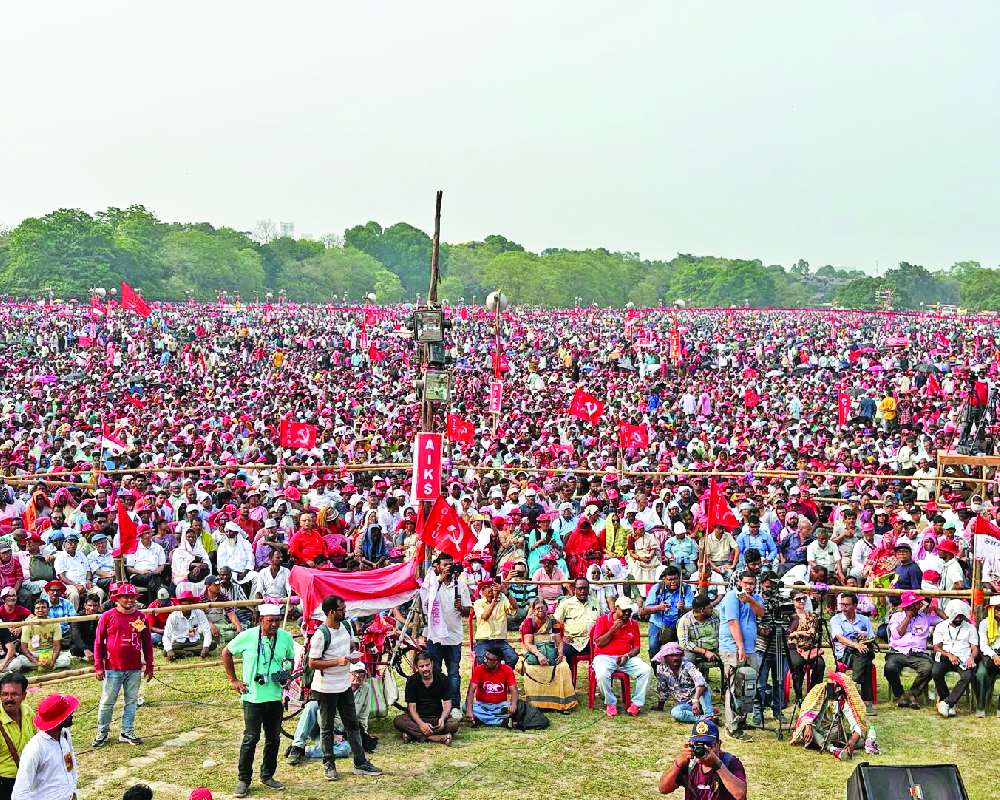
I return from an intense, heart-warming tour of Kolkata, a city I have long admired and whose warmth embraced me again. This is the reflection I offer.
I spent a fortnight walking its lanes, speaking in its historic halls, signing books in its beloved bookstores, sitting under the trees of Rabindra Sarobar, discussing Tagore and Camus with morning walkers at Central Park as if they were old acquaintances, and listening to adda that still carries the old fire. Kolkata is alive with literature, music, argument, and a rare human gentleness. One also notices the quiet scars that history leaves behind. Some of those scars still whisper of a long ideological season that ended in 2011, whose fragrance, and at times its constraints, lingers in the air.
Bengal’s middle class continues to lean towards Government-linked occupations, a legacy that permeates every discussion about security and service. The energetic private-sector youth, so visible in cities shaped by enterprise, are relatively fewer here, one outcome of decades of aspiration shaped by an ideology that distrusted competition and risk. One cannot miss the sight of abandoned factories and hand-pulled rickshaws.
Bengal’s economic reality has many parents: the trauma of Partition, the freight-equalisation policy, long central neglect, and decades of ideology that shaped not just policy but imagination. No single factor can be isolated, yet ideology was a primary influence, and that invites an Advaitic gaze.
Where Marxism Begins: With the Collective, Not the Individual
Marxism begins by declaring that liberation is a social project. Individual freedom, it argues, is shaped entirely by class relations; the worker under capitalism experiences a false freedom constrained by forces beyond his control.
Advaita sees a fundamental flaw in this approach. Yes, material conditions shape consciousness. But liberation does not belong to groups because suffering does not belong to groups. Suffering is always personal. Awareness is personal. Insight is personal. No crowd has ever woken up. Only individuals do.
Marxism asks you to begin with class consciousness; Advaita asks you to begin with consciousness itself. Marxism names your outer enemy; Advaita shows you the one within.
Marxism says bondage arises from property relations; Advaita says it springs from ignorance, independent of what you own.
A society that shifts the axis of liberation entirely from the within to the outside is bound to keep seeking villains, revolutions, and structural replacements. Every such search ends in disappointment because the seeker’s own inner centre remains unexamined.
Class Consciousness: The Collective Ego
Marxism instructs individuals to look at themselves primarily as representatives of a class. You become a worker, a bourgeois, a petty bourgeois, not an individual with a mind and tendencies of your own, but a product of economic relations.
Advaita sees this as the enlargement of the ego.
The personal ego says, “I am this body.”
The collective ego says, “I am this group.”
Both are illusions that bind and blind.
Class identity is not awakening; it is only a change of costume.
Some of the finest Marxist thinkers such as Gramsci on hegemony and Lukács on class consciousness as a possible movement toward totality hinted that the collective we might, under rare conditions, become a mirror in which the individual glimpses the whole. Advaita, however, insists that even this glimpse remains second-hand until the individual turns the mirror inward and sees the seer.
In Kolkata, one senses this everywhere. Many young people can fluently speak of class struggle but rarely examine their own inner struggle. They can diagnose exploitation but not their own fear or insecurity. When an ideology teaches you to study society but not yourself, to analyse the world yet avoid asking “Who am I?”, the result is a distorted vision.
Economic Reductionism: The Marxian Error on Utility
Marx defined use-value as the ability of an object to satisfy needs. But he never deeply examined need itself.
To see the real worth of anything, you must know its full cost: the labour behind it, the damage it causes, the systems it feeds, and above all, the inner bondages that make you crave it.
A worker can be as unconscious in consumption as a capitalist is in ownership. Exploitation is determined primarily by inner animalistic tendencies, not class. From one continent to another, a mobile phone might go through child labour, exploitation, and corporate greed. It doesn't matter whether someone identifies as proletariat or bourgeois; things only change when one understands clearly and makes a conscious choice.
That understanding must transcend economics, as culture, religion, and morality are not just byproducts of industry; they profoundly influence human life as much as the factory floor.
Marx treated culture, religion, law, and morality as mere superstructure, shadows cast by economic relations. While Marxist thinkers have since explored the reciprocal influence of culture and economics, in his foundational framework these are secondary phenomena determined entirely by who owns the means of production.
But the social structure is held together by far more than production systems. People die for nations that offer them no economic benefit. They preserve traditions through upheaval. They sacrifice for faith, for family, for honour, none of which follows the logic of class interest. Bondages are not just material, they also arise from tradition, religion, and belief.
The ego’s sense of the self arises from conditioning far deeper than one’s place in the economy. Reducing one’s identity to economic determinism misses how profoundly consciousness, shaped by culture, mythology, memory, and fear, drives human life and its bondages.
Economic conditions matter, but they are not the deepest. Avidya appears outside as society and economics; the real Maya sits within as Aham-vritti. The external violence and exploitation are only symptoms of the inner darkness.
Systems Do Not Liberate Minds: Minds Create Systems
Bengal offers one window into what happens when a system claims to liberate people but does not address inner clarity.
Marxism promised a worker’s paradise. What emerged in some places was a culture where suspicion of enterprise replaced healthy creativity, ideological identity replaced personal responsibility, and resignation quietly silenced the challenge to deprivation.
This is not a hymn to unregulated markets. Unbridled capitalism is as ferocious a conditioner as the most rigid bureaucracy, turning human attention into a commodity and desire into an endless treadmill. We very well know of the evils of capitalism and how the climate catastrophe is a direct fallout of the ignorant greed intrinsic to capitalist structures. Having said that, true competition is not the jungle’s law but the play of inner freedom: the freedom to act, to fail, to learn, and to offer one’s work without fear or greed steering the motive.
The absence of incentive is not the presence of enlightenment. It is often just the presence of resignation.
You can change rulers, rewrite laws, nationalise industries, or redistribute capital, but if the mind remains conditioned, the new system soon resembles the old. Without inner reform, outer reform collapses.
Marxism still attracts the young because it names real problems—exploitation, inequality, alienation—but misdiagnoses their source.
It blames ownership instead of desire.
It blames class instead of consciousness.
It blames hierarchy instead of ignorance.
This half-truth is dangerous. It generates moral outrage but limited self-understanding. Anger feels like clarity. Revolt feels like purpose. But unless the one who revolts has understood herself, she ends up recreating the same world with different slogans.
Marxism assumes that if capital is redistributed, human nature will change. Advaita says the opposite: unless there is inner clarity, nothing changes except the direction in which greed flows.
Greed remains greed even when it waves a red flag.
Fear remains fear even when it claims to speak for the masses.
Domination remains domination even when it calls itself revolution.
Remove the capitalist and the party-state becomes the new capitalist. Remove the landlord and the committee becomes the new landlord. Remove the elite and another elite emerges from the ashes.
The Explosion is Inner, The Reverberation Outer
The Advaitic critique of Marxism is not a defence of capitalism. It is a defence of clarity.
If greed remains, capitalism will exploit.
If fear remains, communism will oppress.
If desire remains, every system will be misused.
No system can redeem an unconscious mind, nor can inner work excuse inaction against injustice. The point is not to choose between inner and outer, but to see that outer change without inner seeing only rotates power.
A real revolution begins when a person looks at the structure of her own desire, not merely at the structure of society. When she asks, not “Who owns the factory?” but “Who owns my mind?”
Unchecked capitalism too collapses at the same point. It turns the human being into an isolated consumer, driven by manufactured needs. The deepest impulse, the longing for freedom, gets hijacked and reborn as the restless hunger for things. The marketplace becomes a psychological trap as subtle and effective as any state ideology, ensuring the individual never finds the quiet necessary for true self-inquiry.
Kolkata as a Mirror, and a Vision
Whoever has sat in a College Street coffee house through the evening overhearing loud arguments about Sartre and Satyajit Ray, heard temple bells mingle with the morning sounds at dawn, been hugged by perfect strangers after a talk, knows that Kolkata loves the sublime. On my last day, as the participants of my Gita Samagam wisdom program burst into a spontaneous uproar of “Ekala Chalo Re” and the auditorium reverberated with hundreds of voices of consciousness demanding one liberation, I found myself dissolving in the moment.
The cultural depth, the intellectual passion, the unfailing warmth of its people never diminished; they survived because of Bengal’s enduring capacity to hold on to art and affection even in hard times. What did contract, for a while, was touch with the real: with the world as it is and the mind as it is. Charming outer visions can make one lose sight of inner reality.
Time may show that the ideological season left Bengal richer. A renewed realism is returning, slowly, unevenly, joyfully. Young Bengalis are launching sustainable startups, filming vegan commentaries on phones, writing code in Salt Lake, rediscovering the fearless creativity that once produced Tagore, Ramanujan, and Satyajit.
If the gifted youth of Bengal now reclaim their individuality, it will not be by rejecting their collective memory but by adding to it a new chapter, written not in the shadow of ideology but in the light of direct seeing. The same soil that nourished Vivekananda and Ramakrishna can nourish a generation both compassionate and enterprising, rooted and free, collective when it serves society, individual when it serves Truth.
Marx said philosophers have only interpreted the world; the point is to change it. Advaita responds: when the interpreter wakes up, the world is already changed, and the change, for the first time, does not secretly reproduce the old sorrow in new clothing.
Marxism is not wrong for seeking justice. It is incomplete in believing justice can come without awakening. When awakening does come, whether in a Kolkata adda, a Dakshineshwar temple, a Russian factory, a Wall Street floor, or a village panchayat, one sees that every great outer revolution begins when one has the courage to challenge one’s inner structures.
Acharya Prashant
Teacher, founder of the PrashantAdvait Foundation, and author on wisdom literature.