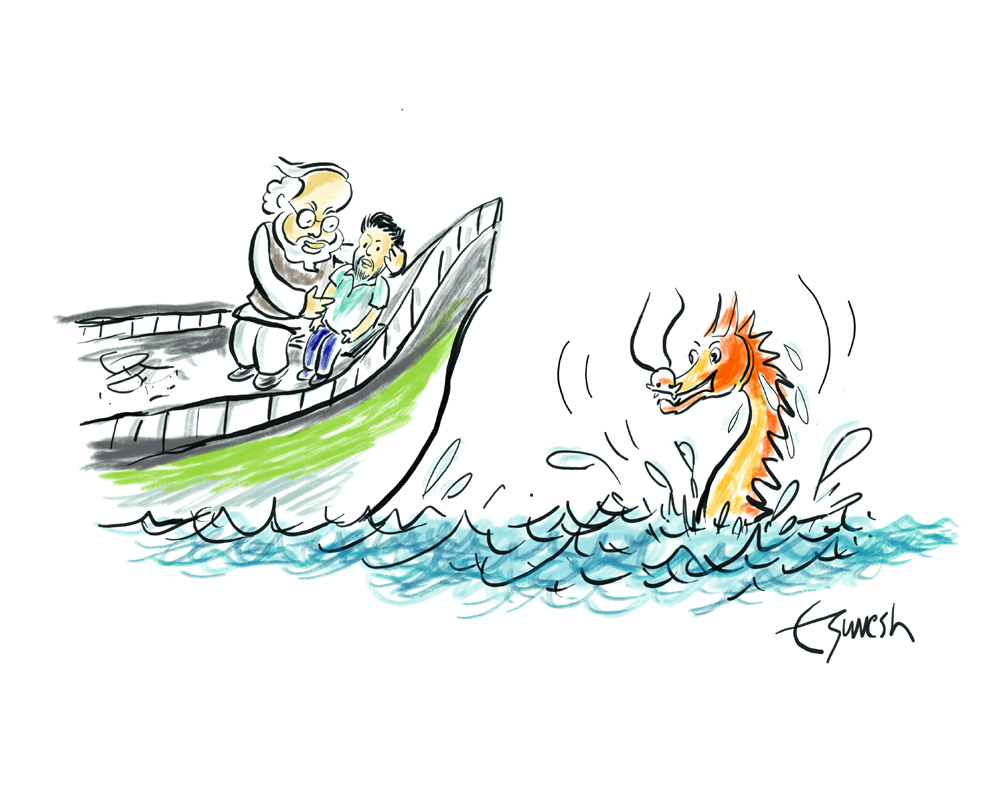
As China deepens its presence through major investments, India is doubling down to protect its strategic interests — offering aid, infrastructure to send a message that it is Sri Lanka’s most reliable partner
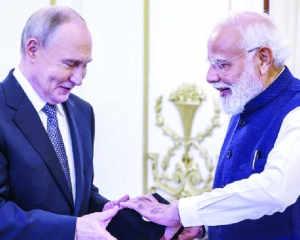
Amid the intensifying India–China battle for influence in Sri Lanka, New Delhi has reason to be satisfied following the recent two-day state visit of Prime Minister Narendra Modi to the island nation during which economic, defence, and energy ties with an important neighbour were shored up. India’s strategic interests are intrinsically tied with those of Sri Lanka, hence the need to maintain close and robust bilateral relations with it. New Delhi also sought to convey to the Anura Kumara Dissanayake — led Government the message, yet again, that it can reap greater benefits from India, which is a reliable friend.
The underlying message herein being that China isn’t one. It was also conveyed to Colombo once again that protecting India’s security interests as well as its own should be of paramount importance. Towards this end, New Delhi also extracted from President Dissanayake an assurance, yet again, that he will keep in mind India’s security interests.
To New Delhi’s undoubted relief, President Dissanayake reiterated that he will not allow Sri Lankan territory to be used in any manner that will threaten India’s security interests. For now, the Dissanayake Government appears to be walking the talk on this account going by news reports that Sri Lanka cancelled a joint naval exercise with India’s arch-foe Pakistan, which was to be held in the waters off the strategically located Trincomalee, not too far from the Indian coastline. But not before New Delhi intervened and made its security concerns known, following which the exercise — which was to have been held around the dates PM Modi was to visit the island nation — was scrapped. Given its strategic imperatives in the Indian Ocean Region (IOR), it’s essential for New Delhi to consolidate its influence in Sri Lanka where India no longer holds sole sway, and to maintain robust ties with the new Government in place there.
In its outreach to the island nation, New Delhi is also seeking to burnish its credentials as a leader of the Global South, projecting itself as a dependable partner for nations facing economic hardship, and who need not fear falling into a debt trap as is often the case when they avail of loans from China.
During the PM’s visit, there was also important messaging for Colombo about the perils of hob-nobbing too closely with Beijing, with PM Modi stating during the visit, “We have shared security interests. The security of both countries is inter-connected and co-dependent.†As a maritime neighbour in the Indian Ocean straddling vital sea lanes, New Delhi knows that Chinese expansionism can pose a strategic threat to both India and Sri Lanka.
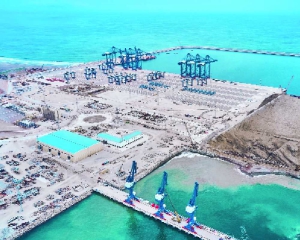
The spreading tentacles of China’s Belt and Road Initiative (BRI) in Sri Lanka too have given New Delhi sleepless nights. As China’s footprints in Sri Lanka increase, New Delhi knows well that it cannot afford to let its guard down vis-à -vis Beijing as the latter builds deep inroads into India’s immediate and extended neighbourhood.
This has forced India to redouble its efforts to ramp up its engagement and provide all manner of development assistance to countries in its neighbourhood so that they remain within its sphere of influence. In the case of Sri Lanka, India provided financial assistance totalling $4.5 billion in 2022 and 2023 to it during its post-pandemic economic meltdown. This played a vital role in helping Sri Lanka obtain an IMF bailout. India’s outreach to the Dissanayake Government has also seen it convert $20.66 million given as lines of credit into grant assistance to reduce Sri Lanka’s debt burden. All this, plus New Delhi’s willingness to help Sri Lanka achieve economic stability, is possibly what has helped it forge close ties thus far with the Dissanayake Government. Despite pursuing a policy of ‘Neighbourhood First,’ India’s strategic space in the IOR is increasingly shrinking amidst a relentless Chinese onslaught. Though India has coined the new term ‘Mahasagar’ (Mutual and Holistic Advancement for Security and Growth Across Regions) replacing the earlier coinage of ‘Sagar’ (Security and Growth for All) for countries in the IOR, containing China’s influence remains a challenge. India’s efforts don’t always bear fruit, especially when China-leaning Governments are in power in the neighbourhood. Besides, the offer of Chinese loans and financial assistance to build infrastructure is too tempting to resist for cash-strapped neighbours of India struggling to execute mega projects.
In the case of Sri Lanka, the Left-leaning Dissanayake has adroitly managed to balance his country’s diplomatic ties with the two Asian giants in the six months since he took charge. It also means that the island nation for now is seeking to reap the benefits from the fierce India–China rivalry in Sri Lanka and the wider IOR. So if Dissanayake earlier this year managed to secure the largest-ever FDI (foreign direct investment) of $3.7 billion for his country from China for a state-of-the-art oil refinery at Hambantota to be built by Sinopec, he’s being wooed by India as well in the area of energy security. PM Modi’s visit saw the joint launch of the plan to build the Sampur solar power plant.
It will be developed by the Trincomalee Power Company, which is a joint venture between Ceylon Electricity Board and India’s NTPC. To boost the island nation’s energy security, all the more imperative as it went through a crippling forex crisis post the pandemic — which meant huge fuel shortages — the visit saw a tripartite agreement between India, Sri Lanka, and the UAE to develop Trincomalee as a regional energy hub. India needs to consolidate its foothold in Trincomalee on the island nation’s eastern coast and keep China at bay. With its huge natural harbour, Trincomalee is of immense geo-strategic import and has the potential to be developed as a naval base. India is also already jointly redeveloping with Sri Lanka World War II — era strategic oil tank farms in Trincomalee. Apart from Trincomalee, New Delhi is also keeping a close eye on another strategic port, the one in Kankesanthurai, which lies not too far away from the Indian coastline. The port in Sri Lanka’s Tamil-dominated northern province is close to the Indian coastline and is being “rehabilitated†with a $61.5 million grant assistance from India. Given its vital security stakes in Sri Lanka, a defence cooperation agreement with the island nation, the first between the two countries, inked during the visit would also help India counter Chinese moves in the region.
After all, China’s hegemonic ambitions present a real and present danger to India and indeed the entire IOR.
(The author is Senior Journalist. Views are personal)