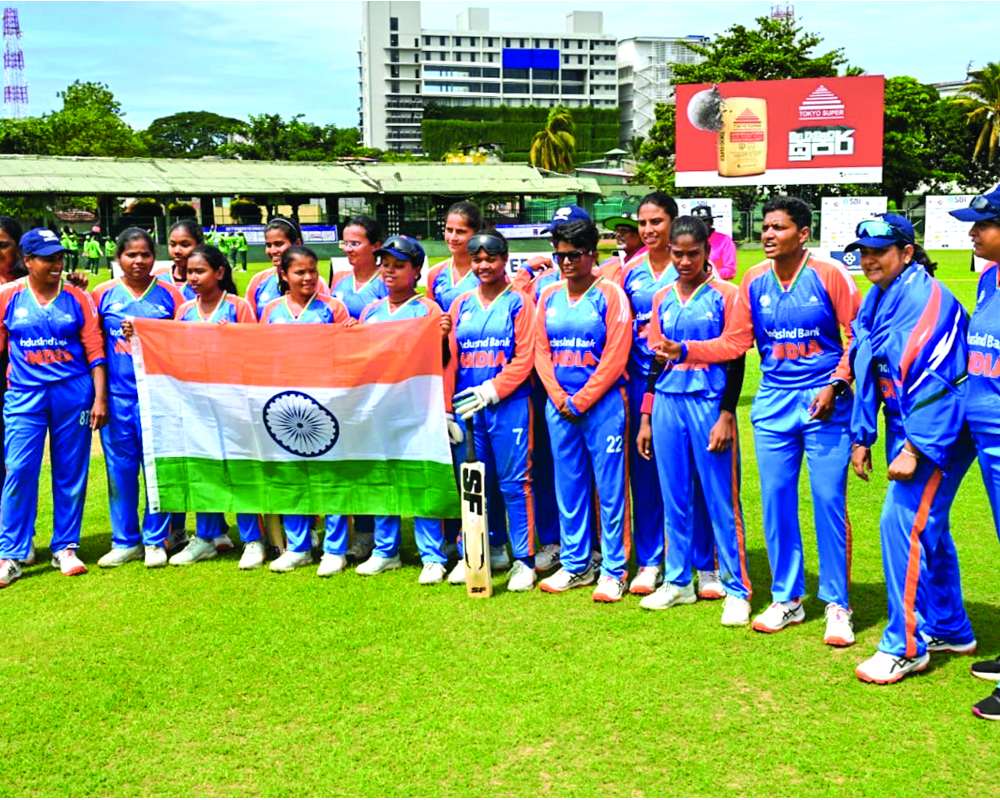
India clinched the inaugural Blind Women’s T20 World Cup after defeating Nepal by seven wickets in the final at Colombo’s P Sara Oval on Sunday, completing an unbeaten run in the six-team tournament. India chased down Nepal’s 114/5 with remarkable ease, finishing at 117/3 in just 12 overs.
India opted to bowl first and controlled the match from the opening overs. Nepal managed only a single boundary in their entire innings, unable to break past India’s tight field placements and disciplined underarm bowling lines. The chase was anchored by Phula Saren, who remained unbeaten on 44. India’s batters relied on clean hitting, communication, and sharp running, closing the challenge well before the final overs. “This is the biggest moment of my and my team’s life,” Captain Deepika TC said after the win.
Deepika said the victory carried emotional weight for the squad. She also said that messages of support from Women’s World Cup winner Jemimah Rodrigues and India’s Test captain Shubman Gill had boosted morale ahead of the final. “Their encouragement was meaningful for us,” she said.
India had entered the final after beating Australia in the first semifinal. Nepal advanced by defeating Pakistan on Saturday. Sri Lanka, the co-hosts, managed only one win in the league phase, against the USA. India was the first team to qualify for the knockouts after winning all five matches in the round-robin stage.
Blind cricket follows specialised rules. The ball is a plastic sphere with metal bearings that produce sound. Players are categorised by vision: B1 (fully blind), B2, and B3 (partial sight). Teams must field a mix of these groups. The ball is bowled underarm along the ground, and B1 batters use runners for safety. Every run scored by a B1 player counts as two. These adjustments shape a game that depends heavily on sound, orientation, and spatial awareness.
For India’s players, the win came at the end of a journey defined by struggle, community support, and late discovery of the sport. Captain Deepika, who lost her sight as a baby, grew up in a farming family in Karnataka. She found cricket in a specialised school where teachers encouraged her to play. She has said that the game gave her confidence and direction at a time she could not imagine a career in sport.
Vice-captain Ganga Kadam’s path was similar. Raised in a family of nine siblings in rural Maharashtra, she was enrolled in a school for the blind by her father to secure a stable future. She played cricket casually until a coach pushed her to develop her skills. Trusting sound cues and coordinating movement took time, but she persisted. Today, she encourages visually impaired girls in her village to take up the game.
India’s win capped a historic month for women’s cricket. Earlier in November, the sighted Indian women’s team won their World Cup in Navi Mumbai. Deepika said her team hoped to “make it a double” for India, a vision the squad fulfilled on Sunday.
India will return home with the first-ever Blind Women’s T20 World Cup title, a trophy that carries both sporting achievement and personal triumph for the players who made it possible.