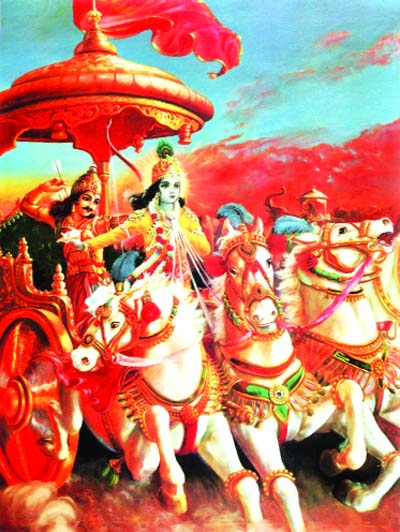
lord Krishna, through the Bhagavad Gita, harmonises their conflicting doctrines, says Swami Vivekananda
The Gita is the gist of the Vedas. It is not our Bible; the Upanishads are our Bible. It (the Gita) is the gist of the Upanishads and harmonises the many contradictory parts of the Upanishads. The Vedas are divided into two portions — the work portion and the knowledge portion. The work portion contains ceremonials, rules as to eating, living, doing charitable work, etc. The knowledge came afterwards and was enunciated by kings.
The work portion was exclusively in the hands of the priests and pertained entirely to the sense life. It taught to do good works that one might go to heaven and enjoy eternal happiness. Anything, in fact, that one might want could be provided for him by the work or ceremonials. It provided for all classes of people good and bad. Nothing could be obtained through the ceremonials except by the intercession of the priests. So if one wanted anything, even if it was to have an enemy killed, all he had to do was to pay the priest; and the priest through these ceremonials would procure the desired results. It was therefore in the interests of the priests that the ceremonial portion of the Vedas should be preserved. By it they had their living. They consequently did all in their power to preserve that portion intact.
The knowledge portion came afterwards and was promulgated exclusively by kings. It was called the Knowledge of Kings. The great kings had no use for the work portion with all its frauds and superstitions and did all in their power to destroy it. This knowledge consisted of a knowledge of God, the soul, the universe, etc. These kings had no use for the ceremonials of the priests, their magical works, etc. They pronounced it all humbug; and when the priests came to them for gifts, they questioned the priests about God, the soul, etc, and as the priests could not answer such questions they were sent away.
Then in the Upanishads there is the doctrine of karma. Karma is the law of causation applied to conduct. According to this doctrine we must work forever, and the only way to get rid of pain is to do good works and thus to enjoy the good effects; and after living a life of good works, die and go to heaven and live forever in happiness. Even in heaven we could not be free from karma, only it would be good karma, not bad.
The philosophical portion denounces all work however good, and all pleasure, as loving and kissing wife, husband or children, as useless. According to this doctrine all good works and pleasures are nothing but foolishness and in their very nature impermanent. “All this must come to an end sometime, so end it now; it is vain.” So says the philosophical portion of the Upanishads. It claims all the pain in the world is caused by ignorance, therefore the cure is knowledge.
This idea of one being held down fast by past karma, or work, is all nonsense. No matter how dense one may be, or how bad, one ray of light will dissipate it all. A bale of cotton, however large, will be utterly destroyed by a spark. If a room has been dark for untold ages, a lamp will end it all. So with each soul, however benighted he may be, he is not absolutely bound down by his past karma to work for ages to come. “One ray of divine light will free him, reveal to him his true nature.” Well, the Gita harmonises all these conflicting doctrines.
Excerpts from Vivekananda’s speech in
San Francisco on May 24, 1900